


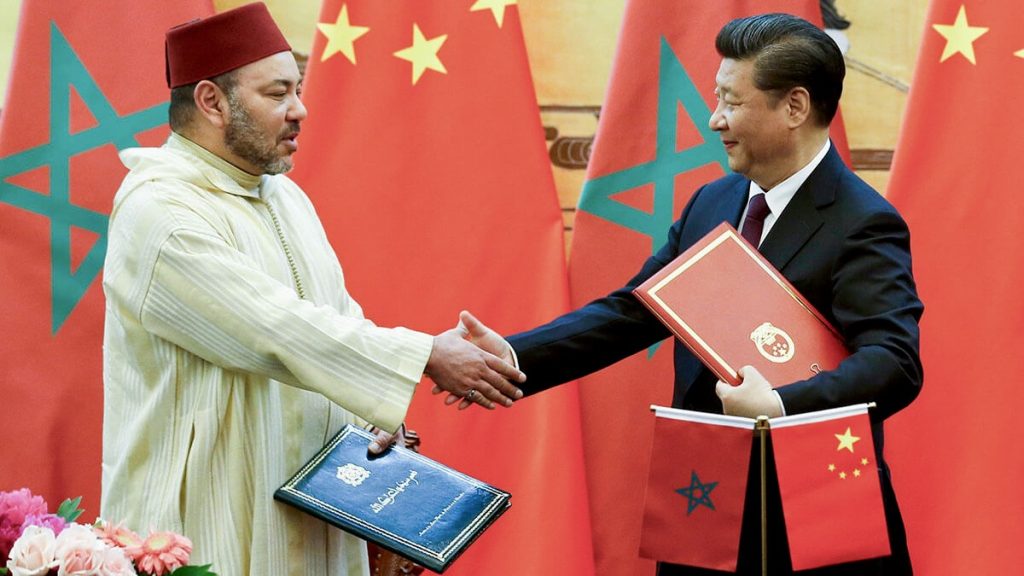
RABAT (Realist English). European Union officials are expressing growing concern over the rapid expansion of China’s industrial presence in Morocco. According to the Financial Times, tens of billions of dollars in Chinese investment flowing into the North African kingdom could transform Morocco into a platform for exporting subsidized Chinese goods into Europe, posing a challenge to European manufacturers.
Scale of the Expansion: From Electric Vehicles to Batteries
Over the past two years, investment by Chinese energy companies, electric vehicle manufacturers, and battery producers in Morocco has increased sharply. According to some estimates, approximately $10 billion has already been directed into the sector. Dozens of Chinese firms are establishing manufacturing facilities across the country, and this appears to be only the beginning. An additional $6 billion in Chinese investment has been announced for Morocco’s automotive sector since the pandemic.
Major projects include:
- Gotion High-Tech’s gigafactory in Kenitra, Africa’s first electric-vehicle battery manufacturing plant, with total planned investment of up to $6.5 billion. Production is expected to begin in August 2026.
- COBCO, a joint venture between Morocco’s Al Mada investment fund and China’s CNGR Advanced Materials. The battery-component facility in Jorf Lasfar, backed by €1.8 billion in investment, began operations in 2025.
- Mohammed VI Tanger Tech City, a large industrial park near Tangier where dozens of Chinese companies have already established or are constructing facilities, including tire manufacturer Sentury and braking-systems supplier APG.
- Boway Group, which is investing $220 million in a plant producing advanced alloy materials in Nador.
- Sunrise, which is developing a $252 million textile project in Fez.
China’s Strategy: A Back Door into Europe
The primary reason for Morocco’s growing appeal to Chinese businesses lies in its unique trade advantages. The kingdom maintains free-trade agreements with both the European Union and the United States.
For Chinese electric vehicle and battery manufacturers facing EU tariffs of up to 45%, Morocco offers an ideal gateway to the European market without additional customs barriers.
As noted by Moneycontrol, Morocco remains an attractive export platform despite the 10% tariff imposed on Moroccan goods by the administration of Donald Trump.
Beijing is also leveraging its own trade incentives, including a zero-tariff regime for 53 African countries. These policies have contributed to the expansion of bilateral trade, which exceeded $10 billion in 2025.
Economic Indicators: Growth Amid Imbalances
Trade between China and Morocco continues to expand rapidly. During the first quarter of 2026, bilateral trade increased by 26.8% compared with the same period a year earlier, reaching $2.95 billion.
Chinese exports to Morocco rose by 29.5% to approximately $2.7 billion, while imports from Morocco increased by only 3.7%, reaching $255.5 million.
The trade imbalance remains substantial. In 2025, Chinese exports to Africa reached $225 billion, while imports from the continent totaled $123 billion.
EU Response: Concerns and Countermeasures
European officials are increasingly alarmed by Morocco’s growing role as a transit and manufacturing platform for Chinese products.
European Commissioner for Trade Maroš Šefčovič has described the issue as becoming “significant for the European economy.”
Several measures have already been introduced:
- Since March 2025, the EU has imposed 31% countervailing duties on certain Moroccan products, including aluminum wheels.
- Brussels concluded that some of these products benefited from unfair subsidies provided by both Rabat and Beijing.
- In March 2026, the European Commission proposed the Industrial Accelerator Act, which would require at least 70% of electric vehicle components (excluding batteries) to be manufactured within the EU in order to qualify for public procurement programs.
At the same time, European policymakers acknowledge that Morocco remains the EU’s largest trading partner in Africa. In 2025, Moroccan exports to the European Union exceeded €26 billion, accounting for roughly one-third of the country’s total exports.
Morocco’s Position: Balancing Between Competing Blocs
The Moroccan government rejects accusations that the country is becoming a dumping ground for excess Chinese industrial capacity.
Officials in Rabat emphasize that rules of origin require a substantial level of local value-added production before goods can be exported to Europe.
In 2025, trade between Morocco and China reached a record $10 billion, making China the kingdom’s third-largest trading partner after the European Union and the United States.
Nevertheless, Morocco faces a delicate balancing act. While ties with Beijing continue to deepen, the European Union remains the country’s most important economic partner. Morocco’s future role as a bridge between China and Europe may depend largely on whether it is granted favorable treatment under the EU’s evolving industrial policies.
Outlook
China’s industrial expansion into Morocco represents a pragmatic response to rising trade barriers in Western markets. The North African kingdom is gradually emerging as one of the most important manufacturing and logistics hubs for Chinese companies seeking access to Europe.
For the European Union, this development presents a strategic dilemma: protecting domestic industries from a potential influx of subsidized imports while maintaining strong economic relations with one of its most important African partners.
The coming years will determine whether Brussels can formulate an effective response to this new phase of Chinese economic expansion.