


YEREVAN (Realist English). On May 28, Armenia marks the 108th anniversary of the proclamation of the First Republic (1918–1920). This day is a national holiday symbolising the revival of Armenian statehood after a break of nearly 900 years.
Historical Context and the May Battles
The First Republic of Armenia was proclaimed following the collapse of the Transcaucasian Democratic Federative Republic (TDFR). A decisive role in the creation of the state was played by the victories of the Armenian forces in the battles of Sardarapat, Bash-Aparan and Karakilis (May 21–29, 1918), which halted the advance of the Ottoman army towards Yerevan.
British historian Christopher Walker noted that defeat in these battles could have led to the disappearance of the name “Armenia” as a geographical concept.
Proclamation of Independence and Recognition
On May 28, 1918, the Armenian National Council in Tiflis declared itself the “supreme and sole authority of the Armenian provinces,” effectively proclaiming independence. On June 4, a peace treaty was signed in Batum with the Ottoman Empire. Paradoxically, Turkey became the first state to recognise the new republic, expecting to gain territorial concessions from it.
Restoration of Statehood
On May 29, 1918, Yerevan was proclaimed the capital. The first government, formed on July 24, 1918, was headed by Hovhannes Katchaznouni. Its members included future prime ministers A. Khatisian (Foreign Minister), General Hovhannes Akhverdyan and Aram Manukyan.
The parliamentary system went through several stages: from a national representative body (until August 1918) to an elected parliament (from August 1919), in which the Dashnaktsutyun party dominated. During the republic’s existence, four governments changed, led by Katchaznouni, Khatisian, Hamo Ohanjanyan and Simon Vratsyan.
Achievements and Legacy
Despite a blockade and economic difficulties, the government of the First Republic achieved significant successes. Armenian was declared the state language, Yerevan State University was founded, and schools, libraries and museums were opened. The government provided support to refugees who had survived the Armenian Genocide in the Ottoman Empire and helped recover historical territories, establishing control over Kars and part of Nakhichevan.
Fall of the First Republic
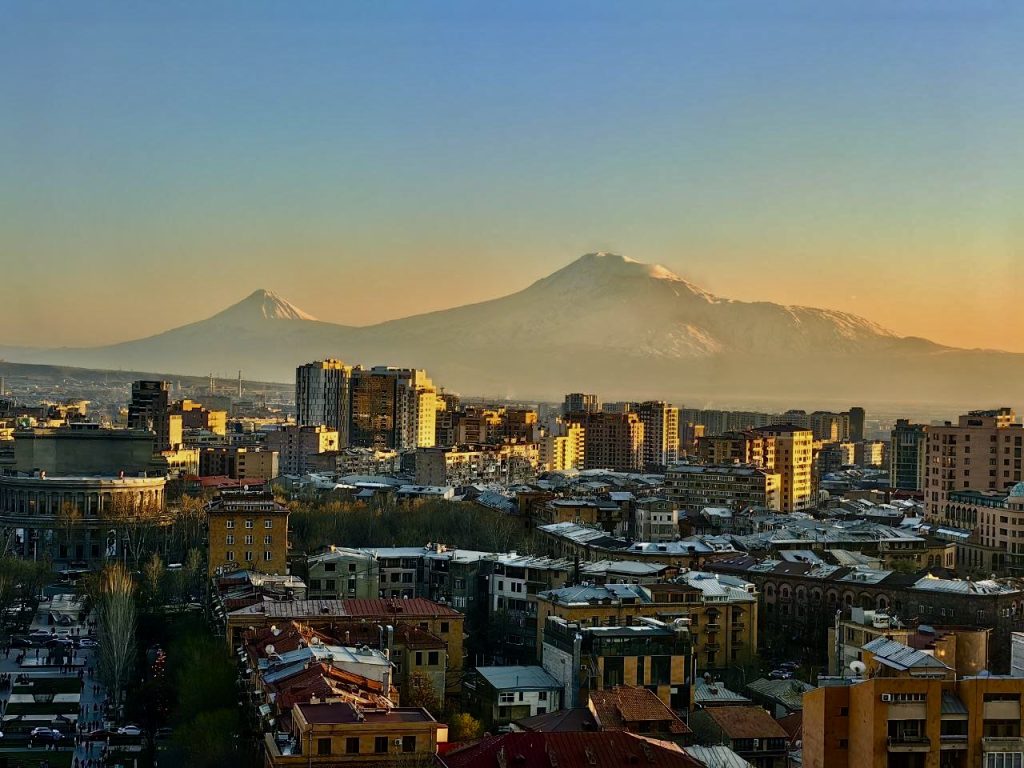
On December 2, 1920, as a result of the invasion of the 11th Red Army and the aggression of Kemalist Turkey, the government of Simon Vratsyan signed an agreement with the Bolsheviks. Eastern Armenia became Soviet, while Western Armenia (Kars, Ardahan) passed to Turkey. Along with the loss of independence, many historical lands were lost, including sacred Mount Ararat.
Contemporary Celebration
On May 28, 1920, a magnificent celebration of the first anniversary of independence took place, with a parade and folk festivities. Between 1968 and 1978, a majestic memorial complex was built on the site of the Battle of Sardarapat. Since 1990, the Day of the First Republic has again become an official holiday of independent Armenia.
Today, the main celebrations traditionally take place at Sardarapat and at the memorial in Aparan, as well as in Yerevan, where military parades are traditionally held. On this day, it is customary to speak of the enduring value of independence: “They saved the last span of our land. The Armenian people, bleeding and on the brink of despair, found the strength to rise against the enemy, to defeat him and to push him back.”
Display of Weaponry
At 10:00, the first military parade in 10 years began on Republic Square in Yerevan for the Day of the First Republic. The parade was commanded by Chief of the General Staff of the Armenian Armed Forces Edward Asryan, and received by Defence Minister Suren Papikyan. The parade ended with three artillery salvoes and a flyover by military aircraft.
The event displayed weaponry and equipment acquired over the past four years from Russia, India, France, Iran, China and other countries. The public saw many samples for the first time, including Russian TOS‑1 multiple rocket launchers and electronic warfare systems, as well as Indian, French and Iranian systems.