


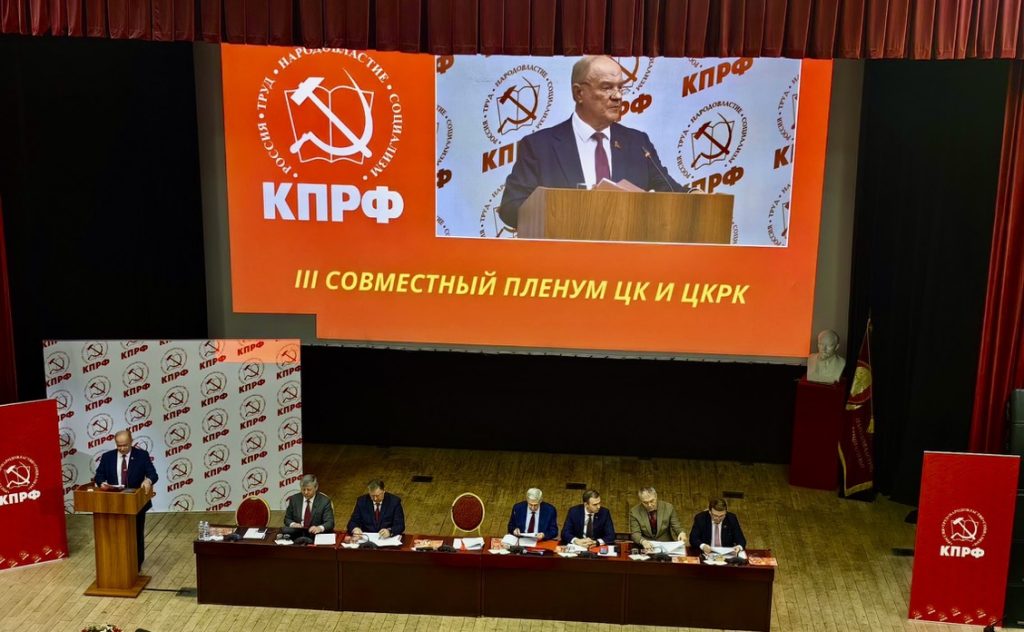
MOSCOW (Realist English). Chairman of the Central Committee of the Communist Party of the Russian Federation Gennady Zyuganov presented the pre-election program “Victory of the CPRF: from survival to development and justice” at the III (April) Plenum of the Party Central Committee in Moscow.
In a two-hour speech, the Communist leader gave a detailed analysis of the global crisis of capitalism, cited dozens of statistical data and warned the authorities about the historical lessons of the February Revolution.
Global context: “Trump is the tip of the spear of big capital”
Zyuganov began by characterising the international situation. In his words, humanity is experiencing “the most difficult period of formidable change”: familiar rules are breaking down, alliances are being restructured, and the threat of a new world war has not been so tangible since the defeat of fascism in 1945.
He recalled the US attack on Venezuela and the kidnapping of President Nicolas Maduro and his wife Cilia Flores, followed by the US‑Israeli aggression against Iran, which unfolded against the backdrop of the war in Ukraine, strikes on Palestine and Lebanon, and the blockade of Cuba.
The CPRF leader criticised those who attribute the escalation to Donald Trump’s personal qualities.
“It is extremely wrong to attribute Trump’s behaviour to personal impulsiveness,” he said. “He is flesh and blood of the oligarchic class. Trump is the tip of the spear in the service of big capital, as is the entire ruling class of the United States.”
Zyuganov cited figures: US military spending has exceeded one trillion dollars, and the additional budget request is $500 billion.
“The budget for the new year is one and a half trillion dollars,” he said. “The increase alone will be larger than the military budgets of Russia, China and India combined.”
He also mentioned the “Golden Dome” programme ($500 billion) and spending on artificial intelligence ($800 billion).
“It is hard to imagine greater madness and aggressiveness,” the party chairman concluded.
Three features of the crisis of capitalism and China’s place
Zyuganov identified three features of the current stage of the crisis of capitalism: its systemic and universal nature; the sharp rise in social inequality and the attack on workers’ rights; and the growing aggressiveness of imperialism.
He noted that the tendency for the rate of profit to fall, predicted by Marx, is now manifesting itself against the backdrop of China’s rise. China’s share of world GDP has grown from 1.5% to 20% over the past 40 years.
“In fact, China has today taken the place of the USSR,” Zyuganov declared. “The USSR had 20% of world production and produced 36% of the world’s electronics. One in three people in the world flew on IL and TU aircraft.”
He called the betrayal of 1991 a “terrible and costly price,” stressing that imperialists do not shy away from war, terror, fascism and genocide, and that international law is being thrown into the dustbin together with its main symbol, the UN.
“Recall Trump’s statement that he will bomb and destroy Persian civilisation in the form of Iran,” Zyuganov said. “The last time I read such speeches was by Hitler.”
Soviet achievements and the space lag
Zyuganov recalled the successes of the USSR: in the 1930s, average growth rates were 14% for 30 years; industrialisation created entire industries; the country gained the world’s best education system and free healthcare.
He cited space data: in 1961 — 17 successful launches; last year — also 17. But in 1990, the USSR carried out 2,500 launches, while the Americans had about a thousand.
“We were 10–20 years ahead of them in everything,” Zyuganov said. “The director of NASA at Baikonur admitted: ‘You are far ahead in all characteristics’.”
Today, he said, the Russian satellite constellation numbers just over 300; China has 1,000; the United States has 11,000.
“There are 20–30 drones above every soldier on the battlefield,” he warned. “If you do not solve this problem, tomorrow everything will be dictated to you from above.”
The catastrophe of the 1990s: 31 million Russians lost
Zyuganov said that as a result of the betrayal, Russia found itself in the position of a capitalist periphery.
“We lost 31 million Russians after 1990 — 10 million more than in World War II,” he cited the figure.
He also said that in 1990 the country had more than 36,000 large enterprises; after privatisation, 6,000 remained. Oligarchs moved assets abroad, built palaces and yachts, while the people got degradation.
“Career CIA officers worked as advisers in Chubais’s entourage, which Putin later admitted,” Zyuganov said. “That bastard freely left for Israel.”
He also mentioned the case in Altai where female deputies, mothers of many children whose sons are fighting at the front, are being persecuted only because their assistants worked for the party.
“Five thousand deputies signed the appeal, all members of the Central Committee,” he said. “I hope they will be heard.”
People’s enterprises: “Not a kopeck from the state”
A special place was devoted to successful people’s enterprises. Zyuganov cited the farm of Ivan Kazankov as the best in Europe: “220,000 pigs, 25,000 cattle. Full social package. They do not take a single kopeck from the state; production is 35 billion and they pay 3 billion in taxes.”
He regretted that the unique film about this experience cannot be shown on television and repeated his request to the authorities: “Give the opportunity to create one people’s enterprise in every district of the country. We are not asking you for a single kopeck. You will get a colossal return within the next two years.”
First-quarter economy: falling production and deficit
Zyuganov gave first‑quarter data: metallurgy – minus 15%; agricultural machinery – minus 21%; aviation industry – minus 30%. Small and medium-sized businesses lost 70,000 enterprises. One in three enterprises is loss‑making; debt grew by 20% over the year.
Tax arrears are approaching 4 trillion rubles; the budget deficit is heading towards 7 trillion (could reach 10 trillion).
“Without touching oligarchs’ profits, the Finance Ministry is planning a sequestration; the social sphere, investment, and science will be cut,” he warned.
Education spending has been reduced from 4.8% to 4.2% of the budget, while spending on science is only 0.85% of GDP. By comparison, in the 1950s the USSR spent 10‑12% of the budget on education, in the 1970s – 7%.
The basic VAT rate in Russia is 20%; in China it is 13%. The average lending rate in the Russian Federation over 17 months was 19%; in China it is up to 3.5%.
Oligarchs, billionaires and social catastrophe
“Four years ago there were 101 billionaires in the ranking; last year there were 146; today there are 155,” Zyuganov declared. “Their total wealth has approached a record — $700 billion. 150 people have more money than the 150 million‑strong state.”
He noted that 400 billionaires have officially asked to raise their taxes and also quoted Trump’s new strategy: the black list was headed by Yugoslavia, Iraq, Libya, Syria; today – Iran, Russia and China.
Zyuganov read letters from constituents. A teacher with a pension of 22,000 rubles is left with 10,000 after paying housing and utilities and must choose between medicines and food. A pensioner with 17,000 is left with 7,000 after paying for water and heating.
“Every second person in the richest country in the world lives on 25‑30 thousand rubles a month. Over 10 million citizens have incomes below the subsistence minimum. The low‑income total 35 million. Up to 70% of Russians have no savings for a rainy day,” the CPRF leader stated.
Money in banks and capital flight
He also said that bank accounts hold 67 trillion rubles of citizens and 63 trillion of organisations — in total 130 trillion (three budgets) that are not working for development.
“Thanks to the obstinacy of the government and financiers, $300 billion have essentially been stolen from Russia,” Zyuganov said, referring to international reserves where over $800 billion (60 trillion rubles) have accumulated.
He gave data on import substitution: imports of Chinese tractors have grown 26‑fold, while at Rostselmash and the Kirov Plant 2,400 units of equipment are idle because farmers were not given money.
Iran, drones and China’s successes
Zyuganov highly praised Iran’s resistance: “It seemed that two nuclear powers had piled on and would smash everything — but nothing came of it. They killed 48 top leaders, but nothing came of it.”
He called for learning from Iran’s economy of resistance and five‑year plans.
The politician also recalled that the Communist Party of China lifted more than 700 million people out of extreme poverty and made the country a leader in technological development.
“Already 35 regions of our country are being shelled by drones,” he said. “This threat is growing.”
Nationalisation and historical warning
“Russia will not be able to emerge from the crisis without breaking free from capitalism,” Zyuganov declared. “We will not be able to break free if we do not take the path of justice, friendship and socialism.”
He called nationalisation the first step — referring to the mineral‑resource base, strategic sectors and system‑forming banks.
“In the 1990s, there were more than 36,000 large enterprises; 6,000 remained. We have to return them,” he emphasised.
In conclusion, Zyuganov drew a historical parallel with the February Revolution of 1917, when a revolt of hungry women and army desertion led to the fall of the monarchy, despite the generals’ oaths.
“I am warning you because you must know your history and you must take decisions on time,” he said, addressing United Russia.
He announced that the party will hold a third International Anti‑Fascist Forum — the previous one was attended by 165 delegations from 91 countries, including all NATO states. The CPRF congress, which will approve the programme, will be held in mid‑June.
“In September, the will of the citizens will determine which path the country will take,” the party chairman concluded.