


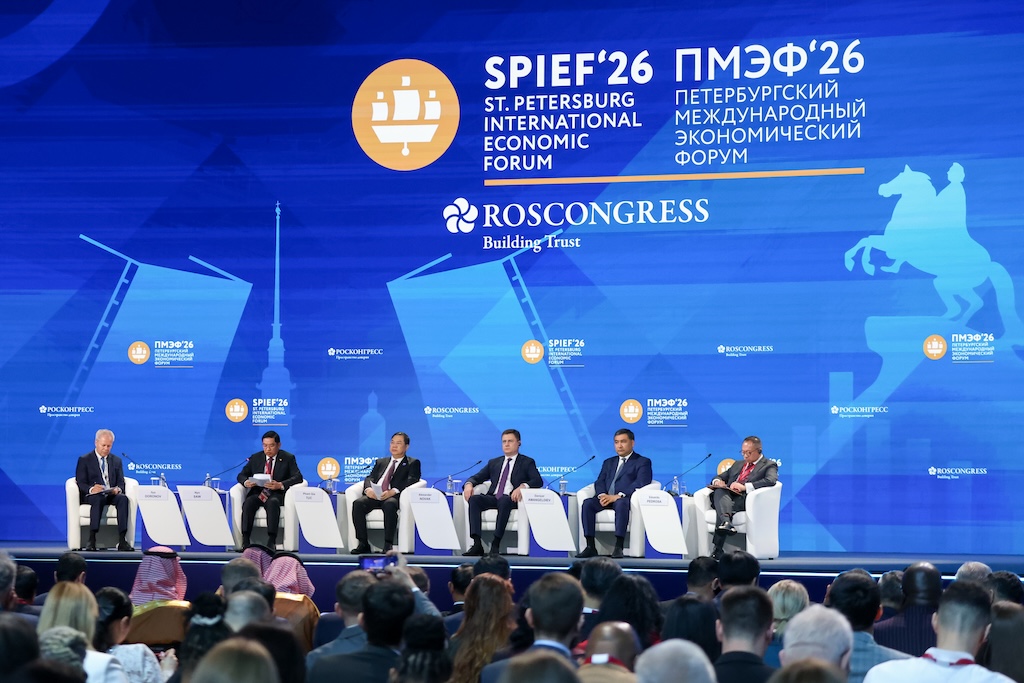
ST. PETERSBURG (Realist English). The 29th St. Petersburg International Economic Forum (SPIEF), held under the motto “Pragmatic Dialogue – the Path to a Stable Future,” has brought together about 20,000 participants from more than 100 countries.
The key events of the second day were statements by Russia’s ministers of finance and economic development, as well as the signing of dozens of agreements worth billions of rubles. President Vladimir Putin’s main address is expected on June 5 at the plenary session.
Scale and Geography
The forum is taking place from June 3 to 6 at the ExpoForum convention and exhibition centre. For the first time, Saudi Arabia has been named guest of honour, with its delegation led by Energy Minister Prince Abdulaziz bin Salman Al Saud.
Also arriving in St. Petersburg are President of Uzbekistan Shavkat Mirziyoyev, President of Tanzania Samia Suluhu Hassan, Vice Chairman of the People’s Republic of China Han Zheng, and Chairman of the U.S. Commission of Fine Arts Rodney Cook (the first official U.S. delegation since 2018).
Among the guests are former German Chancellor Gerhard Schröder and deputies of the German Bundestag from the Alternative for Germany party.
Key Statements on June 4
- Finance Minister Anton Siluanov, speaking at the session “How to Return to a Trajectory of Sustainable Economic Growth,” stated that the foundation for Russia’s economic development is sufficiently stable. The country’s external debt is only 10% and will soon be repaid, while the budget deficit remains under control.
- Minister of Economic Development Maxim Reshetnikov listed priority tasks: improving communication with businesses, increasing labour productivity, and introducing lean manufacturing.
- Central Bank Governor Elvira Nabiullina will not speak at the main session of the forum – her participation in the discussion is not planned.
Key Contracts and Agreements
The total volume of deals at SPIEF 2026 is forecast at 6.4–6.5 trillion rubles (in 2025, it was 6.3 trillion rubles). By June 4, dozens of agreements had already been signed. The most significant:
| Region / Party | Partner / Project | Amount (billion ₽) | Substance of Agreement |
| St. Petersburg | Petersburg Oil Terminal | 6 | Modernisation of facilities and expansion of transshipment capacity in the Big Port |
| St. Petersburg | Koulon Company | 3.2 | Creation of serial production of ceramic capacitors |
| St. Petersburg | Lenta Retail Chain | 2 | Development of retail infrastructure |
| Krasnodar Krai | Insiti Group | 9 | Construction of a logistics park and warehouse complexes |
| Kursk Oblast | VEB.RF | 16.8 | Construction of a modern waste processing complex |
| Kursk Oblast | Metalloinvest | 2.4 | Cooperation within investment projects |
| Kursk Oblast | Total of 14 agreements | 68 | Comprehensive regional development (infrastructure, housing and utilities, sports) |
| Tula Oblast | Atrium Company | 0.7 | Construction of a technopark for medical microelectronics |
| Omsk Oblast | Various investors | 100 | Creation of new industries, housing, sports development |
| DPR | Roman Rotenberg | — | Development of hockey infrastructure (street rinks) |
Other Events and Technologies
The forum hosted business dialogues with China, India, Germany, and the United States, as well as meetings of the SCO and BRICS business forums. Regional stands featured assistant robots, as well as Bashkortostan’s “Wisdom Tree of Shezhere” with artificial intelligence, answering guests’ questions. The organisers abandoned lengthy official opening ceremonies, focusing on the business programme.
A concept for the territory of the former Kresty pre-trial detention centre was presented: it is planned to build 4–5 star hotels, a museum and educational space.
Plan for June 5
The main event is the plenary session with the participation of President of Russia Vladimir Putin.
He will be joined by foreign leaders, including the presidents of Uzbekistan and Tanzania, the Vice Chairman of the People’s Republic of China, and the Minister of Energy of Saudi Arabia.
The president is expected to address the economic agenda and will inevitably touch on political issues.