


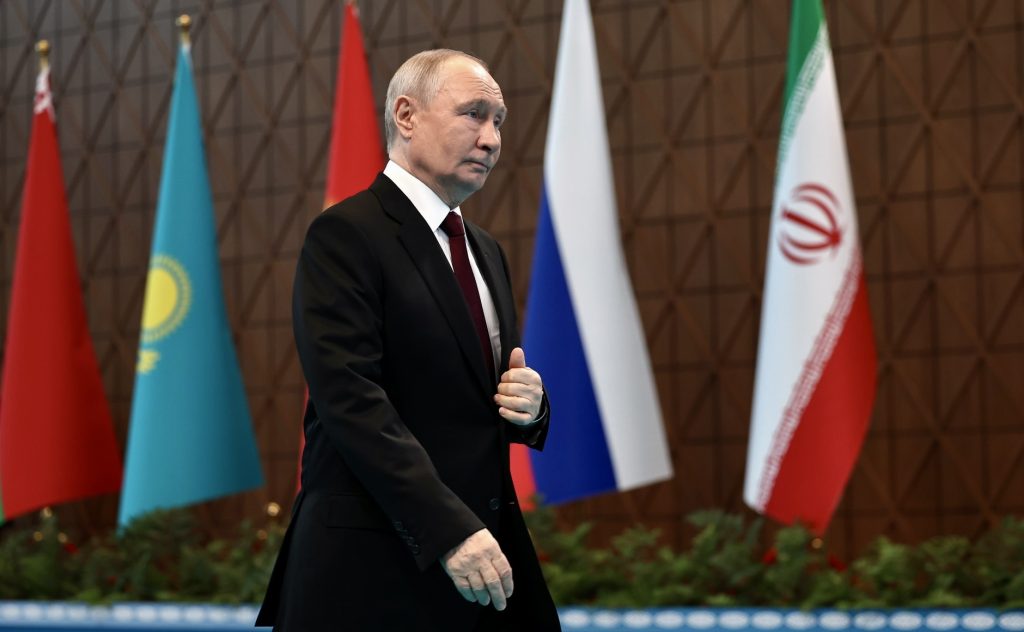
ASTANA (Realist English). A meeting of the Supreme Eurasian Economic Council (SEEC) was held in the Kazakh capital under the chairmanship of President Kassym-Jomart Tokayev, timed to coincide with the 12th anniversary of the signing of the treaty establishing the Eurasian Economic Union (EAEU).
The meeting took place on the 12th anniversary of the treaty – May 29, 2014 – and consisted of two formats: a restricted-attendance session and an expanded session.
Participants
The restricted-attendance session was attended by the presidents of the “Big Five” countries: Kazakhstan’s Kassym-Jomart Tokayev (the chair), Russia’s Vladimir Putin, Belarus’s Alexander Lukashenko, Kyrgyzstan’s Sadyr Japarov, as well as Armenia’s Deputy Prime Minister Mher Grigoryan, who replaced Prime Minister Nikol Pashinyan.
They were joined in the expanded session by leaders of observer states and partners: President of Uzbekistan Shavkat Mirziyoyev, Vice President of Cuba Salvador Valdés Mesa, Minister of Industry, Mines and Trade of Iran Mohammad Atabak, and CIS Secretary General Sergei Lebedev.
Vladimir Putin’s Address: Achievements and Priorities
In his speech, the Russian president presented a detailed picture of the EAEU’s successes and outlined strategic guidelines for deepening integration.
- Unity and priority. Putin called deepening allied ties with EAEU countries an “absolute priority for Russia,” emphasising his intention to continue advancing integration processes across the entire Eurasian space.
- Successful economic statistics. The head of state cited figures demonstrating the Union’s effectiveness: total industrial output in the EAEU grew by 1.6%, agricultural output by 4.6%, and construction by 4.2%. Mutual trade between the “Big Five” countries reached $95 billion, with the share of high-tech products increasing while the raw‑material component declined.
- Financial sovereignty. The president noted that the Union’s countries conduct almost all their settlements in national currencies, thereby “reliably insuring” mutual export‑import operations against external influence and negative global trends.
- Openness to the world. Putin confirmed that the EAEU “remains consistently open to mutually beneficial and equitable cooperation with constructively minded countries and associations,” including the CIS, SCO and ASEAN, and that the circle of the Union’s preferential partners is steadily expanding.
- Food security. It was announced that the EAEU countries intend to supply their domestic markets with essential agricultural products independently and without interruption. A step forward in this direction will be the creation of a common market for seeds of agricultural crops.
- Industrial cooperation. The Russian leader spoke about the launch of a mechanism for preferential co‑financing of industrial projects, under which loans are provided at rates significantly below market levels. This will allow the positive experience in industry to be extended to other key sectors, including agriculture.
Results of the Summit: Documents and Initiatives
The summit was marked by the signing of a number of important documents that set the Union’s development direction for years to come.
- Joint statement on the responsible development of artificial intelligence (AI). Initiated by Kazakhstan, the document defines basic principles for the safe deployment of intelligent systems, the protection of digital sovereignty and, most importantly, the prevention of AI’s use for military purposes and the prevention of its becoming a weapon of mass destruction.
- Expansion of foreign economic ties. A start was made on negotiations to conclude a free‑trade agreement with Tunisia, which the Eurasian “Big Five” regard as a strategic gateway to Africa’s fast‑growing market. In addition, a decision was taken to update the existing agreement with Serbia (by simplifying the requirements for accompanying goods documents). Together with agreements already in force with Iran, the UAE, Indonesia and Mongolia, as well as ongoing negotiations with India, this significantly expands the Union’s external outreach.
- Improvement of internal regulation. Protocols were signed amending the EAEU Treaty, concerning, in particular, the specifics of criminal and administrative liability for violations of customs legislation, as well as the provision of financial support for cooperative projects in the agro‑industrial sector.
The Armenian Question: A Signal to Yerevan
One of the central items on the agenda was the discussion of Armenia’s further participation in the EAEU in light of its course towards rapprochement with the European Union and the constant boycott of Union events by Prime Minister Nikol Pashinyan.
During the summit, the leaders of the EAEU countries adopted a separate statement on Armenia. Although the details of the document were not disclosed, the very fact of its adoption testifies to the serious concern of the partners and their readiness to formulate a joint position.
Earlier, Russian presidential aide Yuri Ushakov noted that the Union’s countries would have to work out a “course of action in the event of Armenia’s withdrawal from the EAEU and to protect their markets.”
This context largely explains Putin’s broader rhetoric. His remarks on the benefits of close integration and the successes of the EAEU, as well as his call for “independent provision” of food security, were addressed not only to current members but also to those considering alternative paths of development.
The Russian leader stressed that the Union’s agreements protect its members from “external influence and negative global market trends,” drawing a clear distinction between the stability of the Eurasian model and the turbulence associated with Western integration projects.
Strengthening Cooperation
The EAEU summit in Astana confirmed the Union’s transition from the stage of forming a common economic space to actively developing high‑tech and innovative cooperation in the context of global geopolitical turbulence.
Despite certain disagreements, primarily related to the “Armenian question,” the member countries managed to demonstrate unity of strategic approaches by signing a substantial package of documents aimed at deepening integration and diversifying external ties.