


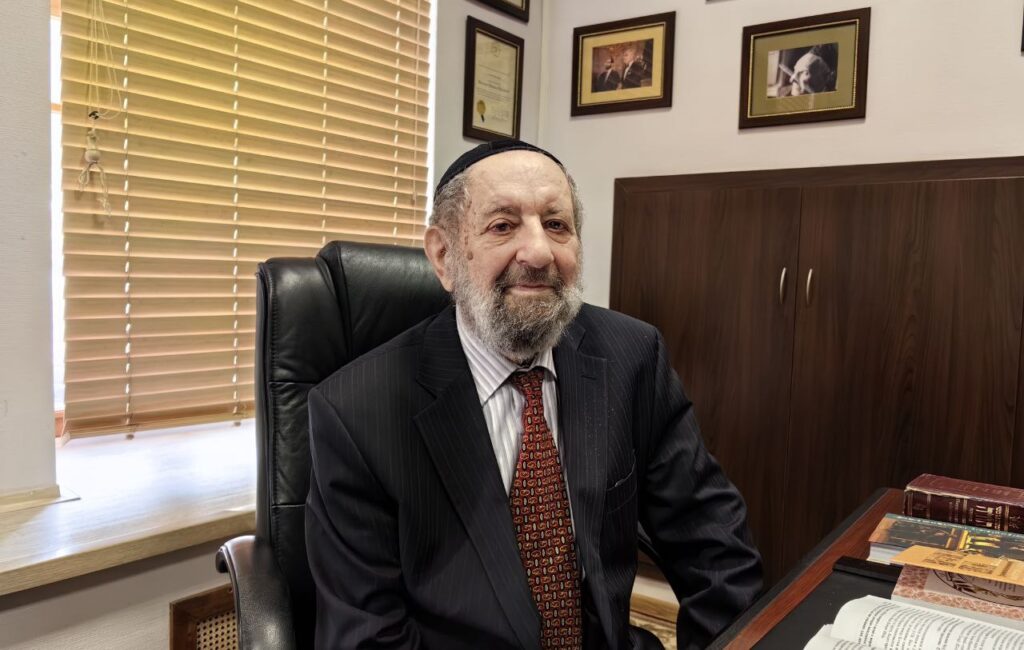
MOSCOW (Realist English). Adolf Shayevich, the Chief Rabbi of the USSR and Russia (according to KEROOR), whose biography uniquely bridges the Soviet past and modern Russia, answered these and other questions from Realist English.
You came to rabbinical work as an adult, with an engineering degree and a stable job. What was the turning point that made you radically change your life?
Adolf Shayevich: Man proposes, but God disposes. As my teachers later explained to me, it was all predetermined by the Almighty. Try as I might, I could not escape it. I came to Moscow simply to change my lifestyle and didn’t even know there was a synagogue in the capital.
I grew up on “Komsomolskaya Pravda.” Our synagogue in Birobidzhan was either burned down in 1947 or it burned down on its own when the “fight against cosmopolitans” began. I only knew about synagogues from Sholem Aleichem’s novels. We grew up completely removed from tradition.
It was 1972. I arrived in Moscow. I couldn’t find a job anywhere. Then I learned from one of my friends that there was a yeshiva (school) “Kol Yaakov” at the synagogue that provided temporary registration for the duration of studies.
The guys brought me to the synagogue. I ended up in a scene straight out of Sholem Aleichem, surrounded by old Jews who had studied in religious schools before the revolution. In the office of the community chairman sat an elderly Jew, about the same age I am now, who came out right after me. It was Lev Gurvich.
“I run this school. Do you want to go to Israel? I’ll help. If you want to stay, I’ll help too,” he said. That’s how my studies began.
I come every morning to classes, understand nothing, don’t know the language. I started participating in prayers, learning little by little. We are supposed to conduct prayer when 10 people are present. You can pray alone, of course, but according to canon, there must be at least 10 men.
Where does the number 10 come from? Why 10, not 7 or 8?
Adolf Shayevich: It’s from the Torah, when God promised Abraham not to destroy Sodom and Gomorrah if ten righteous people could be found there.
So I start learning Hebrew at the school. Lev Gurvich, through the Moscow Council for Religious Affairs, gets permission for my studies and accepts me as a student. Later, I’m hired as a guard at the synagogue. That solves the housing problem.
Every Saturday, several thousand people gather near the synagogue. The entire street is filled from bottom to top. And on holidays, it’s completely packed. Besides the synagogue, there were no Jewish organizations at all.
This was a club of interests. People socialized, learned all sorts of details: what documents to submit for emigration to Israel. Who gets permission, who is refused, who gets what news from Israel. You could find out everything here, including meeting people. I went to museums and theaters, met girls. I visited all the Moscow museums and theaters.
Who was your spiritual guide at the beginning of this journey?
Adolf Shayevich: Lev Gurvich. A man with a fascinating destiny, who received his rabbinical diploma way back in 1917.
The year of the October Revolution…
Adolf Shayevich: Yes, he and Rabbi Leib Levin. They got their rabbinical diplomas in ’17, and then the revolution happened. They had nowhere to work. Then they graduated from the aviation faculty and worked in the aviation industry after the revolution. It was only when Rabbi Levin retired that he was invited here to be a rabbi. That was already the mid-1960s.
He, in turn, found Rabbi Gurvich and invited him here to be the rector of the yeshiva. There were 15 of us studying, of different ages and completely different levels of preparation.
Once, one of the American rabbis visited us. He said he had obtained permission through the Council for Religious Affairs to send several students from the Moscow yeshiva to study in Budapest.
That was the only rabbinical seminary in the socialist camp. Our yeshiva didn’t grant rabbinical diplomas. We were strictly forbidden to go study in Israel or America. I was among the three students selected for Budapest after an exam in Hebrew.
How long did you study there?
Adolf Shayevich: From 1973 to 1980. By the way, within two years I picked up Hungarian and could study in the same group as the local students.
In 1980, I received my diploma and returned to Moscow. I became an assistant to Rabbi Yakov Fishman. He was ill at that time and was very rarely at the synagogue. He was a member of many public organizations back then — the Soviet Peace Committee, the Soviet Peace Fund, various councils for relations with foreign organizations. He was invited somewhere about once a month. I attended all these events instead of Rabbi Fishman.
There’s an opinion that today’s Jewish youth face not the challenge of assimilation, as before, but a choice among multiple identities: religious, national, secular, global. In your view, what constitutes the core of Jewish identity in the 21st century?
Adolf Shayevich: Compared to Soviet times, when the state’s attitude towards religion was sharply negative, assimilation was quite natural. In the Soviet Union, apart from the synagogue, there were no schools, no Jewish institutions. People were cut off from tradition. Today, there is no state anti-Semitism; the attitude towards religion is completely different.
A person has a choice. They can now acquire some knowledge and make a choice. And when there is a choice, everything depends on you. Of course, the environment also matters a lot. Nevertheless, when you live among people of different nationalities and you see this person going to the mosque on Fridays, that one going to church on Sundays, and you, a Jew, can go to the synagogue — why not go? That’s how contact with tradition begins.
Today, there is an opportunity to live according to tradition, to immerse yourself deeply in it, and to make your own choice without pressure. That’s great!
You are often called the last Soviet rabbi and a living symbol of continuity. How do you define your main historical mission yourself?
Adolf Shayevich: I wouldn’t say I had a historical mission. In Soviet times, the state fought against religion to such an extent that practically everything was dying. Even such a powerful structure as the Russian Orthodox Church had a mass of problems. Not to mention us. Then “perestroika” began. CPSU General Secretary Mikhail Gorbachev allowed emigration; a mass of people left, the synagogue emptied. And it seemed that was it.
What will happen in a year or two? We can’t even gather a minyan (a quorum of 10 adult Jewish men) anymore. But nevertheless, the opportunity appeared: it depends on the person to make a choice, to come — when people started taking an interest and knew that nothing would happen for it: they wouldn’t be expelled from the institute, fired from work, or punished by the party. Everything turned out completely differently.
My task back then, in the eighties, was to do everything possible so that the guys studying here could have textbooks. It was difficult with translations of prayer books, especially holiday prayers. Prayer books were published during Tsarist Russia but never reprinted.
In Soviet times, getting permission just to publish the Jewish calendar was a whole ordeal. The Jewish new year starts in September; I needed to have the calendar ready by then. So, in May, I sit down and make the calendar. I submit it to the Moscow Council for Religious Affairs; they check it. I pick it up from there and submit it to the USSR Council for Religious Affairs. They check it for a week. With the approved, signed copies, I go to the publishing house — the only fiction publishing house that handled religious literature, submit it there. I wait there for a week. Then they send it to the next authority. In total, you had to go through ten authorities to publish one calendar.
Then a call from the final authority: “Rabbi Shayevich, we checked the calendar, you haven’t marked Vladimir Lenin’s birthday.” “How outrageous! Yes, of course, sorry. Well, add it then,” I reply. — “No, we can’t do it ourselves; come and write it in by hand.” Can you imagine? And that’s just for the calendar. Not to mention publishing a translation of a prayer or a book. It was a whole saga.
Another example — supplying the communities of the Soviet Union with matzah, kosher wine, religious items: tallits and tefillin. All of this required permission from the councils for Rabbi Schneier from America to send them. We were practically not allowed to receive anything from Israel in the eighties. It became easier later.
Religious holidays approach. Many communities don’t have permanent rabbis. So, I go to the Council for Religious Affairs and work out getting permission for two or three families to come from Israel specifically for the holiday. I send them to Perm, Nizhny Novgorod, Irkutsk to conduct the holidays. I guarantee no anti-Soviet propaganda. They conduct the holidays and return to Israel. You had to arrange with the community to host them, provide normal conditions, ensure kosher food. A shochet (ritual slaughterer) to slaughter meat according to the canon. In Irkutsk, for example, a shochet comes once a month and slaughters poultry or a couple of cows for the coming month, which are stored in the community. It’s an ordinary task, of course. I never considered that I was fulfilling some special mission.
Also, my participation in all public organizations, up to the point when — Rabbi Fishman died in June 1983, and I was invited to the “Anti-Zionist Committee of the Soviet Public.”
Were you a member of the Anti-Zionist Committee?
Adolf Shayevich: Rabbi Fishman was a member of this committee. When he was gone, General Dragunsky, who headed the committee, a twice Hero of the Soviet Union, invited me. And there was a famous lawyer, Zivs, who practically ran things because Dragunsky was a figurehead.

I categorically refused to join the committee. They promised me they wouldn’t demand anything in return. I said, “Alright, if that’s the case, I agree, but I will not participate in any press conferences, I will not sign any letters. Here’s my task: a delegation comes through the synagogue — I receive them. I tell them how free we are, how good we have it. But no statements against Israel.” And indeed, I never wrote a single letter, never participated in a single press conference. I have to thank them, they didn’t bother me much about it.
But during my trips to America, England, and France in various delegations, I was constantly picketed for it. They even held a public demonstration in America against my participation in the Anti-Zionist Committee.
Can it be said that modern Russia is the period of the greatest flourishing of the Jewish community in its entire history?
Adolf Shayevich: Yes, definitely. Starting from “perestroika,” when state anti-Semitism disappeared, and credit must be given to all presidents, starting with Gorbachev, Boris Yeltsin, Vladimir Putin, Dmitry Medvedev — the attitude towards religion became completely different.
In 1991, with the collapse of the Soviet Union, the Councils for Religious Affairs disappeared, they ceased their activities. Committees for relations with religious organizations were established under the president, under the government, under the Moscow government, and in the Duma. Normal working relations really began.
Before, I only met the chairman of the Council for Religious Affairs at Kremlin receptions, and it was impossible to see him otherwise. With the staff — only the one who oversaw us. You could still call the Moscow council and resolve some issues, but it was all problematic, everything needed coordination…
Today, we have phone numbers; you can literally call anyone. You can consult, ask for an appointment, or just resolve issues over the phone. Everything is different.
The people handling religious affairs are knowledgeable. They are not just some appointed officials who don’t understand anything. Every person we work with knows everything perfectly; you don’t need to explain anything. You call and say, “We have this problem.” — “Okay, we’ll handle it, we’ll solve it.” Everything is fine.
Today, practically everything depends on our desire, on our capabilities. There are many desires; unfortunately, our capabilities are much fewer.
You personally had contact and still communicate with the leaders of the Russian state. Tell us about a memorable moment in your communication.
Adolf Shayevich: We communicated quite often with Boris Yeltsin. With Gorbachev, it happened that he received joint delegations: Orthodox, Muslims, Jews, Catholics, and all the rest. We were there several times.
Besides the Kremlin receptions held on holidays, we always went up, congratulated each other. I even had individual meetings with Boris Yeltsin. He, by the way, personally attended the opening of the synagogue on Poklonnaya Hill. He came to the synagogue in person, and I showed him around. We even had a drink together. The relations were normal.
Later, the same kind of relations developed with Vladimir Putin and Dmitry Medvedev.
On July 13, 1999, our community chairman was stabbed. At that time, the community chairman was Leopold Kaimovsky, director of the Jewish Art Center. An attempt was made on his life on the premises of the Moscow Choral Synagogue. Subsequently, Kaimovsky was awarded the Order of Courage.
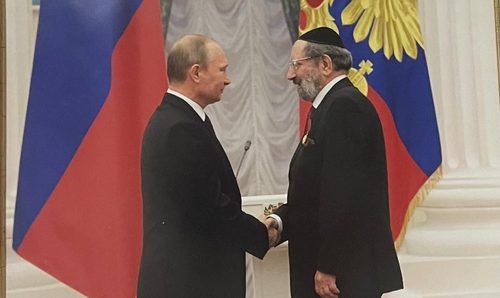
The President was presenting the award in the Kremlin, and I was also invited. After the ceremony, Vladimir Putin came over with a glass of champagne and congratulated Kaimovsky again. And I remember, he told us: “Our common task today is to do everything so that Jews don’t leave Russia, but return.”

There are plenty of anti-Semites even today. But the leaders of the state don’t let anyone raise their heads. In Russia, we have it much easier and simpler than in Europe, where anti-Semitic actions and pogroms occur. Thank God, we are very grateful that we can walk the streets calmly and freely.
How are relations with Jewish business in Russia, with Jewish entrepreneurs?
Adolf Shayevich: It’s more complicated today, of course. Many active Jews, those who specifically helped the synagogue, have left. There are plenty of problems now. And in business, contacts abroad are also much fewer.
The people who helped us are helping much less now. We understand their problems and hope that everything will work out. Because there is work to be done, there are people to work with.
All Jews inclined towards business have always, in all times, known how to find a way out of difficult situations. Let’s hope that a way out will be found from today’s economic situation too, and they will continue to help the community.
What does Israel mean to you?
Adolf Shayevich: Like for every Jew, part of our soul is always with Israel. We would like it to live and develop in a constant atmosphere of peace. But since the state’s creation, it has constantly had to defend itself from unfriendly neighbors.
This, of course, worries, upsets, and saddens us all, but nevertheless, Israel has proven during its existence that it has enormous potential. And it’s amazing because, constantly surrounded by a hostile environment, constantly at war, standing up to numerous, many times superior forces, it has endured.
We would like the world community to help. Unfortunately, apart from America, Israel has no real partners. That is sad, of course. It’s surprising why such powerful Muslim countries as Iran and other states are bent on destruction, dreaming of destroying Israel — such a small piece of land that is truly holy for us, for all Jews, because it was there that the Almighty chose a place for the Jewish people.
We wish that what has been commanded for millennia to many generations would come true. At least in our days — we constantly pray for it. And all previous generations prayed for the Third Temple to be rebuilt and for peace to finally come to our land. Therefore, with all our might, with all we can — with our prayers, with our modest contributions — we try to help Israel. We believe we will endure and that it will be so.
What will be the signs before the rebuilding of the Third Temple? Has construction begun?
Adolf Shayevich: Not yet, but all the prerequisites, judging by the numerous assumptions expressed by sages starting from the destruction of the Second Temple up to today, exist. Many proposals, especially in the early years after the re-establishment of Israel, were made to rebuild the Temple. Financial opportunities existed and still exist today, but everything must be done precisely at the behest of the Lord. He must give that first push for the rebuilding of the Temple. Nevertheless, much is still unfulfilled by the Jews living today. A great deal depends on us.
What exactly is unfulfilled?
Adolf Shayevich: Many must return to tradition. People are still far from living according to tradition. That’s what we all need to work on literally today — bringing Jews back to Judaism, so that they at least absorb it. Then there will be the first push for the rebuilding of the Third Temple.
The confrontation between Jews and Arabs is understandable — they are neighbors. And neighbors often quarrel. But what did Jews not share with Persians? You’re not neighbors with the Persians, are you? During the Shah’s era, Israel and Iran had allied relations. What can’t Jews and Persians share now?
Adolf Shayevich: If you look at the example of the confrontation with Jordan, with Egypt — they somehow found possibilities. Neither Jordan nor Egypt wages war, they don’t stage any provocations. So, some options are possible.
I really hope that Israel has powerful — I don’t know, nuclear or non-nuclear — weapons capable of doing everything to eliminate Iran and other countries. But never has any political or military leader said that our task is to destroy Iran, destroy Kuwait, or other countries.
“We want to live in peace,” Israel declares. We want to live in peace with everyone. Let’s find ways for that. But Iran, for all 47 years since the Shah was overthrown, has continuously declared that its main goal is to destroy Israel. The Houthis from Yemen, who don’t even share a border with us, who are far away, several hours of flight away, dream of destroying Israel. Why do they need this?
Muslims lived for centuries and live today in the Land of Israel, they go to mosques, pray, observe everything they need to. No one persecutes them for their religious beliefs. Opportunities for development — please, live.
A considerable number of Muslims live in Israel today. Orthodox pray, Christians pray in Israel. Masses of pilgrims travel, no problems, no persecution.
If there was a will, authoritative people could be found who would want to find paths to reconciliation. Look at Gaza and Hamas — impossible. If they are left in their current state, it’s only a postponement of a new conflict. They will not calm down, and violence will continue. That means the world community must crush them, do everything to eliminate them.
We need to find some path to reconciliation so that normal people living in Gaza today can have a chance at life. Nobody demands they renounce their faith or change their way of life. For God’s sake, live as you lived. But live peacefully, work. Israel always helped, provided water and medicine, did everything possible so they could live in peace. People spend money on weapons for killing, instead of building normal hospitals, housing for people, providing them with food.
The land issue must be resolved at the diplomatic level. First and foremost, it must be resolved peacefully, as it affects the problems of both Jews and non-Jews. You can’t just take and pass a resolution like “these are our lands, and that’s it, we don’t care,” because it is unacceptable to a huge number of people. Therefore, diplomatic efforts must be directed primarily towards enabling all interested parties to discuss how this can be resolved in a common interest. And then it will be another step towards peace in the Land of Israel. After all, the prerequisites for building the Third Temple really exist.
Should the Temple be built in conditions of peace?
Adolf Shayevich: Exactly. Peace is a mandatory condition.
Clarify for our readers. The Third Temple is the Temple of the One God, isn’t it?
Adolf Shayevich: Absolutely right. After all, during the times of the First and Second Temples, sacrifices were offered on religious holidays for all the peoples living at that time. They prayed in the Temple for all the 70 nations of that period, offered special sacrifices for their existence. And today, on Saturdays, we pray for the health of the president, the prime minister, the mayor, for all the Russian people. This is our traditional, obligatory prayer.
You pray specifically for Russia?
Adolf Shayevich: Yes. And in other countries, we pray for them accordingly, since we live there, and also for Israel, of course, for its well-being. But here, in Russia, we pray for Russia.