


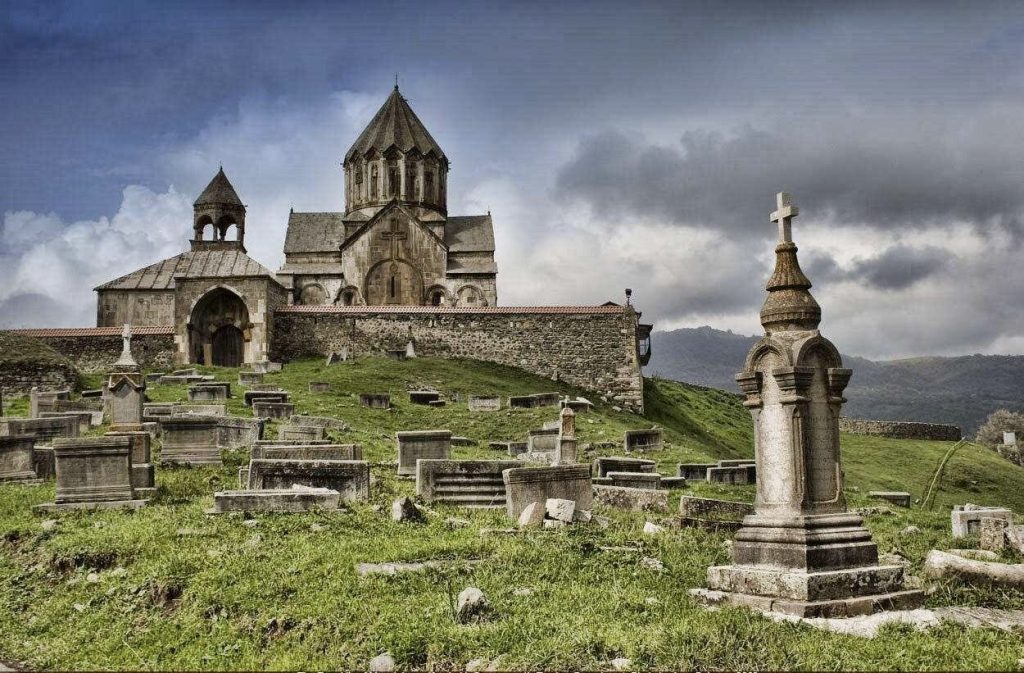
MOSCOW (Realist English). If one looks at the history of Yerevan, founded in 782 BC, and studies its architectural monuments, it becomes clear that similar monuments remain in Nagorno-Karabakh, on Lake Van, and in the Kars region — everywhere we see one culture, one archaeology, one language, one faith. This is the most important evidence of the great history of the Armenian people, according to Doctor of Historical Sciences, member of the Association of Academicians for the Promotion of Science and Culture, Alexander Cheryomin.
“If we turn to historical sources spanning millennia, they show us the great history of the Armenian people. All the polemics, all the archaeology of surviving chronicles, hieroglyphs and manuscripts indicate that the Armenian people have always lived in the Armenian Highlands. If we take the history of Urartu, the history of Byzantium, we will always find there the history of the Armenian people — architectural monuments, various works of art, culture and even poetry, preserved in many libraries around the world. The historical database on the history of Armenia is very extensive; it is present in many archives of the Russian Federation, the US Library of Congress, Great Britain and other countries of the world.”
The policy of the first leaders of the Soviet state in 1921 unreasonably created a precedent for the difficult situation we have today in Nagorno-Karabakh, Cheryomin argued.
“Let’s consider what Azerbaijan was like. It so happened that only in the 11th century did the first Turks from Central Asia arrive in the territory where the Absheron Peninsula is located. On one hand, we see the Armenian people with a history of thousands of years, from Noah and Mount Ararat, and on the other hand, the 11th century and the arrival of Turks on the Absheron Peninsula.”

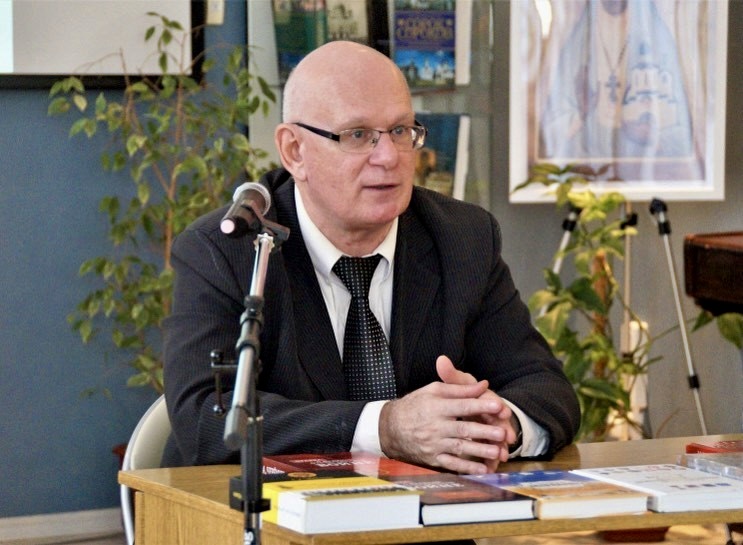
“We look at documents from the historical archive in St. Petersburg: Peter the Great’s Persian campaign in 1723, Russian troops enter the city of Baku. There is not even a mention of Azerbaijanis. Such a nation simply did not exist in 1723. And this is a historical source that lies in our archive. It says ‘Persians,’ by faith — Shiites, no other mentions. We look further: the 1750s, when (unfortunately) there was no Russian influence in this territory. Tatars who had lived there since the 13th century are mentioned. That is what documents show us when Russia was no longer there. We look at the 19th century — Russia’s treaties with Persia and the Ottoman Empire. Nowhere is there any mention of Azerbaijanis. There is a historical region called ‘Azerbaijan,’ but it is located on the territory of Iran. The Absheron Peninsula has no relation to that Iranian region.”
“But if we consider the situation related to the forced relocation of the Armenian people to Persia, which took place during the time of Alexei Mikhailovich, it is from that time that a huge number of Armenians lived in northern Iran, who later moved from there to Moscow. We remember the golden throne that the Armenians from Iran presented to Tsar Alexei Mikhailovich. This throne is now in the Kremlin Armoury. Even on the territory of historical Iranian Azerbaijan, Armenian diasporas were numerous. As for jewelry, it is evidence.”
“Let’s move to the time of the creation of the Caucasian provinces: nowhere is the word ‘Azerbaijan’ even mentioned. Look at the population of the major cities of Transcaucasia at the end of the 19th century. The majority of residents of Baku and Tiflis were Armenians. Unlike Yerevan, large investments were directed to Baku and Tbilisi. But if you look at the history of Yerevan, founded in 782 BC, and study its architectural monuments, it becomes clear: similar monuments remain in Nagorno-Karabakh, on Lake Van, and in the Kars region — everywhere we see one culture, one archaeology, one language, one faith. This is the most important evidence of the great history of the Armenian people.”
Turning to the history of the Soviet Union, Cheryomin noted that the Armenian diaspora took root in almost all regions of the world, and this was linked to the genocide carried out by the Ottoman Empire on the historical homeland of the Armenians.
“We can now see Armenians in Latin America who moved there during that difficult time, and in North America, Australia, and the Middle East. Leaving their homeland, they took their historical documents with them. And in Latin America, Brazil and Argentina, we can see any documents about Armenian history and the Armenian people. By the way, there is not a single document there that speaks of Azerbaijan.”
“From 1936, when Azerbaijan was first formed, we note that the policy of the Soviet authorities was not directed in the direction we would have liked. This is due to the fact that in the early 20th century, Koba, also known as Joseph Stalin, was in a Baku prison, and he very much wanted to pay attention to his youth. Therefore, already in the late 1930s, the first falsification of how Azerbaijan developed began in Soviet textbooks. Sergey Kirov, who commanded the armies of Transcaucasia, also made efforts to show the Armenian people in a negative light, because the Dashnaktsutyun actively resisted the Red Army during its campaign. They (the Bolsheviks – IA Realist) wanted to show that Armenia was an enemy of Soviet Russia in Transcaucasia, while remaining silent about the Musavatists, as if they never existed, as if they were not friends of England, as if they were not involved in the murder of the 26 Baku Commissars, among whom Armenians predominated.”
“Consider the 1940s — the contribution of the union republics to the fight against Nazism. The Armenian Apostolic Church (AAC) was persecuted by the Soviet authorities. Despite this, it raised funds around the world to organize tank divisions that fought the enemy. The AAC’s contribution during the Great Patriotic War is invaluable. What did the religious leaders from Baku do at that time? There was no contribution whatsoever.”
“Look at the 1960s, when archaeology was developed and expeditions were sent to examine the treasures of Soviet times. We see two directions — Armenia and Central Asia. If you look at the finds made on Armenian land, it is a world treasure trove. The Armenian finds are the most ancient. Our Central Asian finds are 2.5 thousand years old, while the Armenian ones are five and a half to seven thousand years old. Even in Soviet times, they were forced to present history correctly.”
“But then the 1980s arrive, and Mikhail Gorbachev’s unfair policy toward the Armenian people leads to a situation where falsification becomes the key. All the officials sent by Gorbachev to Karabakh, after a certain time, began to adhere to Azerbaijan’s policy. Here we must understand who was putting money in their own pockets, because there was a corruption component. A person initially had one point of view, but upon arrival in Baku, it changed to the opposite. Yet in Karabakh, the same cemeteries, churches, and ancient structures exist. It is enough to drive through Yerevan and Karabakh to see whose territory this is.”
“Perestroika policy caused colossal damage to historical science and people’s knowledge about Karabakh. The Soviet authorities received strong support from Turkey, which dreams of creating a Great Turan and including the entire territory of Armenia in it. On what basis? Turkmenistan, Tajikistan, Uzbekistan — fine. But Armenia has never been a territory of Turkey! Who is the executor of the will of the former Ottoman Empire? Of course, Azerbaijan. We have seen this throughout the rule of the Aliyev family, which has always been oriented toward Turkey,” Cheryomin stated.
According to Cheryomin, “as a result of the falsification of the history of Karabakh, many statesmen do not know the history of this Armenian region.” “Everyone should know that Karabakh is the ancestral territory of the Armenian people! And neither Azerbaijan nor any other countries can be there. We see how the mistakes of leaders lead to wars that destroy everything on this blessed and great land.”