


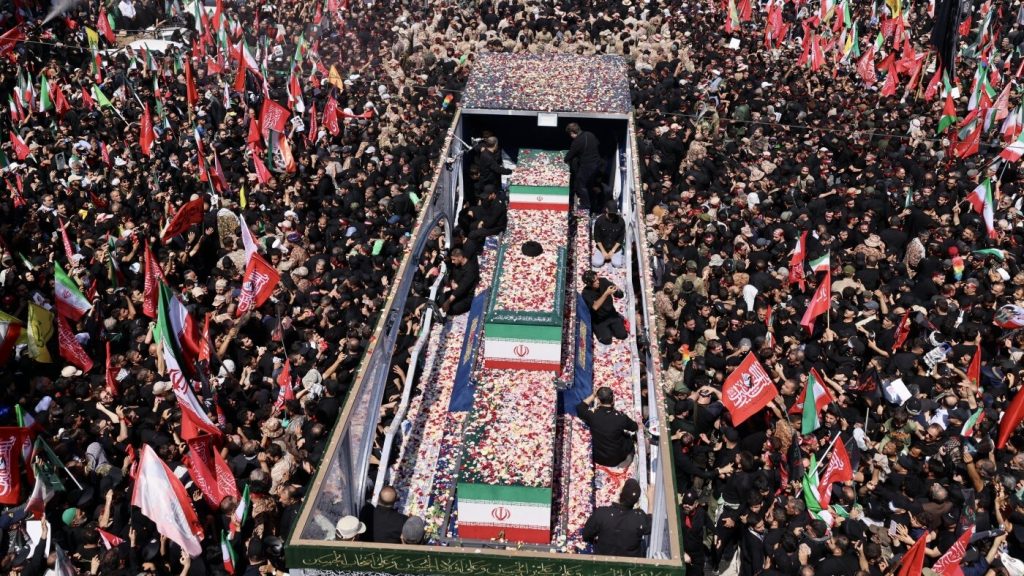
MASHHAD (Realist English). On July 10, in the northeastern Iranian city of Mashhad — sacred to Shia Muslims — Supreme Leader Ali Khamenei was buried. He was killed on February 28 in a joint US-Israeli strike.
The ceremony, which marked the end of a six-day marathon of mourning events, took place against the backdrop of ongoing military escalation between Washington and Tehran.
Khamenei’s flag-draped coffin was carried into the shrine of Imam Reza — one of the holiest sites in Iran. Thousands of mourners, many chanting slogans of revenge against Donald Trump, gathered outside the sanctuary.
The ceremony was attended by Parliament Speaker Mohammad Bagher Ghalibaf, Judiciary Chief Gholamhossein Mohseni‑Eje’i and the late leader’s eldest son, Mostafa Khamenei.
However, the central figure of the mourning — the new Supreme Leader Mojtaba Khamenei, the late ayatollah’s son — did not appear in public. Since his appointment, he has communicated with associates only through written statements and, according to some reports, was seriously wounded in the same strike that killed his father.
Two Days of Escalation: Over 170 Targets and Strikes on the Gulf
Khamenei’s funeral coincided with the peak of military confrontation. On the night of July 8, the US carried out its first massive strike on Iranian targets, followed by a second the next night. Over two days, US aircraft hit at least 170 military targets in Iran.
According to US Central Command (CENTCOM), the strikes targeted air defence systems, coastal surveillance facilities, missile and drone depots, naval facilities and logistics infrastructure along Iran’s coast. Washington said the operation was aimed at “degrading Iran’s ability to threaten freedom of navigation” in the Strait of Hormuz.
Iran’s Health Ministry reported 14 dead and 78 wounded from the US strikes, though other sources put the death toll at 17.
Iran’s Retaliatory Strikes: From Kuwait to Jordan
Tehran responded immediately. The Islamic Revolutionary Guard Corps (IRGC) struck US facilities and US allies in the region.
Targets included:
- A Patriot air defence system in Kuwait;
- An early warning station in Qatar;
- Fuel storage facilities in Bahrain;
- A command centre and air base in Jordan.
In Bahrain, home to the US Fifth Fleet headquarters, air raid sirens sounded several times. Kuwait reported intercepting three ballistic missiles, one cruise missile and ten drones. Jordan reported intercepting eight Iranian missiles.
According to US military officials, most Iranian missiles and drones were intercepted or caused no significant damage; there were no US casualties.
Collapse of the Ceasefire: A Memorandum That Lasted Three Weeks
The escalation has effectively ended the “Islamabad Memorandum of Understanding,” signed by the US and Iran on June 17. The document, brokered by Pakistan, provided for a 60‑day ceasefire and the launch of negotiations on a permanent peace agreement. However, just three weeks later, the sides returned to mutual strikes.
On July 8, at the NATO summit in Ankara, President Donald Trump declared that he considered the ceasefire “over.” “I think it’s over. I don’t want to deal with them,” the US leader said. At the same time, he acknowledged that negotiators could continue contacts, but called it a “waste of time.”
Reaction and Consequences
Iranian Parliament Speaker and chief negotiator with the US, Mohammad Bagher Ghalibaf, warned Washington: “If you strike — you will receive a response.” He also said that the Strait of Hormuz would only open on Iran’s terms, not under “American threats.”
Iran’s Foreign Ministry called the latest US strikes a “grave military crime” and the US administration “evil and psychopathic.”
Despite the escalation, diplomatic channels remain open. According to CNN, Pakistan and Qatar continue to work to bring the sides back to the negotiating table.
Ali Khamenei’s funeral, intended as a demonstration of the Iranian regime’s unity and continuity, took place in the shadow of two days of military escalation.
The absence of the new leader, Mojtaba Khamenei, from public view deepens uncertainty within the country, while the exchange of strikes between Washington and Tehran has effectively buried a peace process that lasted less than a month. Shipping through the Strait of Hormuz has come to a near standstill, and oil prices remain elevated.