


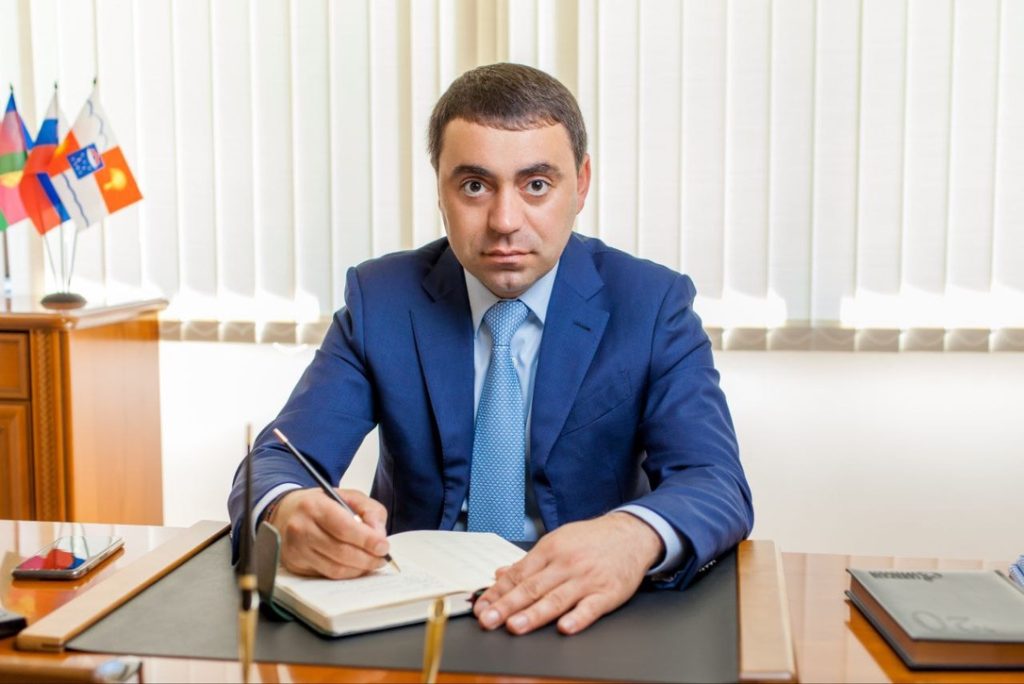
SOCHI (Realist English). Armenak Tozlyan is a deputy of the Legislative Assembly of the Krasnodar Territory, Deputy Chairman of the Committee on Healthcare and Social Protection.
A native of Abkhazia who experienced war in his youth, today he combines legislative work with active charity work and assistance to the front. A patriot of Russia and an Armenian by origin, Tozlyan tells Realist English in an interview about how his upbringing in a multinational environment shaped his worldview, why he considers Russian President Vladimir Putin an example of steadfastness and strength, and what it means for him to be a worthy son of his people.
You were born in Abkhazia, in a Soviet multinational country. How did the experience of living in an environment where Abkhazian, Armenian and Russian cultures intertwined influence your worldview?
Armenak Tozlyan: The main experience and upbringing I received during Soviet times and during the Abkhazian War is the value of people, respect for elders, and continuous connection with compatriots and like-minded people.
Even in my youth, this formed a certain core and potential: that the connection between generations cannot be lost, that one must always fight for justice without crossing any boundaries. Today these principles have been greatly eroded. Respect for elders is a simple thing, but without it we have nothing. No one will ever change my opinion on this matter.
Until the fifth grade, I studied at a Russian school in Abkhazia, and from the sixth grade onwards, I studied in Sochi, at School No. 28 in the Adler district. We could not pass by elderly people walking home with a heavy bag. It didn’t matter if it was on our way or not, we always helped carry the bag and gave up our seats on the bus. And I raise my children the same way.
The fundamental values for me are spirituality, family, not betraying, keeping one’s word, sometimes even when it is beyond your capabilities, when it concerns the state, some historical moments that today seem like just a task, but as time passes, you already look at them as part of history.
I am a volunteer of our great post‑Soviet history and modern Russia. Every grain, in the person of an ordinary citizen, regardless of their place of work, opportunities, status or position, must adhere to simple principled positions. If you can, help; if you can’t, don’t interfere. With this approach, there are no grey areas; everything is extremely clear: where a person can be useful and where they cannot.
Tell us about your most difficult period.
Armenak Tozlyan: This is the period of wartime from 1992 to 2000 in Abkhazia, when the border was closed for people of military age, and grandfathers, grandmothers and children had to cross it, to transport something, sell something, buy something – flour, sugar. And you know, I am proud that I remember this and experienced it, and I am not ashamed of it.
Today, in my position, I try to do everything so that when someone is having a hard time, when something is unclear to someone, I always explain, help, lend a helping hand. I think that only in consolidation with like-minded people can we achieve the goals we set for ourselves.
If we value what we have, take care of our own, create, consolidate society, not lose connection with our historical homeland, not make conclusions based on emotions, but always act with restraint and thoughtfulness, checking our steps – of course, this will bring more benefit. And I always call on people who want to do some good or have stumbled somewhere out of ignorance: you can always correct the situation.
There aren’t many of us. We are all different, we all have complex characters. People in a family sometimes cannot find a common language. What can we say about modern Russia and the post‑Soviet space – it is a big, fragile, complex job, but everything is gathered grain by grain. The course set by the Supreme Commander‑in‑Chief is based not on a simple desire, but on specific, well‑weighted conclusions and the challenges surrounding Russia. They treacherously duplicate information, give false information, misleading society that Russia is a country that attacks someone.
Russia does not attack anyone. I call things by their proper names. I know exactly what my ancestors laid down their heads for. My large family on my mother’s side: four brothers of my grandfather participated in the Great Patriotic War. They all laid down their heads for the peace in which we live, and they will never be forgotten. We will continue their work as long as our hearts beat. And no matter how hard anyone tries to distort our history, to mislead people, no one will succeed.
We are all very lucky with the President of the Russian Federation, who works with complete dedication, always in the ranks. And this further spurs us on to round‑the‑clock work that can bring at least some benefit to our great Motherland.
In the life of every politician, there comes a moment when he makes a fateful decision. What served as an internal turning point for you, after which you decided to run for the Legislative Assembly of the Krasnodar Territory?
Armenak Tozlyan: What I live for is constant responses to the appeals of citizens, our people, neighbors and friends. And this work was done by vocation. I started it long before I ran for deputy: I was elected to the regional assembly in 2022, and to the city assembly in 2015.
Once, at a more conscious age, I asked myself: “Why not? If I help my fellow citizens today, if they trust me with their votes, why not try to do more?” And indeed, it worked out, people trusted me, gave me such a credit of trust that I absolutely calmly won the elections. But it was not calm for me, because it was my first time, I was embarrassed to speak.
Public events were needed, because I was used to doing more. I’ll put it this way, I got to know people better. I learned to speak a little, but I began to do more. Being a deputy gave me more recognition, but also more responsibility.
This is a unique job that can bring benefit to your fellow citizens, now in the regional assembly. I have been working since 2022 in the Committee on Healthcare and Social Protection. Even more opportunities arise to bring benefit to people. We encounter different cases. It is easier to resolve issues that our citizens address.
Our people are very modest, almost everyone has everyday questions: somewhere electricity, somewhere gas, and somewhere more sports. We place great emphasis on sports, so that children are engaged, so that there are more places for leisure – sports clubs, sports schools, playgrounds. We have good results in Sochi, looking even at the past two years – both in Greco‑Roman wrestling and boxing.
We saw posts on social networks where you encouraged young people. Tell us about the case related to sports that you remember most.
Armenak Tozlyan: The boxer Andrey Peglivanyan is the one I remember most. He won bronze at the World Championships in Dubai and gold in Russia. With these results, Andrey brought his team forward. To be honest, I didn’t know him. But, it turns out, I helped him. Andrey first came to Sochi, then won in Yekaterinburg. I was in Moscow when they arrived on an official flight from Dubai. The whole team was in jackets, so beautiful! There was a ceremonial reception with the Russian Minister of Sports, then they came to see me. It is so inspiring: you become close in spirit to people, even though you rarely communicate.
I know almost all the coaches. We all grew up in the same city, I have constant contact with everyone. I am not the only one helping. All the worthy and caring guys help. When they go to various training camps, there is often a lack of funds. And we always try to cover this difference. And when they also achieve positive results, it inspires even more. Here, on May 26, another tournament ended. They write from there who won and how it went (shows correspondence on his phone and smiles).
And this is also an achievement of a common team result. We are doing not just some work with these guys, but we are trying to cover mainly issues that come down to finances. Every sports school has salaries. There is a fund where we transfer money, from which bonuses are paid to coaches so that it is not one‑sided to help someone.
Then the coaches of one or another sport themselves distribute the additional payments in equal proportions so that there is no division. On the contrary, there is consolidation. We try not to separate sports. I do not lead any section, I consider myself a volunteer.
I am a deputy from Sochi. This is the result I must work for – in the city, in the region, in the country. Apart from the fact that we have had a very difficult situation since 2022 – the special military operation is underway – I participate in logistics and supply processes. I don’t want to name numbers, but I will say that it is not food – it is drones, motorcycles, equipment. And at the beginning of 2022, we even taught the guys sniping. I bought Lobaev rifles, they are even engraved. I openly support the special military operation.
I am confident that it will be carried out to achieve its goals, and we must do everything we can for this. What exactly the goals are is up to the country’s leadership to decide. Today we must help and stand side by side with the guys – with continuous communication, to bring victory closer, to try as much as possible to preserve and save lives. And each of this help in real time has proven its relevance: when I equipped 25 Cossacks of the Khostinsky Cossack Society, those very helmets and body armor saved two lives.
The fighters were wounded. We were able to evacuate them quickly and deliver them to the Sklifosovsky Institute. The Russian Ministry of Health interacts closely with us and supports us. In particular, Deputy Minister of Health Andrey Plutnitsky, who oversees the new territories, reacts instantly and supports us – we are very grateful.
This saves the lives of the guys; speed is the most important thing. Difficult times give rise to strong people, while those who speculate on the situation are weeded out. What is the strength? In truth. Therefore, we did our work quietly, without exaggeration, and will continue to do it.
You are engaged in charitable activities and at the same time work on the social policy committee. How do you manage to combine targeted assistance to specific people with systematic legislative work in this area?
Armenak Tozlyan: When there is a desire to do good deeds, nothing can interfere. Besides this, I also run a business, and neither one nor the other interferes with either the quality of my legislative work or my ability to provide assistance. The only thing is that I would like to be in different regions, but I deny myself this, because I don’t have time to travel yet.
But I have assistants (some of them are fighting) who travel from the very first day, they keep their finger on the pulse, provide direct communication and provide targeted assistance. There has not been a single case where something did not arrive or arrived in the wrong hands. Everything is worked out.
If you had the opportunity to solve one social problem of the Krasnodar Territory with a single decision, what would you choose?
Armenak Tozlyan: Focusing on just one problem today – for a healthy person, it would probably be even ashamed of me.
In January 2026, you spoke out against attempts by the Yerevan government to interfere in the affairs of the Armenian Church. Why is the issue of the unity of the Armenian people, torn between different states, so acute for you today?
Armenak Tozlyan: From time immemorial, the Church in Armenia has remained the stronghold of the nation’s identity, and it has maintained its independence from the authorities. Therefore, if pressure is put on the Church by the authorities, we will always stand on the side of the Church. There has already been a practice that shows how it all begins: Western technologies, color revolutions, the split of society through the Church.
We are not afraid of this, no one will split us. But to say that the Church lives in the soul and not to stand by it is a correct self‑withdrawal. We must express our point of view. Let the government do its job, and the Church do its job. Those who meddle in the affairs of the Church must remember: you cannot confuse your job descriptions. The Church has lived independently for centuries and will live. We do not know another Church, so we will stand by it and protect its interests.
As a recognized political figure, a patriot of Russia and an Armenian, what advice would you give to young compatriots who are making their choice in life?
Armenak Tozlyan: I would give them advice to make their own choice. I want to wish them not to look at things short‑sightedly and one‑sidedly, and not to choose the situation in which they are good and “profitable” today. So that they analyze what this situation might lead to. Study international practice before making their choice or conclusion. Everyone wants to live well. But stable peace can only be long‑term with Russia.
We have no other history, and for me there will be no other. I advise you to think thoroughly, to look at the practice of other countries. What results do they get when they break historical ties – not only cultural and economic ones? We are all very close, I understand your question. Russia and Armenia are united by the Orthodox faith. No one will erase this history. All problems are temporary. And I don’t think anyone should be happy about it.
Where do you see yourself in the next five years?
Armenak Tozlyan: That’s a good question. The trust that my voters, people, friends, family, loved ones give me – at least to preserve it, so that I am not ashamed. And then as God wills – we don’t stand still, we work.
Who has been and remains an example for you in your life for many years? Who would you personally like to emulate?
Armenak Tozlyan: Vladimir Putin. I trust him. He doesn’t know me, but we know him. And we judge by his actions and the results of today. His stability. If someone doesn’t understand him somewhere today, time still passes, and the person understands why it was done this way today, because back then he did the right thing.
Of course, we cannot understand everything, because we don’t know everything. We clearly know specific things: the points we value – the Motherland, honor, the flag and the banner.
I grew up in Abkhazia. Both Abkhazia and Russia are in my heart. I grew up in Abkhazia, but I live in Russia. I achieved everything I have achieved in Russia. There is Mother Russia, who united us. I have no other home.
At the same time, I am an Armenian. Armenia is my historical homeland, which I love. Armenian blood flows in me, and in order to be a worthy son of my people, I intend to contribute to the normalization of relations between Moscow and Yerevan.