


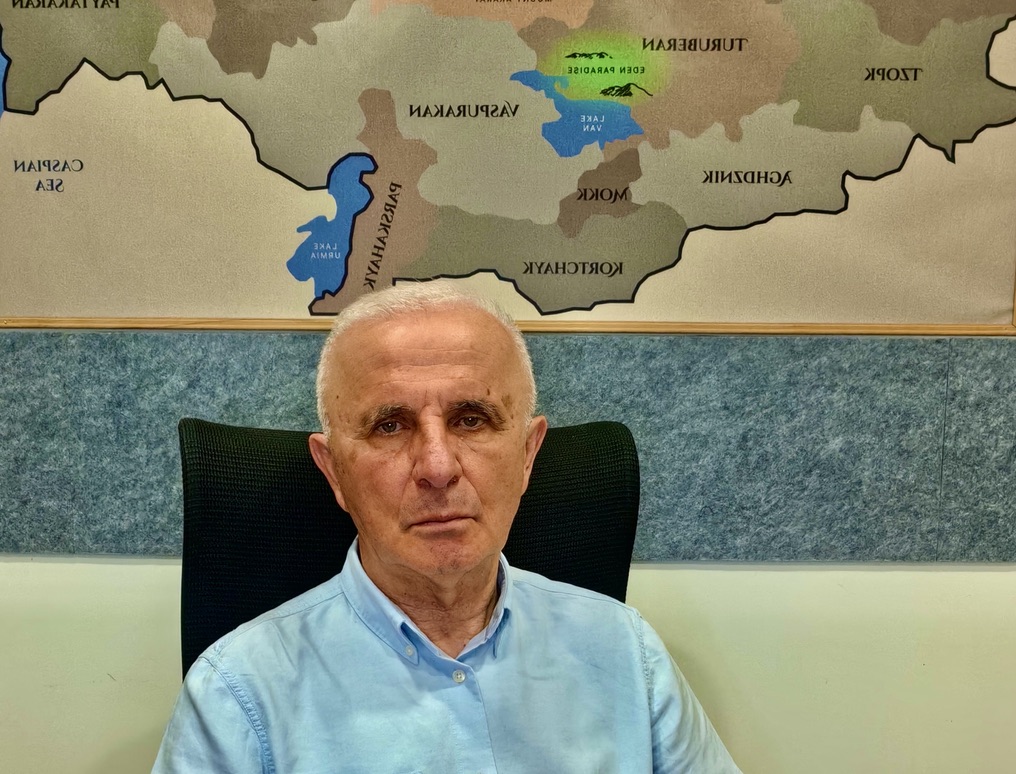
YEREVAN (Realist English). Levon Yepiskoposyan – Doctor of Biological Sciences, head of the Laboratory of Evolutionary Genomics at the Institute of Molecular Biology of the National Academy of Sciences of Armenia, a unique specialist in population genetics and paleogenomics.
For over thirty years, he has been studying the genetic history of the Armenian people, their roots and connections with their neighbors. In an interview with Realist English and the Basis News media platform, the scientist explains why Armenians are the indigenous (autochthonous) population of the Armenian Highlands, how wars and migrations have affected the gene pool, why attempts were made to hide genetic research results in Turkey, and what percentage of Turkic trace Turks actually carry.
A special place in the conversation was given to genetic closeness with Talysh, Kurds, Georgians, and Persians, as well as the role of Caucasian Albania in the ethnogenesis of the region’s peoples. The scientist also reflects on what is more important – the gene or the soul, and why people, being genetic brothers, often find themselves on opposite sides of the barricades.
Mr. Yepiskoposyan, is it possible to use genetics to establish the real area of habitation of a particular people?
Levon Yepiskoposyan: That’s a good question, because it concerns not only the modern population but also our ancestors. We cannot limit ourselves to studying only modern Armenians, wherever they live. We need data on ancient DNA – the genetic portrait of our ancestors.
The short answer is: yes, of course, it is possible. But for that, we need to study burials from various eras, both on the territory of modern Armenia and beyond it, which in their time were historical Armenia.
How well has modern Armenia been studied genetically?
We have something to be proud of here. Our entire region – Southwest Asia – has been studied unevenly. If we take the South Caucasus and Western Asia, the Armenian population is the most thoroughly studied. Without false modesty, this is our “fault”: we began research back in 1997, that is, 29 years ago.
During this time, our laboratory alone has studied about 7,000 DNA samples. And if we take into account other directions (services from companies in America and Russia – studies of Y-chromosome, mitochondrial DNA), their number has long exceeded 10–15 thousand.
What is special about the genetics of the Armenian people and its difference from its neighbors? I understand that we are all genetically related, but there must be something that distinguishes Armenians from neighboring peoples.
Despite our close proximity, we have genetic features. They accumulate for the main reason – isolation over centuries and millennia. Genetic isolation is also called reproductive isolation: marriages took place within the population, interethnic marriages were rare. Take the example of Armenians: they have a long history of living in the Armenian Highlands. In January 2025, a representative international team published an article in the leading journal on human genetics – the American Journal of Human Genetics.
We convincingly showed that Armenians are the aboriginal, autochthonous, indigenous population of the region and have lived here as a genetic community for several tens of thousands of years.
Please understand correctly: the people who lived here 8,000 years ago did not consider themselves Armenians, did not speak Armenian. But there is a continuity, a succession of residence of our ancestors. The international team proved 8,000 years of residence of our great-grandmothers (mitochondrial DNA) in this territory. For great-grandfathers (Y-chromosome) – about 6,000 years. Therefore, we have the right to say that our roots are autochthonous.
The widespread theory about the arrival of Armenians from the Balkan Peninsula has no scientific basis and should now be discarded, remaining only in history. We lived in this territory as a community, gradually forming our gene pool.
Historical data says that Scythians, Cimmerians, Turkic-speaking tribes, Romans, Greeks, Mongols, Arabs invaded here. Are there traces of their presence in the Armenian gene pool?
That is our task. To answer your question: the Armenian population differs from its neighbors because we lived in isolation for a long time. The reason is a separate language (Armenian, Indo-European family). Our neighbors: Iranians speak an Indo-European language (linguistic closeness); neighbors to the right and left speak Turkic; Georgians speak a Caucasian language.
The Turkic language has no deep roots in the region – it is at most a thousand years old. Before that, the peoples on the territory of modern Azerbaijan and Turkey spoke other languages. Genetically close will be those peoples that are geographically close. One should not be surprised at the closeness between the population of Armenia and the eastern regions of Turkey.
First, ancient roots; second – the main feature – Turkification and Islamization included a wide layer of Armenians. The first publication on this subject was by a Turkish graduate student in a Stanford laboratory in 2003.
And the genetic trace of the Turks in the Armenian Highlands – how long ago did it appear?
The invasion of Turkic tribes began roughly from the 10th–11th centuries. Isolated, sporadic raids earlier left no trace, even in records. In the Armenian Highlands and Western Asia, Turkic tribes appeared in waves over four to five centuries. These waves were not very massive, because the region experienced a demographic boom in the Bronze Age. The newcomers from Central Asia, in a genetic sense, dissolved.
The percentage of Turkic genetic elements in the gene pool of Iran’s population is 4–5%. These are data from the reputable company Ancestry, which has tens of thousands of samples on the population of Turkey. The data appeared two or three years ago and puzzled even the Turks themselves. In Armenia, according to our data (hundreds of samples, thousands for Y-chromosome), the presence of Turkic-speaking signals in the gene pool is 0.5%.
Despite prolonged presence, they left no noticeable trace. There is also no genetic trace of Turkic-speaking tribes in the Georgian population. In Iran (except for the northern part, where there is a Turkic belt) – also 4–5%. One of my graduate students from Iranian Azerbaijan investigated this issue: in northern Iran (South Azerbaijan) the figure reaches about 12%.
Compare: 12% in South Azerbaijan, 4–5% in Turkey and 0.5% in us. This indicates barriers and a striking rejection of influence. We can be proud: 8,000 years of continuity of the maternal gene pool, 6,000 years of the paternal gene pool. Let me add: beginning approximately from the Bronze Age, a large mass of population flowed into the Armenian Highlands from the Middle East.
The reason, possibly, was a strong earthquake in the area of present-day Israel and Lebanon (4th–3rd millennium BCE), which caused an outflow of population to the north. Exact figures: in the western part of the highlands this influence was about 45%, in the eastern part – below 30%. After the Bronze Age – the last three and a half thousand years – there has been no foreign influence on our gene pool. We have a genetically isolated Armenian population.
What is more important in your opinion: the soul or the gene?
I am not a specialist, but I am interested. The body – biology, genetics. The soul – ideology, culture, heritage. The soul is shaped by grandmothers’ lullabies, fairy tales, the fields and forests of childhood, mountains, villages. All this is important.
But we must take into account that we are all very close. The peoples in one territory are close. Several millennia ago we spoke one proto-language, and without borders people moved freely. Genetic disunity began to crystallize after the appearance of states. Unfortunately, people forget that they are genetic brothers, and wars begin because of ideological, spiritual, religious differences.
It pains me when genetically close people fight. Today we see this in the Middle East and Europe. The answer: cultural-ideological, spiritual difference prevails today. I would like people to look back and think about how genetically close we are.
There are many posts online that Turkey has banned genetic research highlighting the presence of the Armenian gene in Turks. What do you know about this?
This is a well-known fact. Three or four years ago, the company Ancestry published data showing that the Turkish gene pool is aboriginal, and the Turkic element is only a few percent. In Turkey, there is a site called the Turkish DNA Project with graphs and tables where results were fabricated without any scientific basis. The reality: 4–5% is the presence of the Turkic genetic layer in the gene pool of the Turkish people.
I say “Turkish” meaning that studies are usually conducted without indicating ethnic affiliation. The most famous work (Stanford, 2003, more than 500 donors) showed an average percentage of Turkic element in the male gene pool of about 7–8%. Samples were collected throughout Turkey, classified only by region. And we know that 100 years ago, the grandparents of the participants were certainly not only Turks but also Armenians, Yezidis, Kurds, Jews, Greeks. So 4–5% is the average for the country. There are isolated highland populations where the Turkic element can reach 15–20%, but no more.
After the Ancestry publication, the Turkish DNA Project removed all its graphs. Ancestry’s data are scientifically substantiated: under each result there are surnames and addresses. The incident occurred four years ago. And seven to eight years before that, archives were opened, and many learned that their ancestors were Armenians. There were even suicides – fanatical nationalists could not come to terms with Armenian blood.
To summarize: the modern population of Turkey is the result of the fusion of many ethnic groups. It carries approximately 4–5% of the Turkic genetic substrate. In serious science, there is consensus: genetic features do not determine ethnic identity. This must be accepted. Turkification and Islamization took place under threat of death, under the scimitar – this must be accepted as a historical fact, and the population of Turkey as a genetic one.
If genetically we are all brothers, then it is ideology that separates us?
In general, yes. Imagine: across the Araks River live people who consider themselves Kurds, Turks, Hemshils. But genetically they are the heirs of Armenians who lived there before the arrival of Turkic-speaking tribes or before Turkification and Islamization. In modern humanity, genetic identity is receding before political and ethnic identity. Two brothers, raised in different environments, will have different identities.
In 2017, an international team (including our laboratory) studied the genetic distances between 12 peoples of the region. It turned out that Armenians are genetically closest (by Y-chromosome) to the population living in the territory that fully corresponds to historical Armenia. This is a scientific fact published in a well-known journal with co-authors from Russia, England, Armenia, and the Middle East. The work is beyond doubt.
Did you mean Greater Armenia?
Yes, I meant Greater Armenia. Historical Armenia is where Armenians historically lived, first of all Greater Armenia (not Lesser Armenia, not Cappadocia). The contours of genetic closeness completely coincide with the contours of Greater Armenia.
Do Eastern Armenia and Western Armenia – these two parts of our homeland – differ genetically?
In the early Middle Ages, Armenia split into Western (under Byzantium, then Turkey) and Eastern (under Persia). There was isolation. Look at the language: there are differences in dialects. The longer the separation, the deeper the differences.
The most striking difference is between the Hamshen and Karabakh (Hadrut) dialects. Speakers may not understand each other. Genetically, thank God, this is not the case. It takes millennia and tens of millennia for differences to accumulate. Differences are expressed only in the frequencies of traits. In the Armenian population, there is no territorial group that is very different from others.
For example, Hadrut Armenians have more fair-faced, blue-eyed, fair-haired people. In other territories, darker eyes and hair. This difference is due to several genes. We have no African element (high curliness). Cilician Armenians lived in close contact with the Crusaders, and they should have left a trace. We are currently researching this element. Eastern Armenia turned out to be more “pure” from foreign genes. In the global Armenian population, the same mutations occur, just with different frequencies. The original core was in a certain territory, and then it grew throughout the Armenian Highlands.
Caucasian Albania has become an apple of discord. The Baku regime has appropriated it. To what extent can Azerbaijan consider itself its heir from a genetic point of view?
In genetics, we touch on many problems: ethnogenesis, migrations, contacts. One of the fundamental places is Caucasian Albania. Ancient authors say that it was a conglomerate of ethno-territorial formations on the left bank of the Kura River. This was even written in Azerbaijani textbooks of the 1960s. Today – a diametrically opposite interpretation. Ideology and politics come to the fore. Politics has always hindered science. The leadership of the neighboring country convenes the Academy of Sciences and gives the order to prove the “alienness” of Armenians. The only way to resist is through deeply scientific research. Before the appearance of national formations, people mixed freely. We see common roots of Armenians, Kurds, Yezidis, Georgians.
We have data on Udis – one of the constituent parts of the Albanian population of the South Caucasus. It is a pity that the participation of Udis in projects is being slowed down by the leadership of the neighboring state. They do not want to clarify the true picture. In Azerbaijan, there are no deep scientific projects on the gene pool – the political leadership is afraid that the gene pool will turn out to be indigenous.
Example: about 16 years ago, a dissertation on the genetics of Talysh was defended in Moscow. The researcher pointed out that Talysh are genetically closer to Armenians than to other ethnic groups of Azerbaijan. She received threats to her life, could not return, and received political asylum in Western Europe.
Some states are afraid of objective research. We have grounds to say that the Caucasian tribes – the conglomerate of Albania – participated in the ethnogenesis of the peoples of the South Caucasus. Indirect facts: today there are representatives of Albania – Christians and Muslims from the same people. Some adopted Christianity and became part of the Armenian ethnos, others, having adopted Islam, became part of the Azerbaijani ethnos.
What is the share of Albanian presence in the Armenian ethnos?
My rough estimates: 20–25% at the Y-chromosome level, maybe up to 30%. This is normal for prehistoric layers. There is also a small layer from historical times. Work remains to be done. It would be nice to do it together with Azerbaijani researchers, but that’s fantasy. There will be no cooperation: the instructions they receive are too deep, and they differ from those we do not receive, thank God.
Do you agree with the fact that Talysh are genetically closer to Armenians than to Azerbaijanis?
The Talysh turned out to be close because we are neighbors, and they have preserved their ethnic and genetic identity (“purity”). We, Armenians, have also preserved it. The deeper we go into the layers, the closer we become to our neighbors. The Talysh have a complete absence of Turkic trace. Therefore, we are genetically close. Nothing unusual. We are very close to Persians – a common genetic and linguistic tree.
Where there is a Turkic element, the differences are obvious. Armenians are an indigenous people, but not the only one. There are indigenous representatives in the South Caucasus, the Iranian Plateau, and the Middle East, but not all peoples are autochthonous.
Armenians belong to this number. If we take the South Caucasus, only a few peoples can count themselves among the indigenous ethnic groups of the region. I am convinced that the peoples that were part of the conglomerate of Caucasian Albania are also indigenous. We need to do a joint project of geneticists from Dagestan, Azerbaijan and Armenia to study the roots of the peoples of Caucasian Albania.
Maybe this is utopian, but with respect to Udis and Lezgins it is feasible. I very much hope that in the future I will be able to talk about the genetic connections of the Armenian population with Udis and Lezgins.