


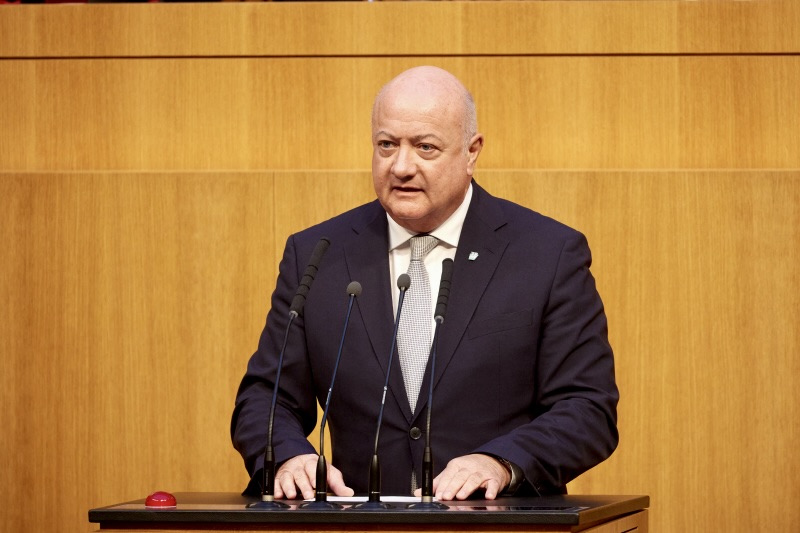
BRUSSELS (Realist English). Austrian Chancellor Christian Stocker has called on European leaders to seize the “momentum” around peace talks on Ukraine and step up efforts to resume dialogue with Russian President Vladimir Putin. In an interview with the Financial Times, he said he fully supports Brussels’ recent attempts to open channels of communication with the Kremlin.
In recent weeks, the European Union, through the office of European Council President António Costa, has established contacts with Russian authorities to explore the possibility of negotiations. Stocker called this step correct and urged his EU colleagues to support this line.
“I agree with that totally. Wars end not with weapons, but with successful diplomacy. And for diplomacy to be successful, you need conversations, you need negotiations, and those channels need to be opened first,” the Austrian chancellor said.
He noted that there is now “momentum” related to the ceasefire between the US and Iran, which had diverted US President Donald Trump’s attention from the Ukrainian conflict. “I am a little bit optimistic that if we find a solution in the Middle East, the focus will shift to Ukraine,” Stocker said.
Negotiation deadlock and European doubts
US-Russian talks on settling the conflict in Ukraine, which has lasted more than four years, have reached a deadlock. This is prompting European capitals to discuss whether to try to break the impasse. However, many leaders are deeply sceptical and argue that the EU should instead increase support for Kyiv and force Putin to negotiate through military defeats.
Stocker declined to comment on who exactly could represent Europe in dialogue with Putin, but stressed that more important than the “who” is the “what” that will be discussed.
“I would not know whether [EU leaders] all are in the same position already. But there is one position where we always had as a common position: that we are not supporting Ukraine to be able to fight an endless war. The result needs to be a just and lasting peace,” he said.
Pedro Lourtie, chief of staff to European Council President António Costa, held telephone conversations with a senior official close to Putin in recent weeks. According to an EU official, these were “brief contacts to open communication channels.” Stocker will attend an EU summit in Brussels on Thursday evening where Ukraine will be discussed. President Volodymyr Zelenskyy, who will address the summit, has endorsed the concept of opening channels to the Kremlin.
Resistance and Moscow’s position
European diplomats expect pushback from leaders sceptical of contacts, particularly those in Europe’s north and east. One senior diplomat involved in summit preparations described Costa’s efforts as “simply delusional.”
Capitals wary of engaging with Putin point to his hardline position: Moscow continues to insist on its goals. In February, Putin’s foreign policy adviser Yuri Ushakov rejected a French proposal for greater European involvement in peace talks. Russia says it remains open to dialogue but implies that Putin’s demands remain the starting point.
Ushakov told state television that Russia still has the upper hand on the frontline: “The Europeans are clearly insisting that the war must go on. They are under the completely incorrect and false impression that the situation on the battlefield is supposedly changing in favour of the Ukrainian forces, which is categorically incorrect.”
Stocker: ‘Neutrality does not protect’
Stocker, who took office in March 2025 at the head of a three-party coalition, has initiated a review of Austria’s traditional neutrality.
“Neutrality doesn’t protect,” he said. “The world changed, the challenge has changed. We need to be more prepared for defending ourselves. Austria will not be a blind spot in Europe where defence is concerned.”
Austria has joined the Franco-British-led “Coalition of the Willing” in support of Kyiv as an “active observer.” This involves participating in discussions on support for Ukraine and future European security arrangements while remaining outside any potential troop deployments.
According to Stocker, Austrians must understand that “we need to strengthen our armed forces and our defence capabilities.”