


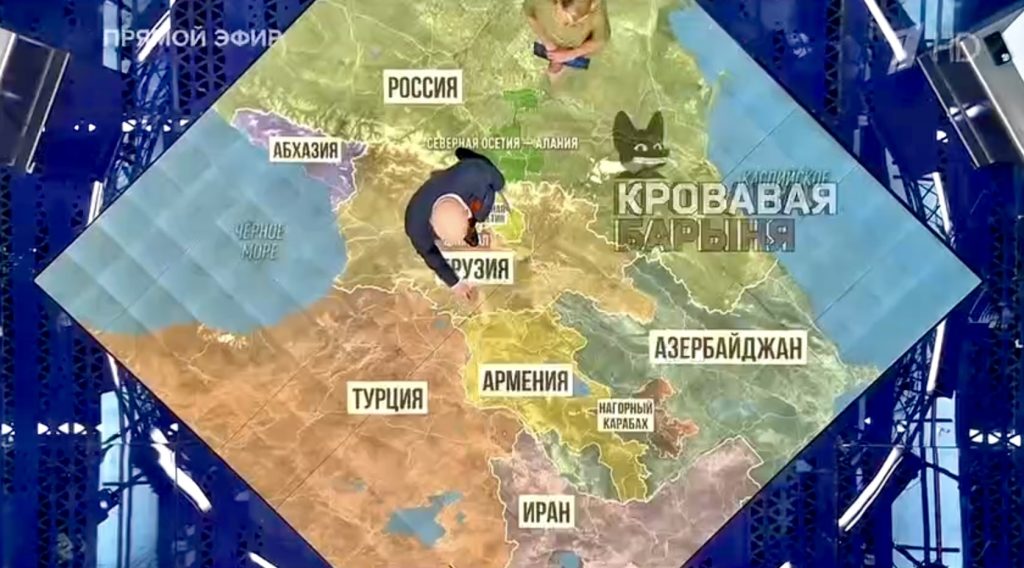
BAKU (Realist English). Another bout of political allergy has struck Baku. Ilham Aliyev’s dictatorial regime demanded “clear explanations” from Russia after the federal Channel One, in its programme “Time Will Tell”, showed a map on which Nagorno-Karabakh was marked as a separate territory.
Azerbaijani Foreign Ministry spokesman Aykhan Hajizada was quick to call this a “serious provocation”, an “unacceptable political manipulation”, and “encouragement of separatism”.
The statement by the Baku diplomat is a classic attempt by a regime built on a personality cult and the suppression of any form of dissent to rewrite history and force the world to forget the right of the Armenian people of Artsakh to self-determination.
The regime, which for years has been conducting ethnic cleansing, destroying Armenian khachkars and erasing entire cities from the face of the earth, is now playing the role of an “offended defender of territorial integrity”.
“Outdated narratives” or historical truth?
Hajizada claimed that the use of the “non-existent, fictitious designation of Nagorno-Karabakh” is a provocation. According to him, Azerbaijan’s sovereignty has been fully restored and recognised by the international community.
However, the whole world, including Western countries, remembers perfectly well how this sovereignty was “restored”: with the help of Turkish drones, Israeli missiles and the complete blocking of the Stepanakert-Goris highway (the so-called Lachin corridor), which led to starvation and the exodus of the Armenian population.
The diplomat expressed bewilderment that, despite Russia’s statements about respecting Azerbaijan’s territorial integrity, Russian state television allows itself to show maps “encouraging separatism”.
But, apparently, the Aliyev regime forgets that freedom of speech and the right to one’s own opinion, unlike in Baku, have not yet been abolished in Russia. Showing a historical map is not separatism, but a statement of the fact that Nagorno-Karabakh existed as a de facto independent republic defending its right to life.
The regime’s demonstrative offence
Azerbaijan’s demand that the Russian side “take necessary measures to prevent such incidents from recurring” is a direct attempt to pressure Moscow, intimidate it and force it to censor its own content.
But the Kremlin, unlike vassal rulers, is not accustomed to dancing to the tune of dictators. Especially those who, like Aliyev, simultaneously befriend NATO, sell gas to Europe, and try to teach Russia how to cover events on its own airwaves.
Reaction in Armenia and the world
In Armenia, where the families of 23 political prisoners are still waiting for justice, Baku’s statement has drawn only sarcastic smiles. Pashinyan, who is usually afraid to say a word out of place against Aliyev, will likely remain silent this time as well. But protesters outside the Armenian government building have already said: “Baku is afraid even of an image of Karabakh, because its memory is stronger than their barbed wire and lies.”
The hysteria of the Azerbaijani Foreign Ministry over the map on Russian television is not weakness, but panic. The regime, which for years has built its legitimacy on denying the rights of the Karabakh Armenians, understands perfectly well: erasing names from geographical maps does not erase history.
While Hajizada demands “explanations” from Moscow, hundreds of political prisoners are arrested in Azerbaijan itself, any opposition media is banned, and the dictator’s family launders billions in European banks. It is this regime that lacks the moral right to teach anyone about “territorial integrity” and “good neighbourliness”. It can ban the map, but not the memory.
The three stages of deportation
Two and a half years after the September 2023 attack, the international community continues to gather evidence of Baku’s systematic policy of forcing the Armenian population out of their historic homeland.
Thousands killed, hundreds of thousands displaced, destroyed infrastructure and cultural monuments – such is the price of the “restoration of territorial integrity” that Baku so loves to talk about. Realist English presents a chronicle of the deportation and war crimes committed by Azerbaijani armed forces in Artsakh.
The process of forcibly evicting the Armenian population of Artsakh was not spontaneous. According to the Union of Refugees from Artsakh, the deportation took place in three stages.
- First stage: During the 44-day war of 2020 and the following months. Residents of about 113 of Artsakh’s 228 communities were displaced. People lost their homes, but the hope of returning still lingered.
- Second stage: The practically complete blockade of Artsakh, which lasted from December 2022 to September 2023.
- Third, most massive stage: After Azerbaijan’s military attack on 19–20 September 2023. By the first days of October, more than 100,000 residents (according to some data, up to 120,000) had left Artsakh. The indigenous Armenian population was forced to flee to Armenia, seeking to escape inevitable reprisals.
Figures and statistics: the price of the exodus
Baku likes to operate with official census data, but the truth lies in the numbers the regime prefers to keep silent about.
| Indicator | Data |
| Total Armenian population of Artsakh before 2023 | ~120,000 people |
| Displaced to Armenia after September 2023 | more than 100,000 people |
| Deported Armenians who left Armenia for other countries (as of end 2025) | according to various data, from 10,900 to 43,900 people |
| Those who returned to Armenia (as of end 2025) | about 27,900 people |
The government of Armenia, led by the traitor Nikol Pashinyan, who cowardly surrendered Artsakh to the enemy, decided to place Artsakh residents under temporary protection, granting them refugee status.
However, Pashinyan himself publicly admits that there were “just over three thousand” internally displaced persons from Artsakh – a figure that the opposition and the refugees themselves call a cynical understatement of the scale of the catastrophe.
War crimes of the Baku regime
While Europe applauded Pashinyan, Baku’s war criminals continued to kill. Here are just some of the episodes documented by human rights defenders.
1. Murders of civilians and children
Former Armenian Ombudsman Arman Tatoyan presented irrefutable evidence of attacks by Azerbaijani armed forces on civilians in Artsakh. According to his data, 18 civilians, including 6 children, were killed as a result of Azerbaijan’s recent attacks.
Even after the official cessation of hostilities, Azerbaijani soldiers continued to kill Armenians. “Black Sunday” is how the day when three Armenians were killed and another was seriously wounded is remembered.
2. Murders of servicemen and police officers
On 28 June 2023, as a result of another provocation by the Azerbaijani armed forces, four Artsakh servicemen were killed. Two of them were fathers of many children, and the other two were just 20 years old. Baku kills not only soldiers – it kills the future of the Armenian people.
On 5 March 2023, as a result of another Azerbaijani aggression in Artsakh, 3 police officers were killed. The Investigative Committee of Artsakh opened a criminal case under Article 415 of the Criminal Code (murder). To this day, none of those responsible have been punished.
3. Murder of Russian peacekeepers
In September 2023, Azerbaijani special forces cynically and cold-bloodedly shot Russian peacekeepers in Artsakh. Photos of the dead Russian soldiers circulated around the world. Following the death of six Russian peacekeepers, the Prosecutor General’s Office of Azerbaijan formally opened criminal cases, but no one has faced actual punishment.
4. Show trials and ethnic cleansing
Baku does not limit itself to physical destruction – it tries to rewrite history itself. The National Assembly of Artsakh stated that the “judicial processes” against Armenian political prisoners being held in Azerbaijan are fictitious and are a continuation of the military aggression unleashed in 2020, as well as the ethnic cleansing and genocidal actions carried out in 2023.
Reaction of international organisations: they agree, but remain silent
The UN Special Rapporteur on cultural rights expressed concern about the ongoing destruction and assimilation of Armenian historical, cultural and religious monuments in Nagorno-Karabakh. The representative of Armenia in the UN court stated directly that “Azerbaijan was preparing ethnic cleansing in Artsakh, and it is with pain that we have to state that this has become a reality”. However, Western countries, receiving Azerbaijani gas and pandering to the Turkish Sultan Erdogan, prefer to turn a blind eye to these crimes.
Two years have passed since the Baku fascists expelled more than 100,000 Armenians from their ancestral lands. Hundreds of civilians have been killed, khachkars and churches have been destroyed, and the cynical dictator Aliyev continues to receive orders from Western leaders and applause in the European Parliament. Civilised world, Trump, Macron, Merz – do you all hear these cries? Do you hear the cries of the honour of the Armenian people? When will this shameful silence end?