


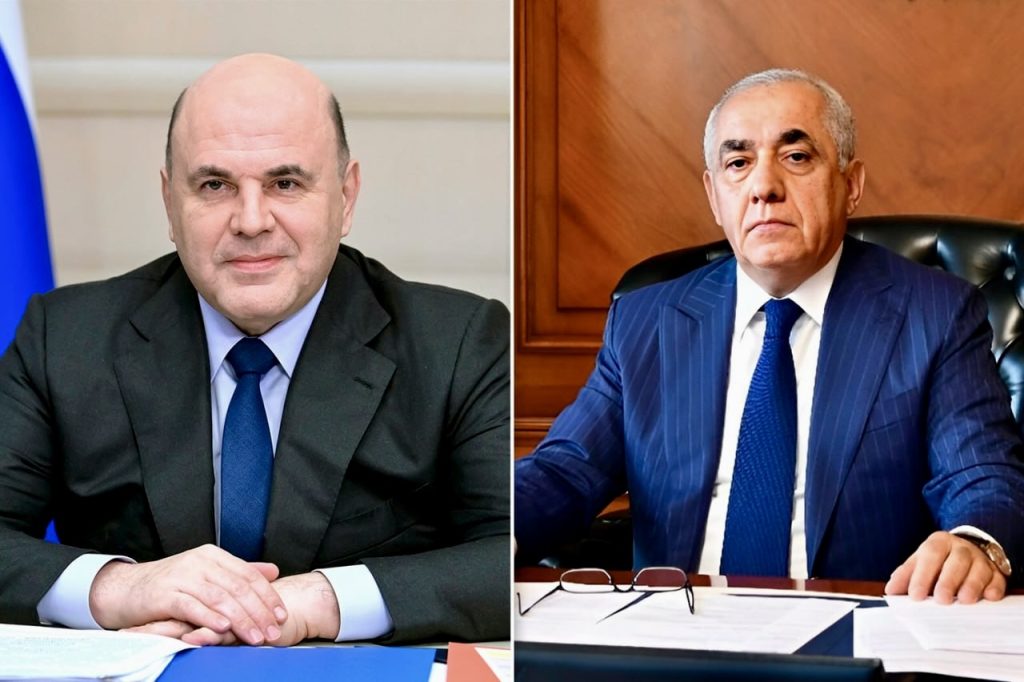
BAKU (Realist English). Russian Prime Minister Mikhail Mishustin and Azerbaijani Prime Minister Ali Asadov held their second round of talks within a week. Their latest telephone conversation took place on May 26, following discussions held on the sidelines of the CIS Council of Heads of Government meeting in Ashgabat on May 22.
“Building on the contacts held during the CIS Council of Heads of Government meeting on May 22, 2026, in Ashgabat, Mikhail Mishustin and Ali Asadov discussed current issues of Russian-Azerbaijani trade, economic, scientific, technological, and cultural-humanitarian cooperation,” the Russian government said in a statement.
Particular attention was given to the implementation of major joint projects in industry, energy, transport infrastructure, and the digital economy, especially the development of the North–South International Transport Corridor.
Economic shift: Russia losing ground
Moscow’s proclaimed “strategic partnership” with Azerbaijan continues to face increasing challenges. Over the past month, Baku has accelerated efforts to deepen relations with Western countries and Ukraine, while reducing certain areas of economic interaction with Russia. Moscow, for its part, continues to stress the importance of allied ties but has shown limited influence over these developments.
According to Azerbaijan’s State Customs Committee, bilateral trade declined sharply in the first quarter of 2026:
- Trade turnover with Russia fell by 47.8% to $746.8 million, compared with $1.431 billion a year earlier;
- Russian exports to Azerbaijan dropped by 56.3%, from $1.198 billion to $523 million;
- Russia moved from second to fourth place among Azerbaijan’s largest trading partners, accounting for 7.94% of total foreign trade, behind Italy, Turkey, and China.
At the same time, Russian Ambassador to Azerbaijan Mikhail Yevdokimov stated on May 26 that total trade turnover “has approached $5 billion.” Analysts note, however, that the overall scale of economic interaction remains relatively modest compared to the size of the Russian economy.
Aliyev and Zelensky: expanding cooperation
One significant development was the visit of Ukrainian President Volodymyr Zelensky to Azerbaijan on April 25. In Gabala, the parties signed six agreements covering security, energy, and industrial cooperation. The visit marked Zelensky’s first trip to Azerbaijan since the start of the military conflict.
Areas of cooperation discussed included:
- cooperation in unmanned aerial systems and defence industry projects;
- energy support from Azerbaijan’s SOCAR, including fuel supplies to Ukraine;
- possible diplomatic initiatives involving Baku as a venue for negotiations.
Publicist Mikhail Shakhnazarov previously described the perception of Azerbaijan as a strategic partner of Russia as “reckless,” pointing to diverging geopolitical interests. Diplomat Mikhail Demurin has also expressed criticism of Russia’s policy toward Azerbaijan.
Military cooperation: dialogue and diversification
In early April, Defence Ministers Zakir Hasanov and Andrei Belousov discussed prospects for military-technical cooperation. At the same time, Azerbaijan has continued expanding partnerships in other directions.
According to various analysts:
- Azerbaijan is increasing cooperation with Turkey and Western institutions;
- discussions continue around regional transport initiatives, including the so-called Zangezur Corridor;
- the country’s foreign policy is becoming increasingly multi-vector.
The Vardanyan issue and Moscow’s response
The case of Ruben Vardanyan remains a separate topic of debate. Critics of Russian policy argue that Moscow has not used all available political mechanisms to defend its interests and support its partners.
Conclusion: a changing balance in the South Caucasus
Recent developments point to an ongoing transformation of the political landscape in the South Caucasus. Azerbaijan:
- is expanding engagement with a wider range of international partners;
- is diversifying its economic and political relationships;
- is pursuing an increasingly independent foreign policy.
For Russia, these trends may require adaptation to a changing regional environment and the search for new approaches to cooperation in the South Caucasus.