


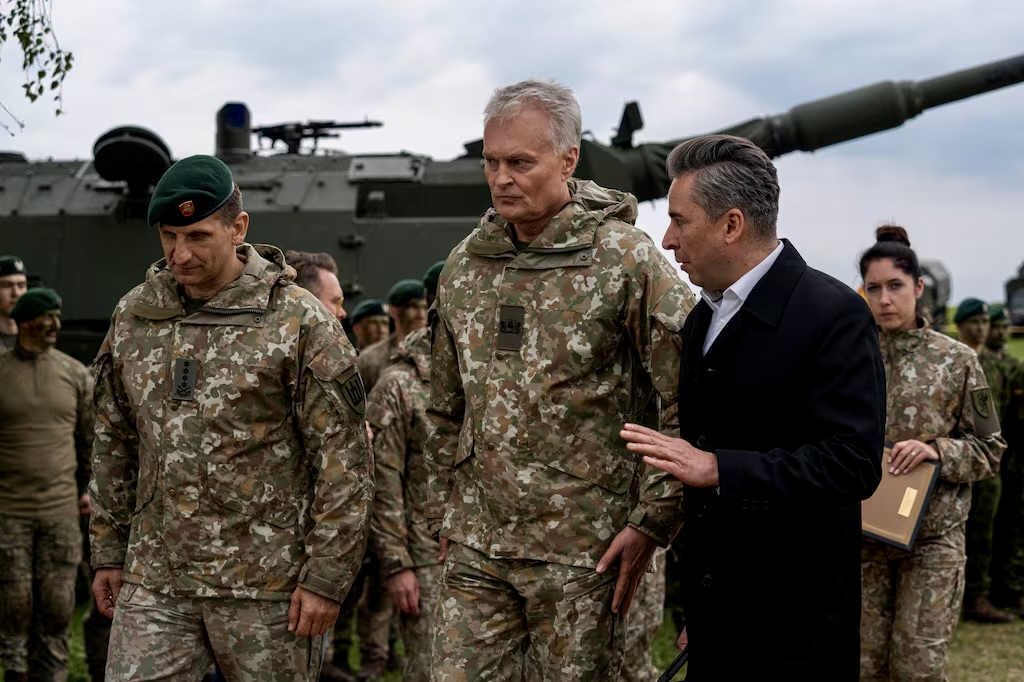
VILNIUS (Realist English). Estonia, Latvia and Lithuania are preparing to spend approximately €12.2 billion ($14 billion) from the European Union’s “Security Action for Europe” (SAFE) programme on new weapons, equipment and ammunition. The first contracts are expected to be signed in the coming weeks.
At the same time, officials from the Baltic states insist that a significant portion of production must be located directly on their territory.
Priority is given to full or partial technology transfer rather than purchasing off‑the‑shelf products. This was stated by participants at the DAIMEX Baltic conference, held on 12–13 May 2026 in Vilnius.
Lithuania: €6.38 billion for tanks, IFVs and ammunition
Speaking at the opening of the conference, Lithuanian President Gitanas Nausėda stressed that Russia’s ongoing invasion of Ukraine has prompted Vilnius to actively attract investment from foreign defence companies.
Lithuania intends to build up its own production capacity to ensure supplies for its army in the event of an armed conflict, as well as to integrate the national defence industry into international supply chains.
Lithuania has been allocated €6.38 billion in SAFE loans. The bulk of the funds will be used to purchase tanks, infantry fighting vehicles and ammunition from European suppliers.
Nausėda noted that Lithuania has managed to attract significant foreign investment:
- Rheinmetall has chosen Lithuania for regional ammunition production.
- KNDS France and KNDS Germany will carry out assembly and maintenance of military equipment.
“The war in Ukraine has shown that industrial capacity is also battlefield capacity. The factory floor and the frontline are now part of the same equation,” Nausėda said. “Lithuania, together with Latvia, Estonia, Poland and Finland, forms NATO’s first line of defence on the eastern flank.”
Vincas Jurgutis, chief adviser at the Lithuanian Defence and Security Industry Association, explained that a special law was adopted in 2024 to simplify procedures and encourage partnerships with foreign companies.
Latvia: €3.5 billion for drones and air defence
Latvia has received €3.5 billion under the SAFE programme. Priorities include the procurement of unmanned aerial systems (UAS), anti‑drone systems and missile systems, largely determined by the lessons of the war in Ukraine.
Artis Pabriks, chairman of the Latvian Military Technology, Drone and Robotics Association and former defence minister of Latvia, said: “Unmanned systems and robotics provide us, as a small country, with asymmetric power. In cyber‑defence, both small and big countries can generate equal damage. The same goes for drones – they are cheap but effective. Our second priority for SAFE is air defence. We are learning the lessons from the war in Ukraine, but also from the Middle East, and we know we need to cover our skies with multi‑layer defences.”
Estonia: €2.34 billion, HIMARS and the “Drone Wall”
Estonia, which has secured €2.34 billion under the SAFE programme, recently decided to put on hold its planned procurement of infantry fighting vehicles and instead redirect funds toward purchases of UAVs, counter‑drone measures and air‑defence systems.
At the same time, Tallinn is moving forward with the selection of a new missile defence system. A choice is expected in the coming months between US, European and Israeli offers.
In addition, in March 2026, Estonian authorities announced that in connection with the purchase of HIMARS rocket systems, Lockheed Martin will open a local maintenance facility under an $11 million investment.
Miiko Peri, head of the Defence Industry Development Department at Estonia’s Ministry of Defence, said that the three Baltic states intend to pool their resources and strengthen the defence of the eastern flank through joint projects such as the “Baltic Drone Wall”.
The Baltic republics, positioning themselves as NATO’s “first line of defence”, are feverishly rearming using cheap European loans. The paradox is that while spending billions on weapons, they remain completely dependent on external suppliers – Rheinmetall, KNDS, Lockheed Martin.
The creation of the “Baltic Drone Wall” and local service centres is a step forward, but true technological independence remains as distant as peace with Russia.