


MOSCOW (Realist English). The Bank of Russia at its meeting on June 19 cut the key rate from 14.5% to 14.25% per annum. This is the ninth consecutive cut, but the easing step was the most modest of the entire cycle — just 25 basis points instead of the 50 the market had expected.
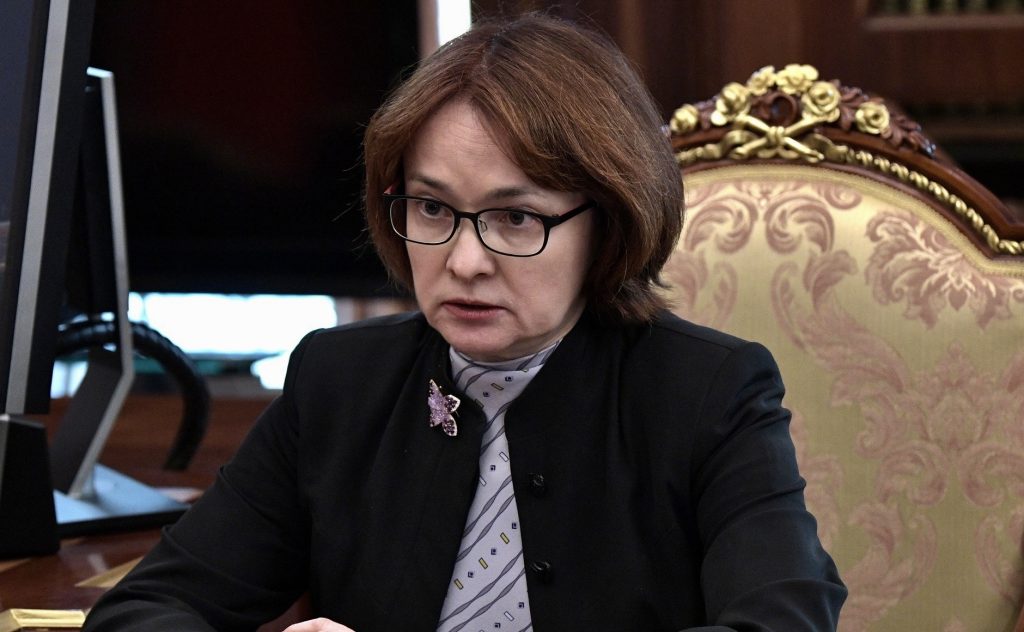
Central Bank Governor Elvira Nabiullina, who returned to public work after a two‑week absence, named the main reasons that prevented the regulator from taking a more decisive step: the budget deficit, rising gasoline prices and accelerating lending.
Why Only 0.25%: Three Restraining Factors
Speaking at a press conference following the board of directors’ meeting, Nabiullina explained that the regulator chose the minimum step because “inflationary risks for the future have increased noticeably” and “budget policy over the next three years will be more stimulating than was embedded in the baseline forecast.”
Key factors that held the Central Bank back:
Budget deficit. As of June 16, the federal budget had received 15.5 trillion rubles in revenues against expenditures of 22.82 trillion rubles. The current deficit reached 7.3 trillion rubles against an annual plan of 4.5 trillion. In January–May, oil and gas revenues fell by a third due to low energy prices and the strengthening of the ruble. Finance Minister Anton Siluanov had previously stated that a return to a zero structural deficit was not expected before 2029.
Rising gasoline prices. The surge in retail fuel prices, according to the Central Bank, will inevitably accelerate inflation in June. “The increase in gasoline prices may also affect inflation expectations, as it is a fairly sensitive commodity for both people and companies,” Nabiullina explained.
Accelerating lending. The Bank of Russia noted a “significant acceleration in lending growth” — both corporate and retail. From the regulator’s point of view, it is appropriate to respond with rate cuts to a slowdown in lending, not to its acceleration.
Annual inflation as of mid‑June, according to the Central Bank, stood at 5.6%. At the same time, underlying inflation, according to the regulator, slowed to 4–5% on an annualised basis. The forecast for 2026 remains at 4.5–5.5%.
Nabiullina’s Return and Resignation Rumours
The June 19 press conference was Nabiullina’s first public appearance after a two‑week break that had sparked active rumours in business circles. Earlier, she had missed the St. Petersburg International Economic Forum and a number of other events. The Bank of Russia explained this as a “severe respiratory infection.” At the press conference, the governor said she had lost her voice due to a cold.
When asked about a possible departure after her term expires, Nabiullina replied succinctly: “The answer to the last question is very simple: I am already on my third term.” She was reappointed for a third term in April 2022; her term expires in June 2027. By law, this is her last term — the Central Bank governor cannot serve more than three consecutive terms.
Earlier, the media had named Deputy Head of the Presidential Administration Maxim Oreshkin and Promsvyazbank head Pyotr Fradkov as the main candidates to replace Nabiullina. However, no official statements about a possible replacement have been made.
Rising Cash Demand and AI Experiments
Nabiullina also commented on the growing demand for cash: “We do see that there is demand for cash, and it has increased. It is quite difficult to separate one reason from another — these include tax adjustments and occasional difficulties with non‑cash payments.” At the same time, she stressed that this does not affect inflation or monetary policy.
Central Bank Deputy Governor Alexei Zabotkin clarified that the share of cash in the money supply had risen only slightly — from 14% to 14.4%.
In parallel, the Bank of Russia, together with one of the major banks, is testing data exchange for the development of artificial intelligence models, anti‑fraud systems and risk assessment. The testing is taking place within the Central Bank’s regulatory “sandbox.” Based on the results, the regulator will formulate proposals for interdepartmental discussion. Earlier, the Central Bank had put forward the idea of creating “trusted platforms” for information exchange between financial market participants.
Expert Opinions on the Central Bank’s Decision
The minimal easing came as a “negative surprise” to the market.
- Konstantin Ordov, Director of the Higher School of Finance at Plekhanov Russian University of Economics, noted that the Bank of Russia “hasn’t been so stingy for a long time.” In his view, with a rate of 14.5%, a cut of 0.25% “is more of a hold,” and in conditions where inflation is declining and the economy needs support, such a step “could be perceived as a tightening of monetary policy.” Ordov also warned that the minimal cut could force businesses to revise their plans downward.
- Andrey Barkhota, a candidate of economic sciences and financial market expert, told IA Regnum that the small cut in the key rate “will have almost no effect on loans,” since many banks had already been cutting rates on loan programmes in anticipation.
- Oleg Buklemishev, Director of the Centre for Economic Policy Research at Moscow State University’s Economics Faculty, noted that the Central Bank “expressed somewhat more concern about existing risks than the market had expected.”
- Analysts at SberInvestments forecast that in July the cut could again be 25 b.p., and in September the regulator could return to a 50 b.p. step. Thus, by the end of the year, the rate could fall to 12.5% per annum.