


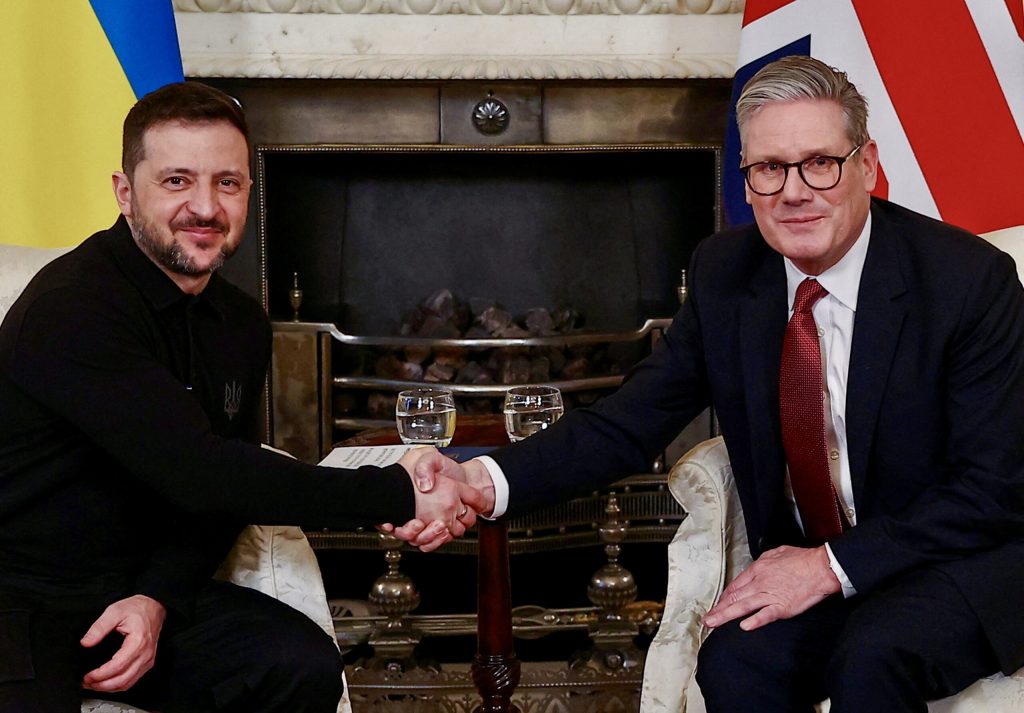
YEREVAN (Realist English). Britain begins formal talks on Monday 4 May on participating in an EU‑led €90 billion loan scheme for Ukraine. London and Brussels are seeking closer defence coordination in the face of security threats from US President Donald Trump.
Meeting in Yerevan: loans, youth and start‑ups
British Prime Minister Sir Keir Starmer and European Commission President Ursula von der Leyen will discuss the loan for Kyiv, steel industry cooperation, youth mobility and a start‑up financing initiative. The meeting will take place in Yerevan on the sidelines of the European Political Community summit.
Before the meeting, the British Prime Minister said that when London and Brussels work together, “we all reap the benefits.” In volatile times, he said, “we need to go further and faster on defence to keep people safe.”
Aid to Ukraine and British industry
The loan scheme talks are aimed at “ensuring that Ukraine gets the equipment it needs to defend its freedom, while driving opportunities for British industry to play its full part.” Starmer called for deeper defence and security cooperation between the UK and the EU back in February 2026, in response to the deteriorating geopolitical situation and Trump’s threats to NATO, including his doubts about the alliance’s mutual defence clause.
Key parameters of the loan
Starmer and von der Leyen see the loan agreement – under which the UK would cover part of the interest costs – as a key deliverable ahead of an EU‑UK summit scheduled for late June or early July 2026.
In February 2026, EU member states agreed to include British companies among those eligible for military procurement contracts to supply Kyiv. The move gives Ukraine flexibility to purchase the weapons it needs for the war effort. The measure was a victory for a group led by Germany and the Netherlands, which pushed for third‑country participation under certain conditions, overcoming opposition from France.
Allocation of funds
Ukraine intends to use €60 billion of the loan to buy military equipment, with the remaining €30 billion allocated to budget support. Under the terms agreed by the EU this spring, Kyiv may use the funding to procure from countries such as Britain and the US if certain types of weapons are unavailable within the bloc or if lead times are significantly shorter.
London’s position
Downing Street said London insists on participating in covering the loan’s interest costs – estimated at about €20 billion over seven years – on an equal footing with EU countries. This is necessary to ensure that British defence companies have greater access to the large contracts being signed by Ukraine.
Officials are keen to avoid a repeat of last year’s negotiations over the UK’s participation in the €140 billion EU loans‑for‑arms scheme, which were marred by public haggling over the cost of London’s involvement.
Related topics and context
This week, Britain will also unveil new sanctions against Russian companies contributing to Moscow’s military operations in Ukraine, as part of further efforts to support Kyiv in the conflict, now in its fifth year.
In Yerevan, Starmer and von der Leyen will continue discussions on a proposed “youth exchange” scheme that would allow young people to study and work on both sides of the English Channel, as well as a proposal for the UK to participate in an EU‑led start‑up financing programme. The leaders will also discuss measures to align policies on steel producers to better compete with supplies from China.
Trump’s threats to impose additional trade tariffs on Britain are fuelling the UK government’s desire to strengthen ties with the EU, almost a decade after the Brexit referendum, officials said.
At the European Political Community meeting on 4 May, Starmer will also discuss the situation in the Middle East with partners. The British Prime Minister’s visit to Armenia is the first in more than a quarter of a century, following a trip by Conservative leader Margaret Thatcher in 1990.
Total European Union support to Ukraine from the start of Russia’s full‑scale invasion in February 2022 to the end of 2025 reached €193 billion, according to European Parliament data. One third of this amount – €69.3 billion – was military assistance.
With the €90 billion loan approved by the EU in April 2026 for 2026–2027, the overall volume of support (both already delivered and pledged) rises to €283 billion. Interest payments on the loan are not included in this figure. According to European Commission estimates, they will amount to about €1 billion in 2027 and will reach €3 billion per year from 2028 onwards.
As of early February 2026, total military support from the EU and its member states was estimated at €69.3 billion.
The United Kingdom has allocated £21.8 billion (approximately €25.4 billion) to Ukraine since February 2022. Of this, £13.06 billion (≈€15.2 billion) was military aid, while £5.3 billion (≈€6.2 billion) was non‑military support, including humanitarian and budget assistance. Altogether, British support is approaching €30 billion. London’s annual spending on military aid to Ukraine is at least £2.3 billion (about €2.7 billion).