


LONDON / PARIS (Realist English). Amid the failure of US-Iran talks and Donald Trump’s announcement of a naval blockade of the Strait of Hormuz, Britain and France have announced an alternative approach.
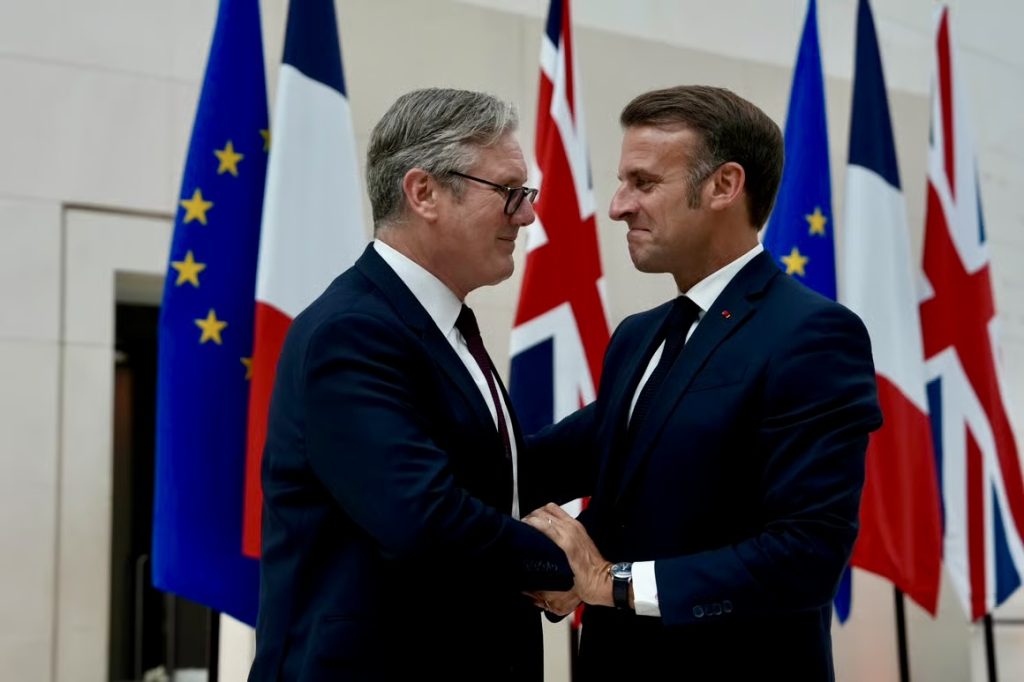
On April 13, UK Prime Minister Keir Starmer and French President Emmanuel Macron said their countries would host a summit to discuss a “peaceful multinational mission” to ensure freedom of navigation in the strait.
“Strictly defensive mission” separate from the blockade
Macron stated that the upcoming conference would bring together “countries prepared to contribute alongside us to a peaceful multinational mission aimed at restoring freedom of navigation in the strait.”
According to him, this mission would be “strictly defensive, separate from the warring parties to the conflict,” and would be deployed “as soon as circumstances permit.” Starmer, for his part, confirmed that Britain had already convened “more than 40 nations who share our aim to restore freedom of navigation,” and the upcoming summit would discuss ways to protect shipping “when the conflict ends.”
Britain will not support Trump’s blockade
In an interview with BBC Radio 5 Live on April 13, Starmer explicitly stated that Britain would not join the blockade announced by Trump. “We’re not supporting the blockade,” he said. “It is, in my view, vital that we get the strait open and fully open, and that’s where we’ve put all of our efforts in the last few weeks and we’ll continue to do so.”
The prime minister noted that Britain had minesweepers in the region, and while he could not discuss operational matters, the military capability was “focused from our point of view on getting the strait fully open.” Starmer also stressed that Britain was facing pressure to join the war, but he would not do so without a “clear lawful basis” and a “clear thought-through plan.”
Trump’s blockade and the European alternative
On April 13, US Central Command (CENTCOM) began operations to block all vessels entering or leaving Iranian ports. Trump wrote on his Truth Social platform that “other countries will be involved with this Blockade,” but did not specify which ones. However, the London-Paris initiative, announced on X, is clearly an alternative to the American approach. Earlier, on April 2, a UK-led diplomatic meeting of some 40 countries demanded “the immediate and unconditional reopening” of the vital shipping route.
Thus, amid the failure of talks in Islamabad and Washington’s escalation, European powers are trying to forge their own path to reopening the strait, without joining Trump’s unilateral actions.
Personal insults and threats from Trump
Trump’s reaction was immediate and extremely harsh. In a series of posts on Truth Social, he lashed out at the allies with unprecedented criticism: London was told: “Gather some of that belated bravery, get into the Strait and just TAKE IT.” Paris was accused of denying overflight rights: “France has been VERY UNHELPFUL.” A key threat was directed at the entire alliance: “You’re going to have to learn to defend yourself, the US will no longer be there to help you.” Personal attacks also targeted Prime Minister Keir Starmer, whom Trump characterized as “no Winston Churchill.”
Transatlantic rift
Since the start of the US-Israeli military campaign against Iran in late February 2026, the transatlantic alliance has been experiencing the deepest crisis in its 77-year history. While Washington demanded unconditional support from its allies, France and Britain not only refused to participate in the fighting but also publicly opposed American strategy, proposing their own plan to resolve the crisis.
The sticking point was the lack of authorization for the military operation. Macron called the actions of Washington and Tel Aviv “outside international law” and said Paris could not approve them. London took a similar position, stressing that it had not been informed of the strike plans.
The practical consequences of this stance included unprecedented restrictions on the use of military infrastructure: France refused to allow US military aircraft bound for the Middle East to use its airspace; Britain allowed its bases to be used only for defensive missions, excluding participation in offensive operations.
The current crisis differs significantly from previous disagreements (for example, over Iraq in 2003). At that time, Europeans argued over methods but recognized a common threat. Now, as analysts note, “the US and Europe no longer share the same vision of the alliance.”
European leaders have effectively begun to distance themselves from Washington, discussing options for action in case of a US withdrawal from NATO and the creation of independent defense mechanisms.
The conflict in Iran has not only failed to unite the Western bloc but has led to its public rupture. The refusal of France and Britain to participate in the war and their desire to play an independent role in resolving the crisis signal the beginning of a new era in transatlantic relations, where monolithic unity gives way to fragmentation and competition of interests.