


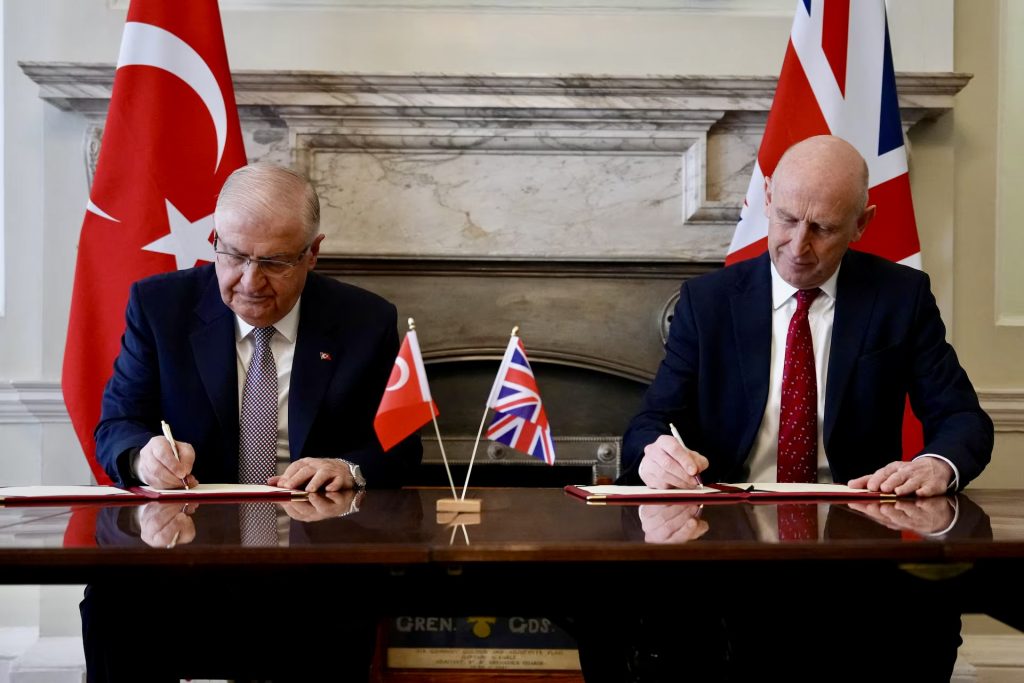
LONDON (Realist English). Turkey and Britain have concluded an agreement on training and technical support as part of Ankara’s multi-billion dollar order for 20 Eurofighter Typhoon fighters. The document was signed on March 25, 2026, in London by Turkish National Defense Minister Yaşar Güler and British Defense Secretary John Healey during the Turkish minister’s official visit to the United Kingdom.
What the agreement provides
According to the arrangements, the British company BAE Systems will supply spare parts and auxiliary equipment, high-fidelity training simulators for pilot training, electronic warfare systems, and will also provide technical support for the first three years from the aircraft’s entry into service.
The exact value of the new contract has not been disclosed. However, when the initial contract for the purchase of the Eurofighters was announced in October 2025, the British government stated that the total value of the deal would reach £8 billion ($10.7 billion). According to BAE Systems, the actual purchase of 20 Typhoon aircraft, along with associated weapons and an integration package, will cost Turkey £5.4 billion ($7.2 billion). Thus, the value of the training and support agreement signed on March 25 is estimated at a maximum of £2.6 billion ($3.5 billion).
Training of pilots and technicians
Under separate agreements with the British government, the Royal Air Force (RAF) will train 10 Turkish instructor pilots and nearly 100 maintenance technicians. This will allow the Turkish Air Force to independently provide training for future pilots and ground personnel.
The Turkish Air Force intends to carry out depot-level maintenance of airframes, engines and other onboard equipment on its own territory after the aircraft enter service.
Participation of British industry
As noted in a press release by the British government, the deal will also ensure the production of components and spare parts to support Turkey’s maintenance of the aircraft, with the involvement of British industrial partners including BAE Systems, Leonardo UK, MBDA, Rolls-Royce and Martin Baker.
Over the past year, military cooperation between Turkey and Britain has reached a strategic level, marked by the largest export contract for fighter jets in 75 years and reinforced by unprecedented training programs. This leap has become not just a sale and purchase deal but a symbol of a new military-political rapprochement between the two countries, accelerated by Turkey’s difficulties in procuring Western weapons.
Historic deal of the century: 20 Eurofighter Typhoon fighters
The central event was the visit of British Prime Minister Keir Starmer to Ankara on October 27, 2025, where an agreement was signed to purchase 20 Eurofighter Typhoon fighters for a total amount of up to £8 billion ($10.7 billion). This deal became Britain’s largest export contract for fighter jets since 2007.
Britain acted as the main initiator, overcoming a long-standing German veto that was only lifted in mid-2025. The deal became Ankara’s key response to its exclusion from the American F-35 fighter program. It allowed Turkey to modernize its aging F-16 fleet and diversify its sources of weapons supplies, reducing critical dependence on the United States.
Joint drone development
Cooperation went beyond the purchase of finished products. On November 6, 2025, BAE Systems (Britain) and Turkish Aerospace Industries (TAI) signed a memorandum of understanding on the joint development of advanced unmanned aerial systems. This strategic partnership, aimed at creating drones for NATO, is a symbiosis of British combat aviation experience and Turkish drone development expertise, opening new horizons for cooperation.
Naval cooperation: from flagships to migration
Interaction was not limited to aviation. Over the year, other aspects of cooperation were notable:
- Exercises: In January-March 2026, the flagship of the Turkish fleet, the amphibious assault ship TCG Anadolu, took part in NATO exercises Steadfast Dart off the coast of Britain.
- Cooperation: Advanced negotiations were reported on new contracts in the field of military shipbuilding, indicating an expansion of cooperation in the naval arena as well.
- Practical interaction: In February 2026, the Royal Navy deployed the RFA Mounts Bay to support NATO operations for the return of refugees and migrants to Turkey.
From cooling to strategic alliance
This rapprochement took place against the backdrop of Ankara’s difficult relations with other allies, especially the United States. Exclusion from the F-35 program became a powerful incentive for Turkey to seek alternatives, and Britain, despite Germany’s initial veto, acted as a reliable partner. This deal became not just a contract but a geopolitical statement, strengthening NATO’s southern flank and giving a powerful boost to Britain’s own economy (the agreement will support 20,000 jobs in the kingdom).