


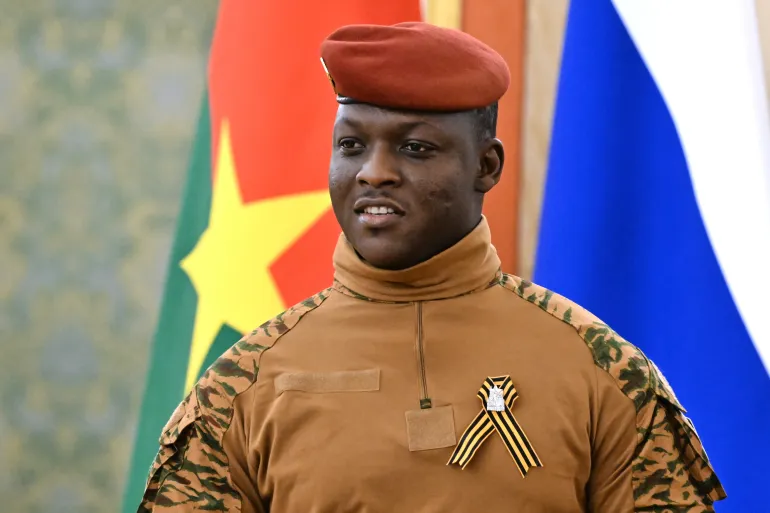
OUAGADOUGOU (Realist English). Burkina Faso’s military leader Ibrahim Traore has called on citizens to “forget” about democracy, marking a sharp escalation in the country’s shift away from civilian governance following the dissolution of all political parties earlier this year.
In a televised interview, Traore said democratic systems were not suited to Burkina Faso, arguing that attempts to impose them elsewhere had led to instability and violence.
“People need to forget about the issue of democracy,” he said. “Democracy isn’t for us.”
He cited Libya as an example of what he described as the failure of externally imposed democratic systems, adding that such efforts often result in conflict rather than stability.
The remarks reflect a broader departure from earlier pledges by the military government to restore civilian rule. Traore, who seized power in September 2022 after a coup that followed an earlier military takeover, had initially promised elections in 2024. He later postponed them indefinitely, citing security concerns.
In January, the government dissolved more than 100 political parties and confiscated their assets. Parliament had already been suspended, and the electoral commission was disbanded in 2025, further narrowing the political space.
Human rights groups and analysts say the authorities have also targeted journalists, opposition figures and members of the judiciary. Some critics of the government have reportedly been forcibly conscripted and deployed to frontline areas in the country’s conflict with armed groups.
Burkina Faso continues to face a severe security crisis, with groups linked to al-Qaeda and ISIL controlling large parts of the territory. Despite the junta’s stated priority of restoring security, violence has intensified.
According to data from the Africa Center for Strategic Studies, fatalities have nearly tripled since Traore took power, reaching more than 17,000 deaths over three years, with civilians accounting for a large share of the casualties.
The country’s trajectory mirrors developments in neighbouring Mali and Niger, where military governments have also curtailed political activity and postponed elections. All three states have withdrawn from the Economic Community of West African States (ECOWAS) and formed the Alliance of Sahel States, signalling a regional shift away from Western-backed governance frameworks.
At the same time, the Sahel juntas have strengthened security cooperation with Russian paramilitary forces after ending military partnerships with France.
Traore’s latest statements suggest that the transition period is evolving into a more permanent political model centred on military rule, justified by security imperatives.
The key issue now is whether the rejection of democratic institutions will stabilise Burkina Faso — or further deepen the cycle of violence and institutional erosion already gripping the country.