


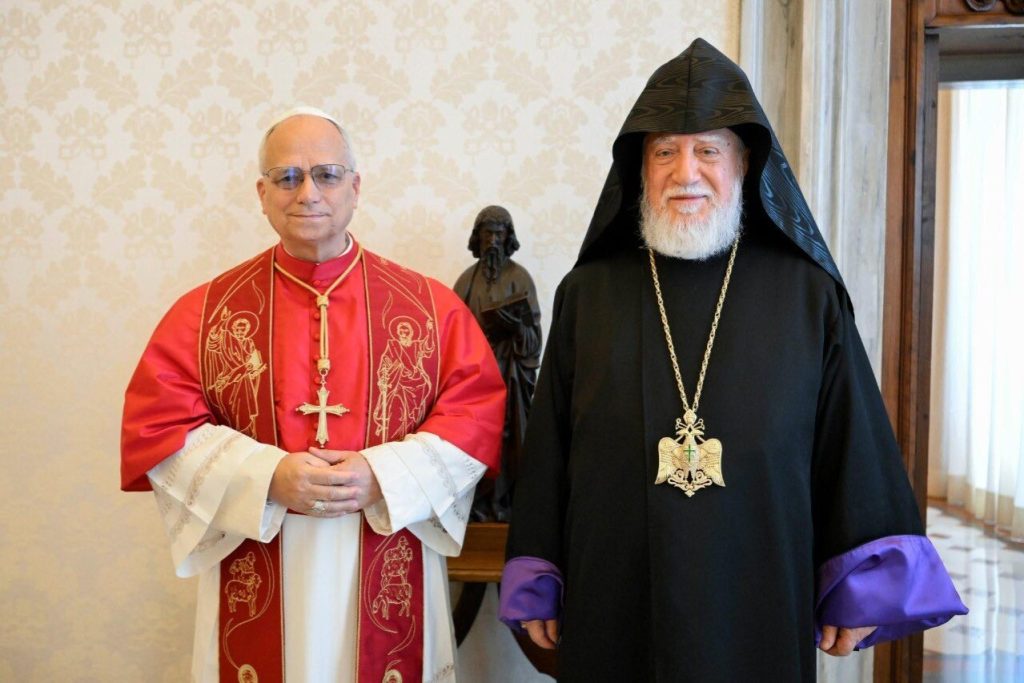
VATICAN CITY (Realist English). A historic meeting took place at the Vatican between Catholicos of the Great House of Cilicia Aram I and Pope Leo XIV. It was the first official meeting between the two spiritual leaders, later described as having taken place in a “warm and brotherly atmosphere”.
During the audience, Aram I raised pressing issues concerning the fate of the indigenous Armenian residents of Artsakh and demanded the immediate release of Armenian political prisoners held in Baku.
Key topics of the meeting:
- Artsakh and the right to return: Aram I stressed the need to guarantee the right of displaced persons to return to their homes under strict international guarantees.
- Armenian political prisoners: the Catholicos raised the issue of the former military-political leadership of Artsakh, still languishing in Baku’s dungeons, and emphasised the urgent need for their speedy release.
- Cultural heritage: the protection of Armenian churches and historical monuments in the region, in accordance with international law, was also discussed.
Pope Leo XIV expressed understanding and support for the issues raised. At the end of the meeting, the two sides held a joint prayer in the Chapel of Urban VIII, praying for unity, lasting peace and the renewal of the “face of the earth”.
During Aram I’s visit to Rome, he also delivered a lecture at the Pontifical Oriental Institute on the challenges facing the Christian churches of the Middle East.
In his numerous appeals, the Catholicos consistently highlighted three key demands grounded in international law.
1. The urgency of release (list of 23 names)
The spiritual leader consistently demands the release of the military-political leadership of Artsakh: former presidents Arayik Harutyunyan, Arkady Ghukasyan, Bako Sahakyan, former state minister Ruben Vardanyan, commanders Levon Mnatsakanyan and David Manukyan, former foreign minister David Babayan, and speaker David Ishkhanyan.
2. The right to return and the preservation of heritage
Aram I insisted that the right of the Armenians of Artsakh to return home must be guaranteed by international guarantees, and that Armenian churches and historical monuments in Karabakh must be preserved in accordance with international law.
3. Legal argument
Aram I’s main argument was a reference to the norms of international law, which equally emphasise the importance of both the release of prisoners of war and the protection of spiritual and cultural heritage. He also openly criticised the closed court proceedings in Baku.
His appeals to world leaders were consistently based on the inviolability of international law and the condemnation of ethnic cleansing, which lent his diplomacy a particular moral weight.
Aram I’s efforts to secure the release of Armenian political prisoners are multifaceted and span all key diplomatic centres: from the Vatican and Washington to Moscow and Ottawa.
Against the backdrop of these diplomatic efforts, domestic initiatives are brewing in Armenia itself. Samvel Karapetyan, leader of the “Strong Armenia” party and a candidate for prime minister, has announced the creation of a special group for the return of prisoners.
“Every Armenian must return home. These people fought for our homeland,” Karapetyan stressed, noting that his team intends to use all possible international contacts and mechanisms to resolve this issue as quickly as possible.
In addition, relatives of Armenian prisoners of war have previously appealed to Armenia’s Foreign Ministry and international organisations, urging the activation of the patron-state mechanism. The reason was the deterioration of the prisoners’ situation after the Red Cross ceased its activities in Azerbaijan, leaving them in complete isolation.
The question of the exact number of Armenian political prisoners held in Azerbaijan remains open: there is a significant gap between the official figures from Baku and the estimates of human rights defenders and experts. Baku gives a figure of 33 people, while according to Armenian human rights organisations, the number is 80.