


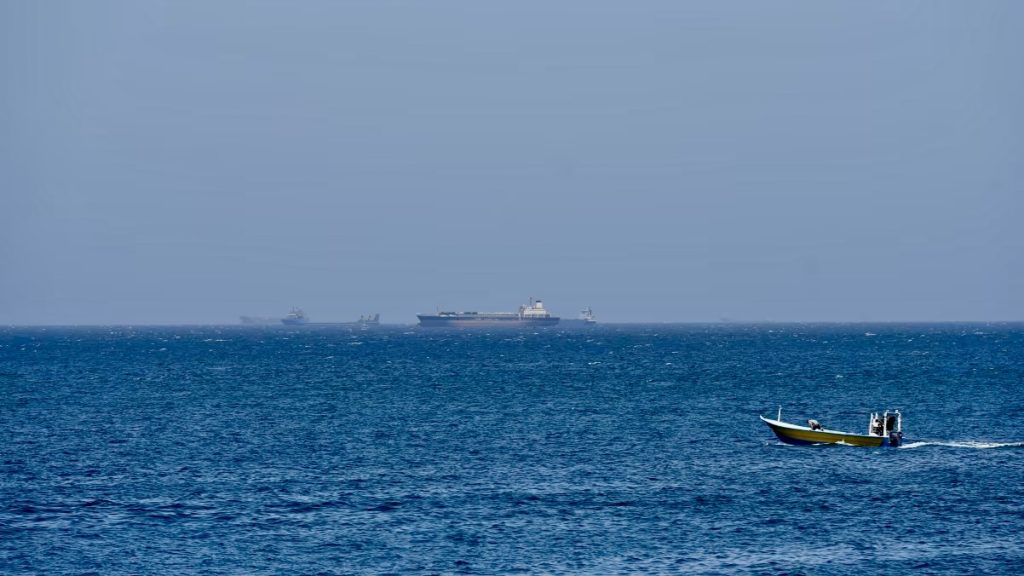
NEW YORK (Realist English). The fragile two-week ceasefire between the United States and Iran, announced on April 8, is not giving ship owners the confidence to return to the Strait of Hormuz — the key waterway through which 20% of global oil supplies pass, CNN reports.
Even if the strait officially reopens, experts warn that the economic consequences of the war will be felt for many months, and a return to normal shipping could take up to six months.
“Almost no one feels confident enough.”
Despite US President Donald Trump’s statements that the strait is open, only a handful of vessels have passed through in the days since April 8. According to data from analytics platform Kpler, only two oil or gas tankers have transited the strait since the ceasefire was announced. Meanwhile, more than 400 crude oil tankers, 34 LPG carriers and 19 LNG vessels remain in the region, MarineTraffic reports.
“Almost no one feels confident enough to transit the strait,” said Matt Smith of Kpler. Typically, more than 100 tankers pass through the Strait of Hormuz daily, but that number has now dropped to 10 or fewer.
Lale Akoner, a global market analyst at eToro, noted: “A two-week ceasefire that is fragile — I don’t think that would give ship operators the confidence they need.” In her estimation, restoring shipping to pre-war levels could take up to six months.
The problem is not just getting out, but getting back in
The main difficulty, experts say, is not only letting the trapped vessels out, but also getting empty tankers to re-enter the strait to load new oil cargoes. Smith explained that about 400 loaded oil tankers are waiting to exit the Persian Gulf, but only about 100 empty vessels are ready to enter. Even if the strait opened today, normalizing oil flows would take until July.
Peter Tirschwell, vice president for maritime and trade at S&P Global Market Intelligence, added that about 100 container ships are waiting to exit, but virtually no empty vessels are ready to enter. That means 30% of the world’s fertilizer supplies, normally shipped from the region, could be stuck for months, as shipping by sea is the only way to move them. “The capacity does not exist to easily reroute those cargoes,” he stressed.
Iran charges fees, ship owners wait for first movers
The situation is aggravated by Iran’s stance. Iran’s Islamic Revolutionary Guard Corps (IRGC) charges passing ships up to $2 million per tanker, with payment accepted in Chinese yuan or cryptocurrencies, bypassing the dollar-based financial system and US sanctions. Even Trump himself has floated the idea of a toll as part of a “joint venture” with Iran.
Ship owners, according to Sanne Manders, president of global logistics company Flexport, have “no information” on how to transit during the ceasefire and are not in contact with Iranian authorities. “They are basically waiting until others test the passage,” Manders said. He predicted that tankers and vessels of Chinese origin would likely test the waters first (China is an ally of Iran).
Consequences for ordinary Americans
The real impact is already being felt at the pump. According to AAA, average US gasoline prices have risen 40% since the start of the war — up $1.18 per gallon, reaching $4.17. Returning to pre-war levels of around $3 per gallon, analysts say, is a distant prospect even if oil begins to flow freely again.
Joe McMonigle, president of the Global Center for Energy Analysis, warned: “If this continues for another week or two, the consequences not just for energy prices but for the global economy are dire. This is a very tenuous ceasefire.”