


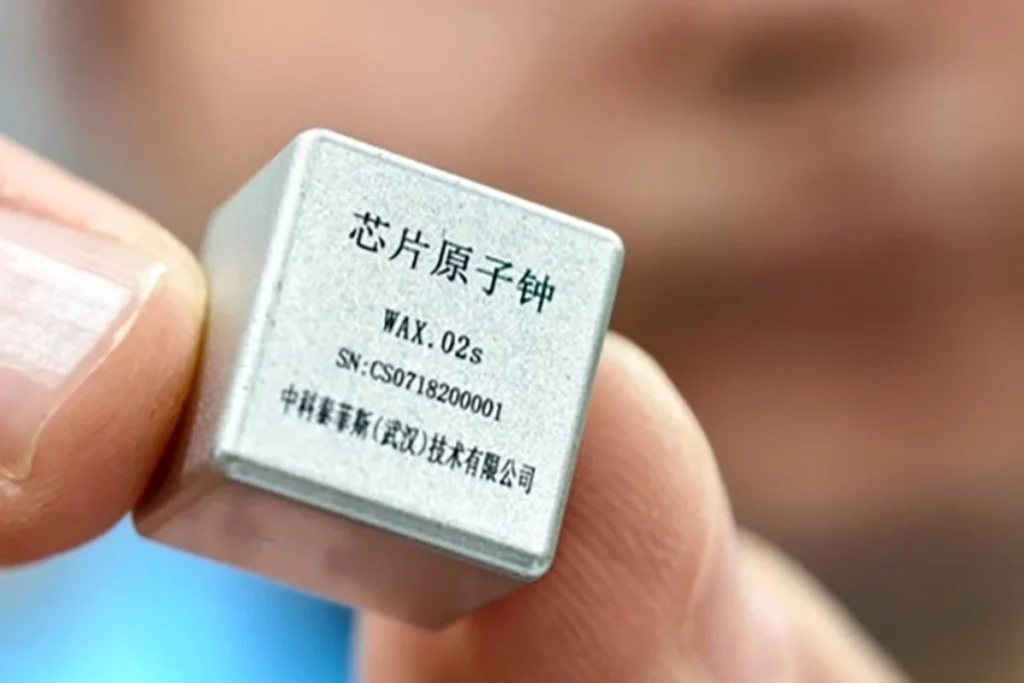
BEIJING (Realist English). China has begun mass production of a chip-scale atomic clock described as the smallest of its kind, a development that researchers say could significantly improve precision timing in drone warfare, navigation systems, and military communications, according to the state-backed Changjiang Daily.
The device, developed by a team led by Professor Chen Jiehua at Wuhan University’s Satellite Navigation and Positioning Technology Research Centre, measures just 2.3 cubic centimetres — roughly the size of a fingernail — and is capable of losing only one second every 30,000 years.
Key facts
The clock is substantially smaller than existing models. Researchers said comparable US devices measure around 17 cubic centimetres, making the Chinese version less than one-seventh the size while maintaining similar performance.
According to Chen, the technology has already entered practical use. “We have achieved mass production of chip-scale atomic clocks,” he said, adding that they are being applied in positioning, navigation and timing (PNT) systems, including underwater BeiDou navigation, low-orbit satellites and drone swarms.
The project has moved beyond the laboratory stage. A spin-off company, Taifs (Wuhan) Technology Co, backed by the state-owned Yangtze River Industry Group, has begun manufacturing the clocks. Several hundred units were reportedly sold in 2024, with demand expected to increase.
Technology and innovation
The miniaturisation is based on a quantum optical method known as coherent population trapping, which differs from traditional microwave-based atomic clocks.
Conventional systems rely on resonant cavities and microwave interactions, limiting how small they can be made. The new design instead uses a microfabricated cell containing alkali atoms, such as rubidium, and laser-generated optical signals to create a stable frequency reference.
This approach allows the entire system to be integrated into a chip-scale device with significantly lower power consumption, making it suitable for mobile and distributed systems such as drones.
Context
Atomic clocks are critical for modern military and civilian infrastructure. They enable precise synchronisation of signals across communication networks, satellite navigation systems, and coordinated weapons platforms.
In high-speed warfare scenarios, even microsecond-level discrepancies can degrade targeting accuracy or disrupt coordinated operations. Smaller, low-power atomic clocks allow these capabilities to be embedded directly into autonomous systems.
China has been investing heavily in positioning and navigation technologies, including its BeiDou satellite system, as part of broader efforts to reduce reliance on US-controlled GPS infrastructure.
Why it matters
The development reflects a shift toward decentralised precision timing in warfare. By embedding high-accuracy clocks into individual platforms — such as drones or underwater vehicles — militaries can reduce dependence on external signals, which are vulnerable to jamming or disruption.
If scaled effectively, the technology could improve the resilience and autonomy of China’s military systems, particularly in contested electromagnetic environments.
What comes next
Despite the progress, cost and technical challenges remain. The specialised lasers required for the system are still expensive, limiting widespread adoption.
State-backed investors say efforts are underway to industrialise production and reduce costs. As manufacturing scales, the technology is expected to expand into broader military and civilian applications, including telecommunications and autonomous transport systems.
The next phase will determine whether chip-scale atomic clocks become a standard component in next-generation warfare systems or remain a niche high-end technology.