


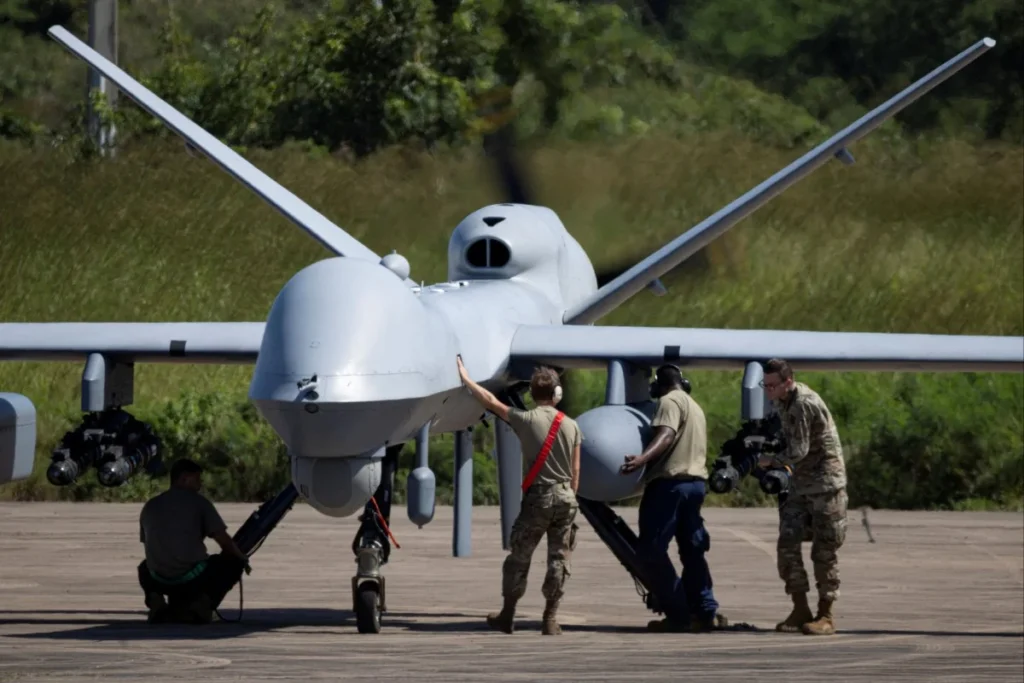
BEIJING (Realist English). The expanding use of U.S. MQ-9 Reaper drones in the Indo-Pacific is heightening pressure on China’s military to bolster counter-reconnaissance capabilities, according to Chinese defense analysts.
The MQ-9 Reaper, developed by General Atomics, is a long-endurance unmanned aerial vehicle capable of both intelligence-gathering and precision strike missions. It has been deployed across multiple theaters and was used in the 2020 strike that killed Iranian General Qassem Soleimani.
In recent years, the platform has become an integral component of U.S. surveillance architecture in the Indo-Pacific, operating from bases and partner territories across the region.
Chinese military publication Ordnance Industry Science Technology said the drone’s maximum altitude — up to 15,240 meters (50,000 feet) — combined with its extended endurance and relatively low radar signature, presents a significant monitoring challenge.
According to the magazine’s assessment, these capabilities allow the United States to deploy MQ-9 systems at a considerable distance from mainland China while still conducting intelligence, surveillance and reconnaissance missions near Chinese airspace or maritime peripheries. Such operations could also support target designation in the event of a crisis.
In January, a maritime-focused variant of the platform, the MQ-9B SeaGuardian, was upgraded to carry an expanded sonobuoy dispensing system, doubling the number of sonar devices it can deploy. Sonobuoys, released from aircraft or ships, are used to detect and track submarines — a development viewed as particularly relevant in the context of undersea competition in the Western Pacific.
Analysts say the increased operational flexibility of MQ-9 systems underscores the importance for the People’s Liberation Army to improve electronic warfare, air defense detection and anti-drone interception technologies.
The growing presence of unmanned surveillance assets reflects a broader technological contest between Washington and Beijing, where intelligence dominance and early-warning capabilities are increasingly central to strategic deterrence.