


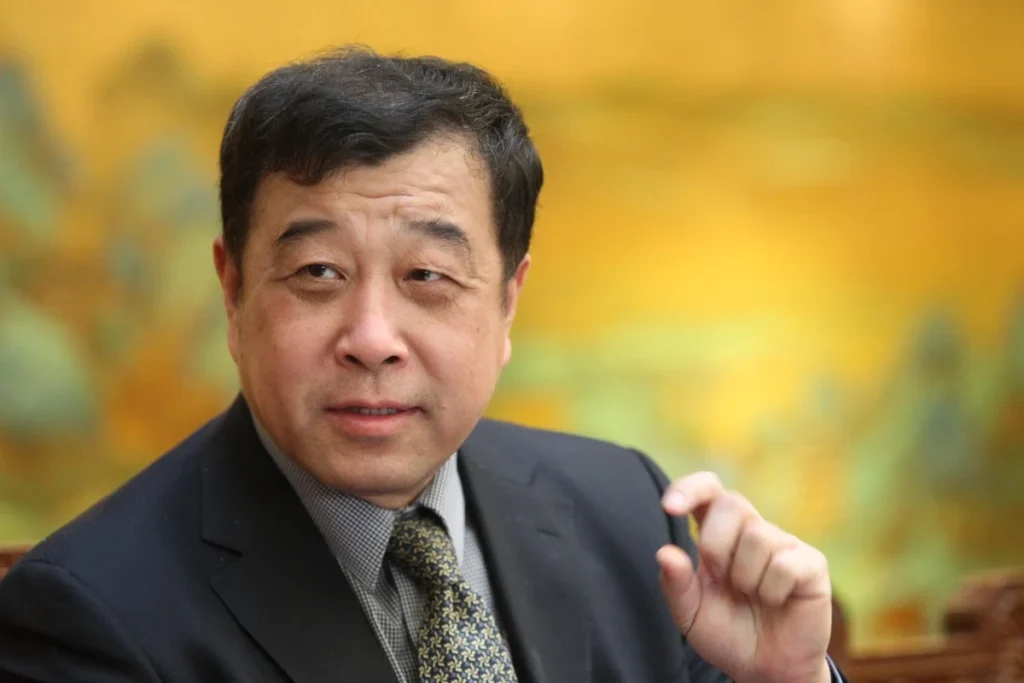
BEIJING (Realist English). China could gain a strategic advantage in the Taiwan Strait if U.S. military resources continue to shift toward the Middle East, although Beijing still prioritizes peaceful reunification with Taiwan, a prominent Chinese expert said on Tuesday.
Li Yihu, dean of the Taiwan Research Institute at Peking University and a deputy to China’s National People’s Congress, said Washington’s involvement in several conflicts — including the ongoing war involving Iran — is placing growing strain on U.S. military capabilities and reducing its presence in the Asia-Pacific.
Li pointed to the recent redeployment of elements of the U.S. Terminal High Altitude Area Defense (THAAD) system and Patriot missile defense batteries from South Korea to the Middle East as an example of the shift. Such moves, he said, could significantly affect U.S. military positioning in East Asia.
“Any weakening of the U.S. presence in the Asia-Pacific will inevitably benefit someone — and it is not difficult to see who that might be,” Li said.
According to the Chinese scholar, Beijing could benefit strategically if U.S. deployments in the region decline, particularly as China expands its area-denial capabilities around the Taiwan Strait.
The comments come as the U.S.-Israeli military campaign against Iran enters its twelfth day, raising concerns among analysts that a prolonged conflict could force Washington to redistribute military resources across multiple theaters.
The redeployment of American defense systems has sparked concern among U.S. allies in the region. However, South Korean President Lee Jae Myung said on Tuesday that the transfer of some U.S. missile defense assets would not undermine Seoul’s ability to deter North Korea.
Speaking to reporters on the sidelines of China’s annual parliamentary meetings, known as the “two sessions,” Li said the People’s Liberation Army (PLA) had made significant progress in developing area-denial capabilities through a series of military drills around Taiwan.
“The PLA’s operations near Taiwan are becoming increasingly close to the island, and our denial capabilities are advancing rapidly,” Li said. “These preparations ensure readiness if action ever becomes necessary. At the same time, we remain committed to resolving the Taiwan issue and achieving reunification through peaceful means.”
Since 2022, the PLA has conducted at least seven large-scale military exercises around Taiwan. The most recent drills, held in December, simulated a blockade of the island, including the closure of key ports, strikes against maritime targets and the repulsion of external intervention.
Area-denial systems are designed to prevent outside forces — including the United States and regional allies such as Japan — from approaching the island or providing support in the event of a conflict.
Beijing considers Taiwan part of China and has stated that reunification may be achieved by force if necessary. Most countries, including the United States and Japan, do not recognize Taiwan as an independent state, though Washington opposes any attempt to seize the island militarily and is legally obligated to provide it with defensive weapons.
U.S. media reported in February that the administration of President Donald Trump had postponed announcing a proposed $13 billion arms package for Taiwan, which would exceed the $11 billion deal approved in December.
Li also called on Washington to end arms sales to Taiwan entirely rather than suspend them temporarily ahead of an expected summit between Chinese President Xi Jinping and President Trump in Beijing later this month.
“We hope the United States will honor its commitments under the three China–U.S. joint communiques,” Li said. “If assurances are made during negotiations, the U.S. side should follow through.”
U.S. arms sales to Taiwan are governed by a complex framework of agreements and legislation. Under the Taiwan Relations Act of 1979, Washington is required to help Taiwan maintain its capacity for self-defense and provide weapons of a defensive nature.
At the same time, a 1982 joint communique between Beijing and Washington stated that the United States intended to gradually reduce the quality and quantity of arms sold to Taiwan. However, Washington later issued the so-called “Six Assurances” to Taipei, pledging that it would not consult Beijing or seek its approval regarding arms sales to the island.