


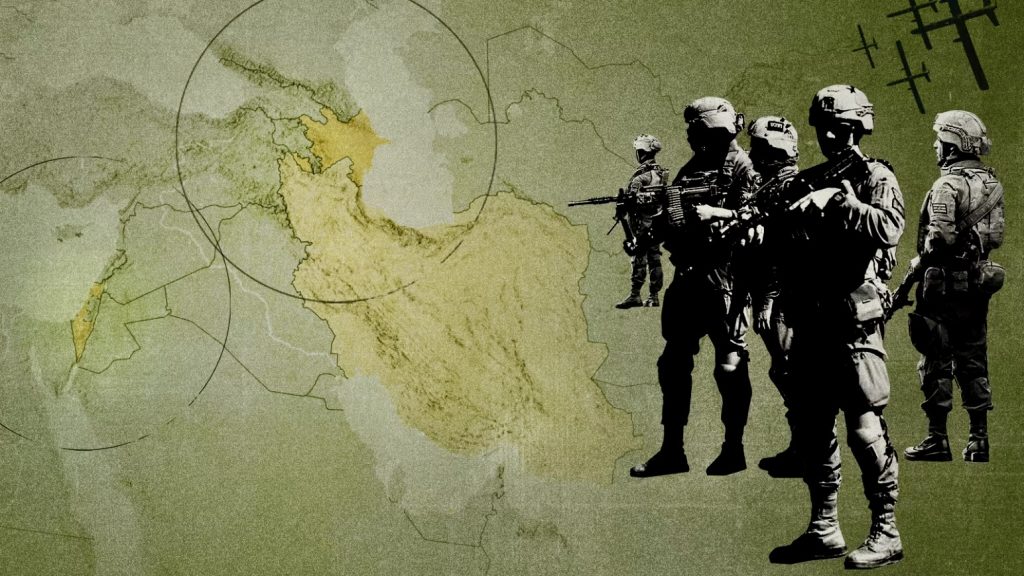
BAKU (Realist English). Israel secretly deployed elite military and intelligence units to Azerbaijan during the war with Iran, CNN reported on June 5, citing four informed sources. The operation was part of a network of covert Israeli sites across the Middle East designed to facilitate strikes against Iran.
Baku has called these reports “unfounded claims” and “blatant information manipulation.”
Secret Network: Azerbaijan, Iraq, UAE, and Somaliland
According to the sources, Israeli forces operated from several locations in southern Azerbaijan, adjacent to Iran’s northern border and, at its closest point, only about 60 miles (100 km) from the Iranian city of Tabriz, which was hit by Israeli strikes during the war.
Commando units deployed there carried out intelligence-gathering missions and drone operations, giving Israel a valuable vantage point from which to monitor northern Iran.
Beyond Azerbaijan, CNN reported, Israel maintained secret military sites in Iraq, the United Arab Emirates, and the breakaway republic of Somaliland in the Horn of Africa. Initially planned as emergency rescue sites for downed pilots, these positions expanded in scope to become full-fledged military and intelligence-gathering outposts.
Together, they allowed Israel to encircle Iran from the south, west, and north, extending its operational range hundreds of miles deep into Iranian territory.
The Azerbaijan Operation: From Plans in January to Strikes in March
According to the sources, preparations for the covert mission along the Azerbaijan-Iran border began in mid-January 2026. Israel planned to install listening devices and intelligence-gathering equipment under the cover of the opening US strikes against Iran.
However, President Donald Trump called off the strikes at the last minute, saying Iran had agreed to stop killing demonstrators. Israel proceeded on its own.
The Israeli Air Force used stealth jets and special forces to install the equipment, as Israel’s political leadership believed that US‑Iran negotiations were doomed to fail. The intelligence site was later used to collect information on Iranian military movements and provide early warning of missile launches.
On January 26, 2026, Israeli Foreign Minister Gideon Saar visited Baku, meeting with Azerbaijani President Ilham Aliyev and other top officials. In May 2025 (before the war began), Azerbaijan secretly hosted rare direct talks between Israel and Syria.
Assassination of an IRGC General and the Nakhchivan Attack
One of the key operations launched from Azerbaijani territory, sources said, was the March 4, 2026 killing of Rahman Moghaddam, head of the Islamic Revolutionary Guard Corps (IRGC) intelligence division. Israel accused him of planning a 2024 assassination attempt on Donald Trump.
On March 5, 2026, drones attacked an airport in the Azerbaijani exclave of Nakhchivan, damaging the terminal building and wounding several people. Aliyev blamed Iran, calling the attack an “act of terror” that was “ugly, cowardly and shameless.” Iran denied involvement.
On March 6, 2026, Azerbaijan’s State Security Service announced that it had broken up an IRGC plot to attack critical infrastructure, as well as Israeli and Jewish targets. Weeks later, Israel publicly acknowledged that it was a joint operation involving the Mossad, the Israeli military, and the Shin Bet security service.
The Israel-Azerbaijan Alliance: Oil for Weapons
Azerbaijan and Israel have long maintained close ties. Baku supplies a large share of Israel’s oil; in return, Israel sells advanced weaponry to Azerbaijan, some of which was used in the Nagorno‑Karabakh conflicts of 2016 and 2020 against Armenia. In 2016, Azerbaijan became the first foreign country to purchase Israel’s Iron Dome air defense system.
According to experts, Israel deliberately keeps a low profile in its relationship with Baku, focusing on arms transfers, intelligence cooperation, and long‑term technological interdependence in the security sector.
For Azerbaijan, the Israeli connection provides access to a powerful lobby in Washington, helping Baku position itself as a regional power and a bridge between Israel and Arab states.
Baku’s Reaction and Other Countries’ Positions
A spokesperson for the Azerbaijani embassy in the United States told CNN: “We firmly reject unfounded claims regarding the alleged use of Azerbaijan’s territory for operations against third countries.”
After the article was published, the Media Development Agency of Azerbaijan issued a statement: “The publication of this information is aimed at creating confusion with the international community, undermining regional stability and interstate relations, and generating tensions in the region … Such fabricated claims constitute blatant information manipulation.”
Regarding Somaliland, one source said the breakaway republic provided Israel with an additional military position, allowing Israeli aircraft to make potential stops on long‑range flights to Iran. In December 2025, Israel became the first country to formally recognize Somaliland; the UAE maintains an expansive commercial and military presence in the port city of Berbera.
Iraq, according to the sources, also provided Israel with two secret military bases for logistics support and search‑and‑rescue operations. However, the Iraqi military said in early March that there were no “unauthorized bases or forces” in the country. Israeli officials have not commented.
The United Arab Emirates, as previously reported (notably by Axios), agreed to the covert deployment of an Israeli Iron Dome battery and support personnel during the war with Iran.
CNN also reported that Prime Minister Benjamin Netanyahu, the head of the Mossad, and the Israeli military chief visited the UAE during the war; the UAE has denied these visits.
The CNN report, based on four anonymous sources, paints a picture of an extensive Israeli military network deployed across several countries to fight Iran. Azerbaijan is portrayed as playing a key role, allegedly providing not only intelligence positions and staging grounds for special operations but also diplomatic cover.
Baku vehemently denies the claims, calling them “information manipulation.” Israel has not yet issued an official response.