


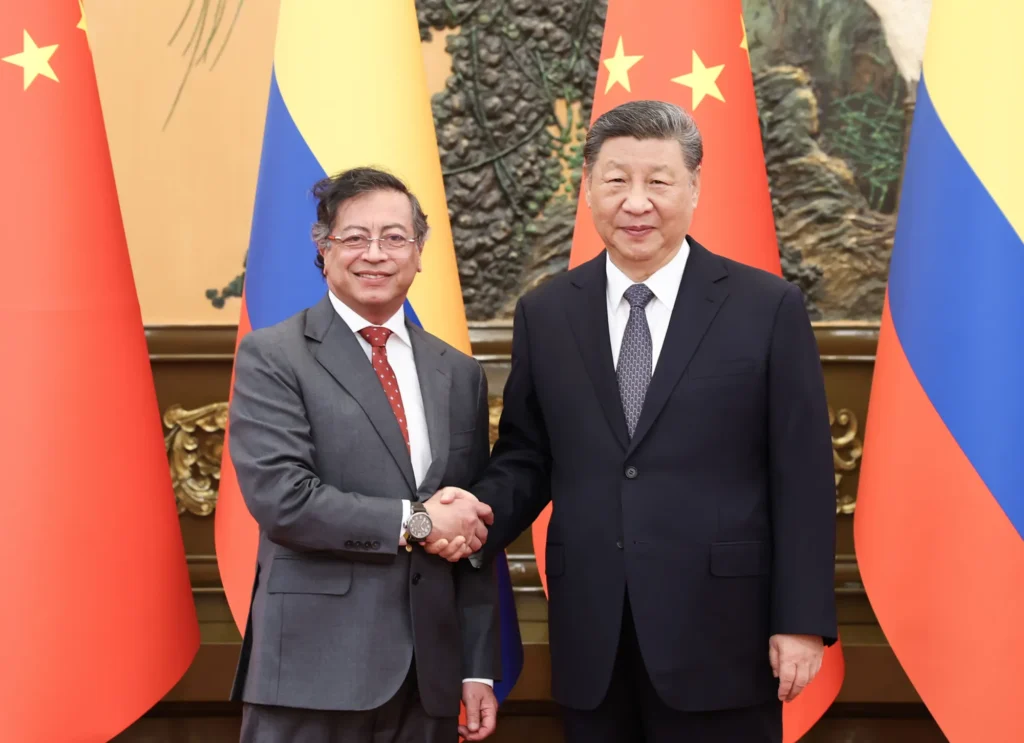
BOGOTÁ (Realist English). China is rapidly expanding its political and economic footprint in Colombia as relations between Bogotá and Washington fray under President Donald Trump. According to multiple people familiar with the matter, Beijing has stepped up its outreach ahead of Colombia’s 2025 presidential and congressional elections, inviting candidates and lawmakers on all-expense-paid trips highlighting China’s technological capabilities and infrastructure achievements.
At least three presidential contenders, four senators, and a government minister have taken part in such visits this year, alongside business leaders and media executives. Participants are given exclusive factory tours, photo opportunities in upscale state venues, and presentations by guides who speak polished Spanish and demonstrate detailed knowledge of Colombian politics and culture.
One guest, presidential hopeful Juan Manuel Galán, said he was impressed by the depth of the programme, describing guides — many of them former diplomats — as “incredibly well-prepared.” Galán first visited China on a similar tour 16 years ago, but this year’s effort comes as Colombia’s long-standing alliance with the United States faces unprecedented strain.
Washington–Bogotá tensions accelerate China’s opening
Trump has personally targeted President Gustavo Petro, calling him a “thug,” imposing sanctions on Petro and members of his inner circle, and decertifying Colombia as a partner in the US-led war on drugs. US aid to Colombia was sharply reduced this year, and Washington has hinted it may consider military action inside Colombian territory.
“For China’s growing influence, the issue isn’t Petro and Trump disliking each other,” said Veneta Andonova, a professor at the University of the Andes. “It’s that the US is no longer willing to write checks — and China is.”
Chinese Ambassador Zhu Jingyang told reporters last week that Beijing’s outreach is intended to deepen a “mutually beneficial relationship, regardless of who occupies the presidential palace” after next year’s vote.
Research shows the shift is already visible: during the 2023–24 congressional period, 28 Colombian lawmakers travelled to China, compared with 24 who visited the United States.
Part of a broader Latin American strategy
China’s invitation programme stems from a pledge by President Xi Jinping, who said Beijing would host 300 Latin American politicians per year over the next three years. Analysts say such trips have long served as Beijing’s soft-power tools, allowing Chinese officials to cultivate political goodwill and counter US influence.
Chinese investment across Latin America has evolved from large sovereign loans in the 2000s — particularly to Venezuela — to a new focus on strategic, innovation-linked projects. In Colombia, this shift has been visible for more than a decade.
Colombia joined China’s Belt and Road Initiative in 2024 after Petro’s state visit to Beijing. Bilateral trade reached $20.8 billion last year, up 13 percent, though Colombia’s trade deficit with China widened to $12.4 billion.
Chinese companies have become central players in Colombian infrastructure. In 2019, a consortium led by China Harbour Engineering Company (CHEC) won the $4.5 billion Bogotá metro contract — the largest Chinese project in Colombia to date. CHEC also holds a majority stake in the Highway to the Seas 2 concession linking Medellín to the Urabá Gulf.
Bogotá has also partnered with Sinovac Biotech to establish Bogotá Bio, a vaccine research and production venture expected to attract $100 million in investment.
Technology competition intensifies
The Petro administration is preparing to award a 1.3 trillion-peso ($341 million) cloud-services contract covering nearly 200 public institutions. American firms such as Amazon, Microsoft, Google, IBM and Oracle have expressed interest. But Washington and Colombian officials worry that Chinese firms — including Huawei and Alibaba — will also compete.
Ambassador Zhu rejected security concerns, saying claims that Chinese firms pose risks while American firms guarantee safety are “a false narrative.”
Trips shape political perceptions
China’s outreach appears to be influencing some candidates. Senator and presidential contender Roy Barreras returned from his tour praising China’s economic success, asking followers: “Is China a danger or an opportunity? The danger would be to distance ourselves from it.”
Not all invitees are swayed, analysts note. Yet with Trump’s confrontational approach pushing Colombia away from Washington, analysts say Beijing is positioned to fill the vacuum.
“What China is doing in Colombia is not new — but the context is,” said Margaret Myers of the Inter-American Dialogue. “It’s arriving at a moment when the United States is pulling back, and that makes Beijing’s offer all the more appealing.”