


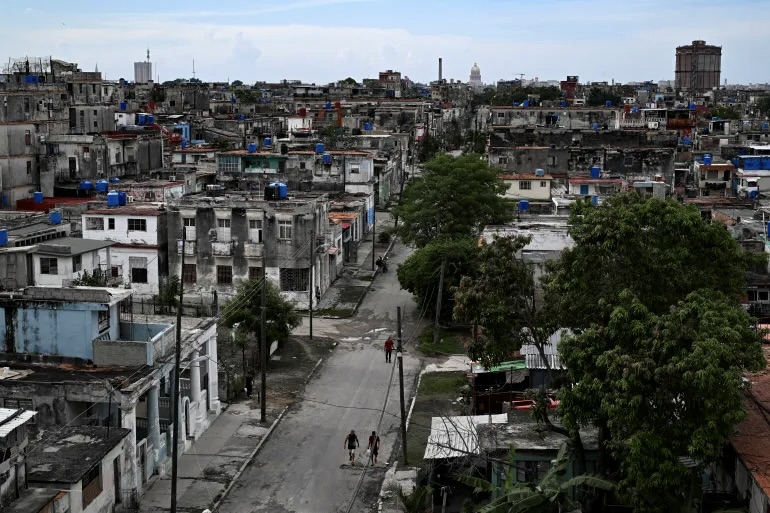
HAVANA (Realist English). On July 6, Cuba’s electrical grid completely failed.
The state electricity company Unión Eléctrica (UNE) reported a “total disconnection from the national electricity generation system.”
This is the third nationwide blackout since the beginning of 2026 and the eighth since late 2024.
Chronicle of an Energy Collapse
Long before the complete shutdown, Cuba’s power system was operating at its limit. On July 3, an accident at the “Victoria de Girón” substation in Havana triggered widespread power outages across the country. In most areas, including the capital, electricity was available only 1–2 hours per day, and in many regions, outages lasted 2–3 days.
These local failures became precursors to the total collapse that occurred on July 6. On its X account, UNE stated: “A total disconnection of the National Electric System has occurred. The causes are being investigated.”
Causes: Oil Blockade and Aging Infrastructure
Cuba has faced problems in its energy sector for decades due to aging infrastructure, fuel shortages and US sanctions. However, the situation deteriorated sharply in January 2026, when the Trump administration imposed a de facto oil blockade on the island.
The US cut off supplies of Venezuelan oil, which for years had sustained the Cuban economy. Washington also pressured Mexico to halt shipments and threatened tariffs on any country that supplied fuel to the island.
From January to the end of March, not a single tanker called at Cuba. Only at the end of March did the US allow one Russian tanker with 730,000 barrels of oil to deliver to the island. Those reserves were exhausted by May. A second Russian tanker carrying diesel fuel never reached Cuban shores.
In May, authorities announced that fuel reserves were completely depleted. As Bloomberg notes, the US blockade has significantly exacerbated chronic power outages. Cuba itself can supply only about 40% of the fuel it needs.
An additional factor is the technical condition of Cuba’s power plants. Generating units built in the Soviet era have been in operation for decades: seven of them have been running for more than 40 years. Wear and tear on equipment, along with a lack of spare parts and funding, makes the system extremely vulnerable.
Life in the Dark: What the Blackout Means for Cubans
For ordinary Cubans, conditions are becoming increasingly difficult. In Havana, electricity is usually available only 3–4 hours a day, but the current blackout is felt much more heavily due to the total uncertainty about when it will be restored.
In some areas of the capital, rolling blackouts can exceed 24 consecutive hours, and in some rural areas — 70 hours. A young programmer working in a tourism startup in the capital lamented the impossibility of working due to the lack of Wi-Fi and electricity. A 51-year-old self-employed social media manager called the current situation “torture.”
Water supply systems have been disrupted, as pumps cannot operate without electricity. The situation is compounded by the abnormal heat typical of the Caribbean summer.
Government Reaction and Attempts to Exit the Crisis
Cuban President Miguel Díaz-Canel directly blamed US sanctions policy, calling it the “asphyxiation” of the island. Earlier, he stated that the US blockade was aimed at provoking a social explosion in the country.
Cuban authorities have begun work on a phased restoration of electricity supply, prioritising hospitals, water supply systems and other critical facilities. However, as Lázaro Guerra, director of electricity at the Ministry of Energy and Mines, stated, the fuel shortage “undoubtedly complicates the restoration process.”
Seeking a way out of the crisis, Cuban authorities embarked on large-scale reforms, including the largest partial privatisation of the economy in 65 years. In June 2026, the country’s leadership proposed nearly 200 market reforms to secure the lifting of the fuel blockade.
However, according to DW, talks between Cuba and the US have reached a dead end, as the White House expects regime change in Havana.
Washington Bets on Regime Change
The energy collapse in Cuba is occurring against the backdrop of systematic pressure from the Trump administration. Following the capture of Venezuelan President Nicolás Maduro in early January — a key ally of Havana — Trump stated that Cuba “looks ready to fall.” The US leader also suggested the possibility of a “friendly takeover” of the island.
The US views economic strangulation as a tool to force the Cuban government to open up its political system and allow foreign investment. But for 10 million Cubans, it means only one thing: life in constant uncertainty, without light, water or the ability to work normally.