


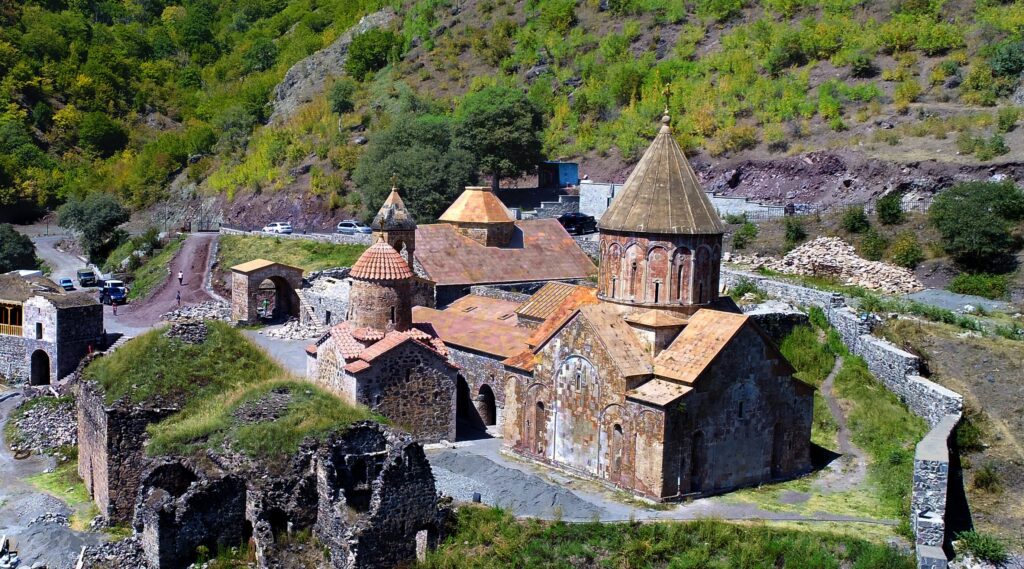
YEREVAN (Realist English). In Artsakh, before the ethnic cleansing and forced deportation – simply put, genocide – carried out by Azerbaijani aggressors, there were 5,658 monuments, including 385 churches, 60 monastic complexes, 2,835 khachkars (cross-stones), 400 ancient cemeteries, 115 fortresses, bridges, burial fields, tombs, and melik (noble) estates.
One of the 60 monastic complexes is Dadivank. It is located on the forested slopes of Mount Mrav, on the left bank of the Tartar River.
According to tradition, it was built as early as the first century on the burial site of Saint Dadi.
Dadi was one of the 70 disciples of the Apostle Thaddeus and was killed in the Artsakh district of Verin Khachen (Tsar). Dadivank was the spiritual center of the Mets Kvenk district.
Over the centuries, the monastery was repeatedly ravaged and destroyed – during Arab and later Seljuk invasions. However, each time the complex was restored and became more magnificent than before.
In the 12th century, Mkhitar Gosh lived here for some time and worked on his “Lawcode” (Datastanagirk), which played a huge role in medieval Armenian civil life.
The monastic complex had various structures: two ancient churches, two narthexes, monastic cells, a guesthouse, workshops, a library, etc.
The jewel of Dadivank is the Cathedral of the Holy Mother of God, built in 1214 by the wife of Prince Vakhtang, Arzu Khatun, in memory of her husband and two sons, Princes Hasan and Grigor, who died for the Homeland.
Dadivank preserves two highly artistic khachkars, as well as inscriptions recounting events of the 12th-13th centuries.
During excavations carried out as part of the restoration of Dadivank, on July 21, 2007, the relics of Saint Dadi were discovered under the altar of one of the complex’s churches. The cathedral itself is adorned with rich frescoes.
Dadivank served as the ancestral burial vault of the princely house of Vakhtangyan, belonging to the ancient monarchical clan of Aranshahik, which ruled in Artsakh and Utik since the time of Sisak (the grandson of Hayk, the patriarch of the Armenian people, mentioned in the Book of Jeremiah 51:42). The monastery had extensive possessions, but in 1920, after the forced annexation of the district to Azerbaijan, it lost its lands and ceased its activities.
In the 1960s, Azerbaijani authorities established a village within the territory of the monastic complex, whose residents damaged the complex’s buildings and frescoes.
On March 31, 1993, during the Artsakh Liberation War, Dadivank was liberated.
After the 44-day war in 2020, according to a trilateral statement, the Kashatagh and Shahumyan (Karvachar) districts of the Republic of Artsakh came under enemy control, including Dadivank.
On November 14, 2020, Russian President Vladimir Putin discussed the Church of Surb Amenaprkich Kazanchetsots in Shushi and Dadivank with Azerbaijani President Ilham Aliyev. During the conversation, the Russian President told Aliyev that Dadivank and the Church of Surb Amenaprkich Kazanchetsots would be under his personal protection. However, in 2021, representatives of Azerbaijan’s Udi community held a liturgy in Dadivank for “their faithful.”
For this purpose, Baku used the head of the so-called Albanian-Udi religious community, Robert Mobili.
I advise this Christian clergyman to deeply study his national identity, as well as the history of the Artsakh and Utik provinces, which were part of Greater Armenia. I wonder, is it possible for there to be Artsakh churches in Syunik or Gugark? If yes, then there could also be a Udi church in Artsakh. Surely one cannot be so foolish!
It is regrettable that, succumbing to Azerbaijani provocations and falsifications, in 2024 an article was published in the official newspaper of the Vatican where Dadivank and Gandzasar were presented as Albanian, without any factual basis. It is known that the Aliyev-Pashayev clan continues to make major financial investments in the Vatican.
Let us remind the editor of the Vatican’s official newspaper that on April 12, 2015, in St. Peter’s Basilica, during the holy liturgy dedicated to the 100th anniversary of the Armenian Genocide, Pope Francis proclaimed Saint Gregory of Narek a Doctor of the Universal Church, and February 27 is marked in the Catholic Church calendar as the day of remembrance of the Doctor of the Universal Church, Saint Gregory of Narek.
By the way, in the village of Drahtik in the Hadrut district of the Republic of Artsakh, there is a Church of Saint Gregory of Narek, built in 1645, the whereabouts of its facade still unknown to this day.
A question arises: can Christian brotherhood, cooperation, and finally, Christian love be replaced by oil-tainted dollars and euros?
I believe Christian love should unite the Orthodox, Catholic, and Protestant churches for a joint struggle and pressure on Azerbaijan to ensure access to the holy sites of Artsakh.
Let us remind our friends that a small Christian state called the Republic of Artsakh has been erased from the world map as of now.
Ashot Sargsyan – Deputy of the National Assembly of the Republic of Artsakh of the 1st and 2nd convocations, former Head of the Department for Religion and National Minorities of the Government Staff of the Republic of Artsakh, specially for the Realist Information Agency