


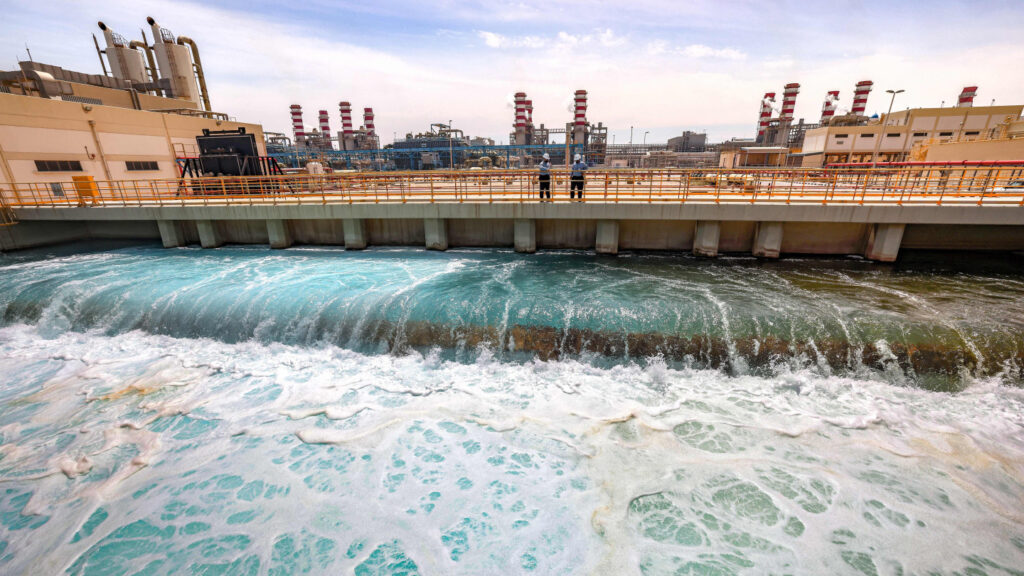
LONDON (Realist English). Iran and Bahrain have both reported damage to desalination facilities amid the ongoing US-Israeli war with Iran, raising concerns among analysts that attacks on water infrastructure could trigger a humanitarian crisis across the Gulf region.
The warnings come as the conflict enters its second week and military strikes increasingly affect critical civilian infrastructure.
Iran said one of its desalination plants was hit in a US airstrike, while Bahrain accused Tehran of damaging a desalination facility on the island kingdom. Since the war began on February 28 with US-Israeli strikes on Iranian targets, Tehran has launched missile and drone attacks against US bases and infrastructure across Gulf Cooperation Council (GCC) states.
Desalination plants are essential to life in the Gulf, where many countries rely almost entirely on converting seawater into drinking water. Major cities across the region depend on these systems to sustain their populations and economies.
Analysts say attacks on such facilities could be more destabilizing than strikes on energy infrastructure.
“Crippling desalination plants in countries without alternative freshwater supplies would pose an existential threat to their populations,” said Barbara Slavin, a senior fellow at the Stimson Center in Washington.
She suggested that the alleged strike on Bahrain’s facility may have been a response to an earlier attack on a desalination plant on Iran’s Qeshm Island, which reportedly disrupted water supplies to dozens of nearby villages. US Central Command has denied targeting the Iranian facility.
Experts warn that escalating attacks on water systems could have long-term environmental and humanitarian consequences.
Arash Azizi, a lecturer at Yale University, said that while attacks on oil infrastructure often draw immediate attention, water resources could prove even more critical in the long run.