


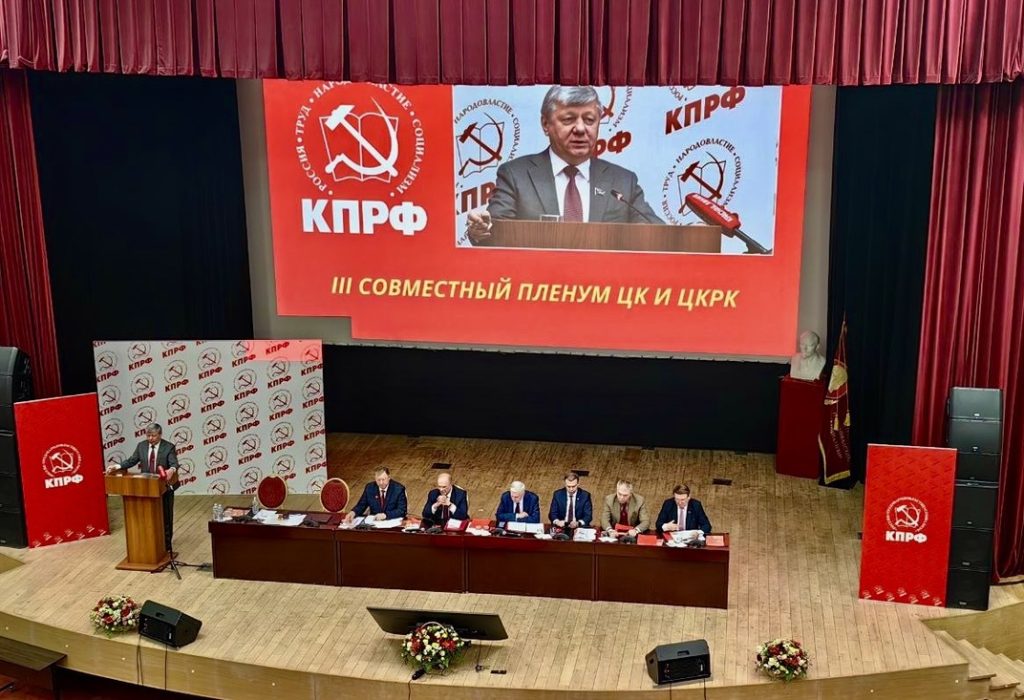
MOSCOW (Realist English). Russian authorities have proven unprepared for competitive struggle in the digital space and, instead of creating quality alternatives, resort to bans and administrative restrictions. This was stated on the radio “Komsomolskaya Pravda” by Deputy Chairman of the Communist Party Central Committee, First Deputy Chairman of the State Duma Committee on International Affairs Dmitry Novikov.
The politician also proposed making the internet free for citizens.
“We, communists, will go into any audience”
According to Novikov, messengers and social networks have become an integral part of modern life and cannot be abolished: “They solve many applied tasks — from medicine to business.” However, as the deputy noted, the authorities choose the path of prohibitions instead of competing.
“As a result, the authorities, having proven completely unprepared to compete in this space, sometimes tell us: ‘You communists like the Russian experience of Chinese communists.’ There is their own social network, their own messengers — WeChat. But WeChat began to be developed 15 years ago. That is why it has certainly become a convincing alternative to Western social networks,” Novikov said.
The parliamentarian emphasized that people in Russia who have used certain platforms for years are suddenly being “herded, turned into migrants,” forced to move from one messenger to another.
Criticism of the messenger “race”
Novikov recalled that after calls to switch to Telegram as an alternative, a huge number of people, including government agencies and firms, spent time and resources on migration. But now Telegram is also falling under a ban.
“How much time has passed since then. Now Telegram is also falling under a ban. They start herding people again. Now let’s switch to Max. But first, why don’t you get this Max on its feet… Then people themselves will see that Max is cool, great, and they will switch there,” the deputy said.
The politician added that if a platform is truly convenient, users will switch to it voluntarily, just as they once left LiveJournal, which became an anachronism. Coercion, according to Novikov, raises only one question: “Is the authorities ready to compete on information platforms? Come out and prove you are right, don’t leave these platforms.”
“Don’t turn Russia into a penal battalion”
As an example of effective polemics in an unfavorable environment, Novikov cited Communist Party leader Gennady Zyuganov.
According to him, at the party’s April plenum, Zyuganov, digressing from his prepared text, delivered a phrase that spread widely on social networks: “Don’t turn Russia into a penal battalion.”
“Drive around Moscow — drivers have nowhere to park. Official vehicles also have nowhere to park, and then drivers are fined, and very often. This fine-collecting economy has become very painful for people,” Novikov explained.
Free internet as a social guarantee
The deputy also put forward a legislative initiative. He believes Russia should move toward providing free internet access for all citizens.
“The time has come for us in Russia to think about such a guarantee for all citizens as free internet. Because today, both a low-income grandmother, and not-wealthy citizens, and a housewife, a single mother with children — they need to use Gosuslugi (public services portal). They need the internet for that,” Novikov said.
In his conviction, if the state takes this responsibility upon itself, the economic effect will be positive. “Let’s make the internet free, so that it becomes a civil, social guarantee for our people,” the deputy concluded.
Novikov believes that the global network should remain a free space, and the authorities should skillfully defend their point of view, as the Communist Party does, rather than create “administrative problems and restrictions” for citizens.
Outcome of the blockades
In recent months, the Russian government has finalized its position regarding foreign messengers. WhatsApp faces a complete ban during 2026, while Telegram’s operation is being gradually reduced to zero through traffic slowdowns and technical restrictions. The authorities are betting on the development of the domestic platform Max.
WhatsApp is owned by Meta, which has been recognized as an extremist organization in Russia. Since August 2025, audio and video calls have already been restricted in Russia. As for Telegram, there is no full ban yet, but the service’s operation in Russia has been deliberately degraded since February 2026 — video and image downloads, as well as mobile app performance, have been slowed.
Nevertheless, the head of Rostelecom, Mikhail Oseevsky, stated that “there is no official Telegram traffic in Russia now” and that the messenger is “dying.”