


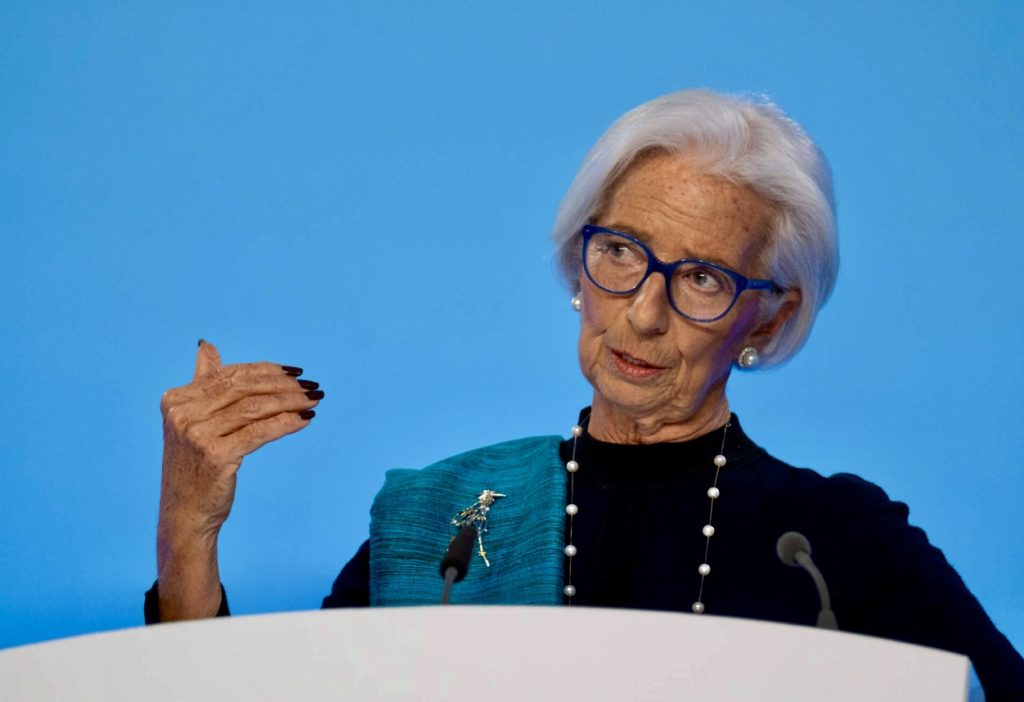
BRUSSELS (Realist English). European Central Bank President Christine Lagarde announced a shift in monetary policy: the regulator will no longer fight inflation with the same intensity as in 2022–2023.
The statement came at the ECB’s annual conference in Sintra, Portugal, two weeks after the first rate hike in a year.
At the same time, the European Commission set an October deadline for achieving “tangible results” in negotiations with China to reduce the record trade deficit, which reached €360 billion in 2025 — about €1 billion per day.
ECB: ‘No Need to Act with Same Force’
Speaking in Sintra, Lagarde stressed that policymakers can now take a more measured approach to adjusting interest rates, citing Europe’s growing economic resilience.
“We no longer need to act with the same force as during the unprecedented tightening cycle of 2022–2023,” the ECB chief said.
During that period, the regulator conducted “the fastest tightening cycle in its history,” raising the base deposit rate from -0.5% to 4% in just over a year.
In June, the ECB raised borrowing costs by a quarter point to 2.25%, becoming the first G7 central bank to hike rates after the US-Israel conflict with Iran.
The decision came after inflation reached 3.2% in May.
Justifying the Rate Hike
Lagarde also defended the June hike, clarifying that it was not merely “insurance” against future inflationary threats. According to her, without this increase, inflation would have remained above the ECB’s 2% target in 2027 and 2028.
“Our rate hike was justified under every scenario we considered,” Lagarde said. “Nothing we have seen since has called that assessment into question.”
According to the Eurosystem’s June forecasts, inflation is expected to return to 2% in the last three months of 2027.
Eurozone Economic Resilience
The ECB chief also noted that the eurozone “has weathered the largest US tariff hike in nearly a century, as well as what the International Energy Agency called the largest disruption to oil supplies in history.”
She added that there are no signs of “disintegration of inflation expectations or second-round effects that would justify a tougher response.”
EU and China: October Deadline for Trade Balance
On the same day, a meeting took place in Brussels between EU Trade Commissioner Maroš Šefčovič and Chinese Trade Minister Wang Wentao.
The parties agreed to establish four working groups on key areas: trade and investment balance, Chinese export controls (including restrictions on rare-earth metals), intellectual property protection, and WTO reform.
Šefčovič stated that his goal “from the very beginning was clear: to start balancing the trade relationship between the European Union and China.”
“Our teams have a clear mandate and an ambitious timeline to achieve tangible results by October this year,” he stressed.
The October deadline coincides with the EU leaders’ summit on October 15. Šefčovič will visit Beijing in the autumn to assess progress.
The parties also agreed to create a joint mechanism for monitoring trade flows using shared data.
Record Deficit and Pressure on Brussels
The EU’s trade deficit with China reached €360 billion in 2025. Imports of Chinese goods into the EU grew by 45% over the five years to 2025, driven by China’s industrial overcapacity and subsidised exports.
The situation remains particularly tense in the automotive sector: in October 2024, the EU imposed anti-subsidy duties of up to 35.3% on Chinese electric vehicles. Chinese automakers were pricing below cost, harming European competitors.
At the same time, European manufacturers, especially in Germany, fear retaliatory measures from China, which controls supplies of rare-earth metals critical for “green” technologies and the EU’s defence industry.
Europe faces a dual challenge. On the one hand, the ECB is moving from emergency inflation targeting to a more measured policy, acknowledging the economy’s resilience.
On the other hand, Brussels is hardening its negotiating position with China, demanding a rebalancing of trade by October. As Šefčovič warned, “this trend is not sustainable, and maintaining the status quo is not an option.”