


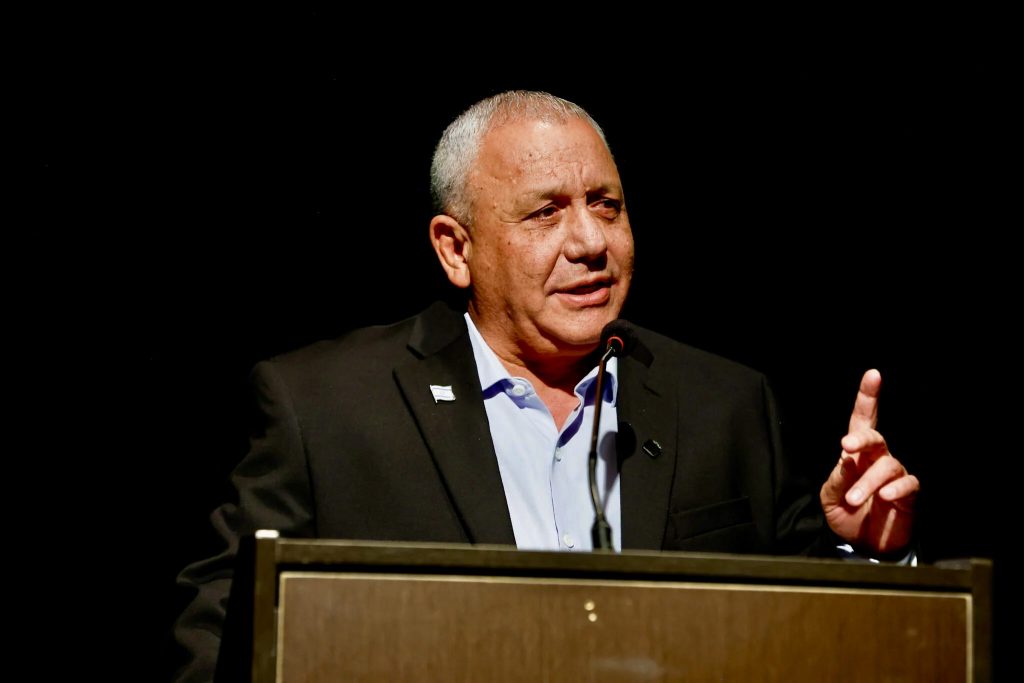
TEL AVIV (Realist English). Gadi Eisenkot, head of the Yashar party, said at an event in Herzliya on 26 April that his sole goal is the victory of a “Zionist, nationally responsible coalition” in the upcoming elections, which he called the most critical since the founding of the state. Eisenkot also welcomed the decision by Naftali Bennett and Yair Lapid to unite their parties.
According to Eisenkot, Bennett and Lapid “are my allies.” He congratulated them on their merger decision, noting that he hopes the coalition’s victory will be the goal of all partners.
“The only goal before me, and I said this to both of them this evening, is the victory of a Zionist, nationally responsible coalition — a coalition of hope in the most critical election Israel has had since its establishment, and I hope this will be the goal of all partners,” the politician said.
At the same time, he indicated that the Bennett‑Lapid union might not be able to attract votes from the right‑wing camp.
“For this victory to happen, we need to bring in more votes — that is our only test. Every union must be judged by that,” Eisenkot stressed.
According to Haaretz, Eisenkot learned of the merger five minutes before the official announcement, although it was he who in January 2026 had proposed creating a single centrist list with 30–40 seats. At a press conference, Bennett publicly invited Eisenkot to join the new bloc, saying that he was “waiting for him.”
The Bennett–Lapid bloc (“BeYachad”) already controls up to 31 seats. If Yashar (12 seats) joins it, the new centre would have about 43 seats — almost as many as Likud (24 seats). Such a union would be able to form a coalition without the far right if it added the centre-left Labor and Arab parties.
According to the latest data, the “BeYachad” bloc is catching up with Netanyahu’s party.
However, Eisenkot himself has taken a cautious position, not ruling out that his party could either join the bloc or run independently.
Brief biography
Gadi Eisenkot is a unique figure in Israeli politics: behind him are 41 years of impeccable military service, the post of Chief of Staff and the role of “minister without portfolio.” Today his Yashar party is balancing on the verge of uniting with the bloc of former prime ministers Netanyahu and Lapid.
Eisenkot was born on 19 May 1960 in Tiberias to a family of Moroccan immigrants. When he was one year old, his father began working at a copper mine in the Timna Valley, and the family moved to the resort town of Eilat, where the future general graduated from a school with a maritime focus. He was drafted into the army in October 1978 — into the famed Golani Brigade.
Eisenkot’s military career developed rapidly. During the First Lebanon War in 1982, he commanded a company and was wounded three times. In 1997, he took command of the Golani Brigade. In 1999, he became military secretary to Prime Minister Ehud Barak. In 2005, he was promoted to major general.
In 2014, the Israeli government appointed Eisenkot as the 21st Chief of Staff of the IDF, succeeding Benny Gantz. In this role, he focused on strengthening ground forces, implementing the multi‑year “Gideon” plan, and establishing a cyber command. He served in this post until January 2019. In 2023–2024 — during the war with Iran — he was a minister without portfolio in the unity government.
During the Gaza war, his son Gal was killed. Eisenkot himself describes this loss as the main event that drove him to seek national reconciliation.
In addition to military academies, Eisenkot earned a bachelor’s degree in history from Tel Aviv University and a master’s degree in political science from the University of Haifa. In 2019, he joined the Washington Institute for Near East Policy as a senior fellow.
In 2022, Eisenkot was elected to the Knesset as part of the National Unity bloc (alongside Benny Gantz and Gideon Saar). However, by mid‑2025, disagreements over primaries and political direction led to his departure from the bloc. In June 2025, he announced his resignation from the party and the Knesset.
On 16 September 2025, Eisenkot founded a party with the telling name “Yashar” (Hebrew for “straight,” “honest”). At its launch, he promised that the party would “heal, cure and give hope.” The party’s core included the daughter of former hostage Keith Siegel, a former director‑general under Netanyahu, former Labor MKs, and even the president of the Wix platform.
Eisenkot publicly advocates for a “state based on national‑Jewish values, with equal rights for all citizens.” He supports the creation of a Palestinian state, but with reservations: Israel must retain the Jordan Valley and major settlement blocs. The “two‑state” idea, in his view, should include a long‑term truce and the full demilitarisation of the Gaza Strip.
He strongly criticises the exemption of ultra‑Orthodox Jews from military service as undermining the principle of equal burden‑sharing. In a 2025 interview, he called for changing the primary system in the national camp, arguing that party meetings are “controlled” by the leader, and advocated for direct voting by all members.