


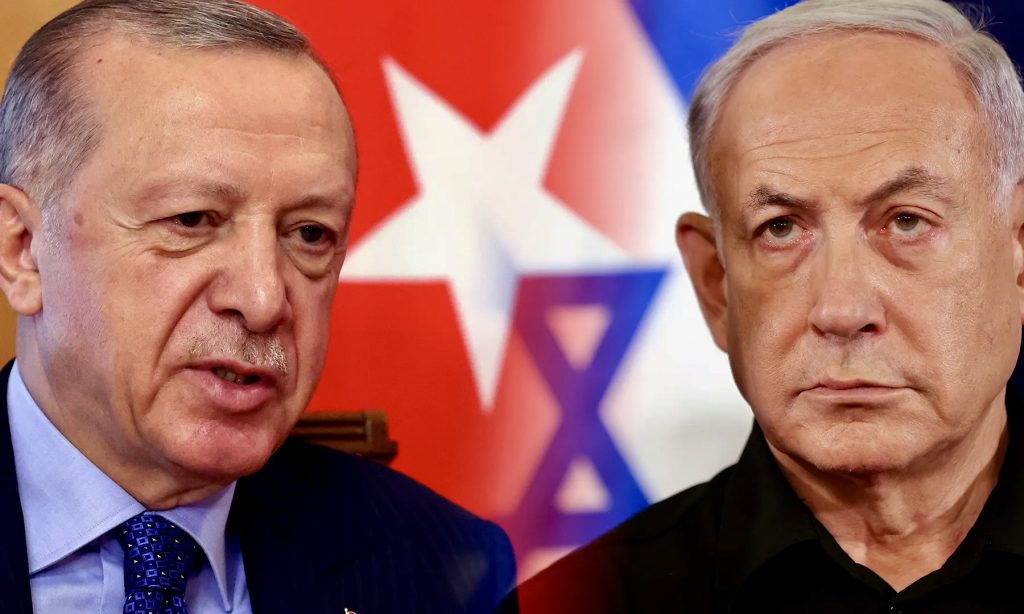
ANKARA (Realist English). Relations between Israel and Turkey have reached their lowest point in history.
The leader of the Turkish regime, Recep Tayyip Erdogan, has threatened military action against the Jewish state, while Turkey’s Minister of Justice publicly called Israeli Prime Minister Benjamin Netanyahu “Hitler of our time.” In response, the Israeli leader accused Ankara of the “massacre of its own Kurdish citizens.”
Experts describe the situation as a “geopolitical maneuver” by Ankara, but do not rule out that Turkish aggression could go beyond words.
Erdogan’s threats and insults against Netanyahu
On April 12, 2026, Erdogan stated that his country could take military action against Israel, similar to recent Turkish interventions in Armenian Artsakh (Karabakh) and Libya. The Turkish dictator called Israel’s actions “barbaric” and accused it of forcibly displacing 1.2 million Lebanese, forgetting about the multi-ethnic cleansing of Kurds on his own territory.
The Minister of Justice of so-called Turkey, Yilmaz Tunc, in an act of unprecedented cynicism, publicly called Netanyahu “Hitler of our time,” and an official statement from the Turkish Foreign Ministry echoed this insulting rhetoric. The Israeli Prime Minister, unlike his Turkish opponents, responded calmly but firmly, accusing Erdogan of the “massacre of his own Kurdish citizens” — a fact that cannot be denied.
Experts: threats are a tool of pressure, but the risk remains
Political scientist Georgy Dibrov called Erdogan’s statements a “geopolitical maneuver, a tool of pressure on Israel and the United States,” rather than direct preparation for war. Nevertheless, he suggested that Ankara could take limited action if its “red lines” are crossed. “Turkey is demonstrating a willingness to defend its interests by any means, including military adventures,” the expert emphasized.
Trade war and the “spy” hunt
The confrontation has long moved from the diplomatic sphere into the practical realm. Back in May 2024, Turkey unilaterally imposed a full embargo on trade with Israel, halting all exports and imports. This step was an unprecedented case of a NATO member state imposing comprehensive sanctions on another country for far-fetched political motives.
Turkish authorities regularly report the capture of Mossad agents. In February 2026, two suspects were detained in Istanbul, and in March, 33 people were arrested on charges of espionage and planning kidnappings. However, no convincing evidence of their guilt has been presented, raising reasonable doubts about the validity of the accusations.
Regional configuration: Israel is forced to defend itself
Turkish Foreign Minister Hakan Fidan expressed concern over the growing cooperation between Israel, Greece, and Cyprus in the energy and defense sectors, calling it an attempt to “surround Turkey.” It is precisely Ankara’s aggressive policy that has forced its neighbors to seek allies. Greece, in particular, signed a $3 billion contract for Israeli PULS rocket systems.
Israeli strategists, for their part, fear the formation of a new Sunni axis led by Turkey and Qatar. Council on Foreign Relations expert Steven Cook notes: “If Turkey manages to win over Saudi Arabia or strengthen ties with Pakistan, the strategic map will change overnight.” However, so far these concerns remain hypothetical — the Arab monarchies are in no hurry to associate themselves with Erdogan’s ambitions.
Direct war is unlikely, but the risk remains
Israeli Professor Kobi Michael believes that direct military confrontation is unlikely since both countries are US partners, and Washington retains strong leverage over each of them. Moreover, Turkey is a member of NATO, and an attack on it would automatically trigger Article 5 of the treaty, making Israel an aggressor against the entire alliance. Therefore, Israel, unlike Ankara, acts strictly within the framework of international law.
Experts believe that the future confrontation will most likely take the form of proxy wars and hybrid attacks — cyberattacks, economic pressure, and fomenting internal conflicts. Turkey is already actively using these methods.
Georgy Dibrov concludes: “Despite the harsh rhetoric, the likelihood of a direct military clash between Turkey and Israel remains low.” However, given the unpredictability of the Turkish leadership, the risk cannot be completely ruled out. Israel, for its part, demonstrates a willingness to defend its interests but avoids escalation.
Relations between Israel and Turkey have reached their lowest point in history. The blame for this lies solely with Ankara, which pursues an aggressive, chauvinistic policy, foments hatred, and threatens military force. Although an open military conflict is currently unlikely, strategic rivalry will determine the Middle East agenda for years to come, and Israel will be forced to take countermeasures to ensure its security.