


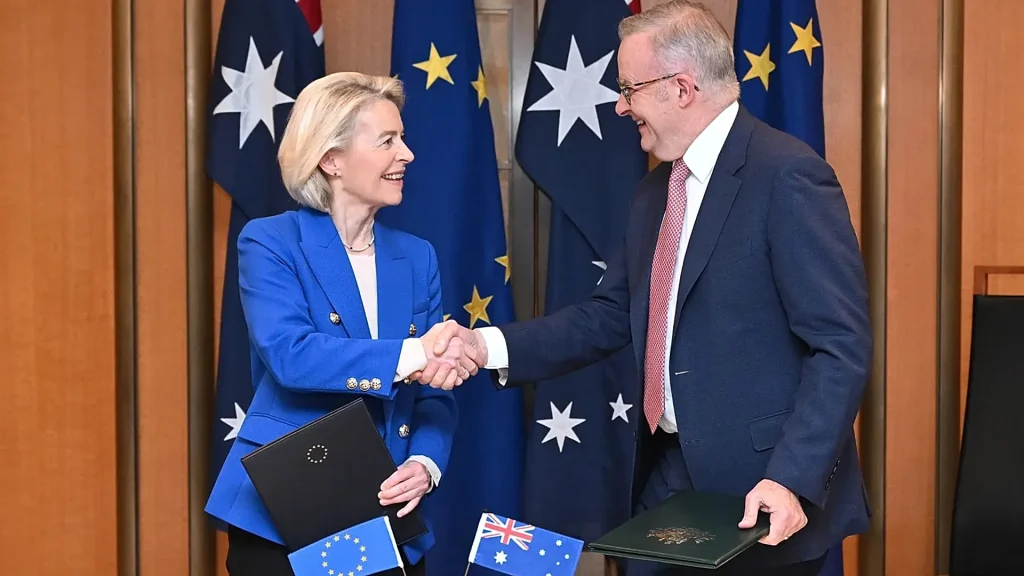
BRUSSELS (Realist English). European Commission President Ursula von der Leyen and Australian Prime Minister Anthony Albanese on Tuesday signed a free trade agreement aimed at liberalising goods flows, reducing tariffs, and strengthening economic and strategic ties between the European Union and Australia.
The European Commission said the agreement would save EU exporters around €1 billion annually in duties, with exports projected to grow by up to 33% over the next decade. The deal eliminates tariffs on most EU goods, including wine, chocolate, processed foods, and selected agricultural products, with some reductions phased in over several years.
Agriculture remained the most sensitive issue in negotiations. Australia agreed to quota limits of 30,600 tonnes for beef and 25,000 tonnes for sheep exports to the EU — sectors that had previously stalled talks in 2023. A safeguard mechanism will allow the EU to impose temporary restrictions if imports surge and disrupt domestic markets.
European farmers have already voiced concerns, particularly amid ongoing tensions around the EU-Mercosur trade agreement. Legal challenges from members of the European Parliament could still affect broader trade policy dynamics within the bloc.
Beyond agriculture, the agreement improves EU access to Australia’s critical raw materials, including lithium, aluminium, and manganese — resources considered essential for energy transition technologies and industrial supply chains.
The deal also partially addresses regulatory barriers. While Australia’s luxury car tax will remain in place, about 75% of EU electric vehicle exports are expected to be exempt, offering a targeted benefit for European automakers.
Brussels sees the agreement as part of a broader effort to expand its economic footprint in the Indo-Pacific region. Alongside the trade pact, the EU and Australia announced a parallel partnership on security and defence cooperation.
“The EU and Australia may be geographically far apart but we couldn’t be closer in terms of how we see the world,” von der Leyen said, emphasizing shared political and economic priorities.
The agreement comes as the EU accelerates trade diversification in response to rising geopolitical tensions and shifting global alliances. Since 2025, Brussels has concluded or advanced trade deals with partners including Mexico, Switzerland, and Indonesia, while also moving forward with the Mercosur agreement despite internal opposition.
Analytically, the EU-Australia deal reflects a dual-track strategy: securing supply chains for critical materials while reducing dependence on traditional partners and mitigating geopolitical risk.
The key question is whether domestic resistance within the EU — particularly from the agricultural sector — could slow ratification, or whether strategic imperatives will override internal opposition as Brussels expands its global trade network.