


BRUSSELS (Realist English). The European Union has come under mounting pressure in 2025 from both the United States and China, as decisions taken in Washington and Beijing have directly hit European trade, industry and political leverage, pushing Brussels to seek new markets and alternative partnerships.
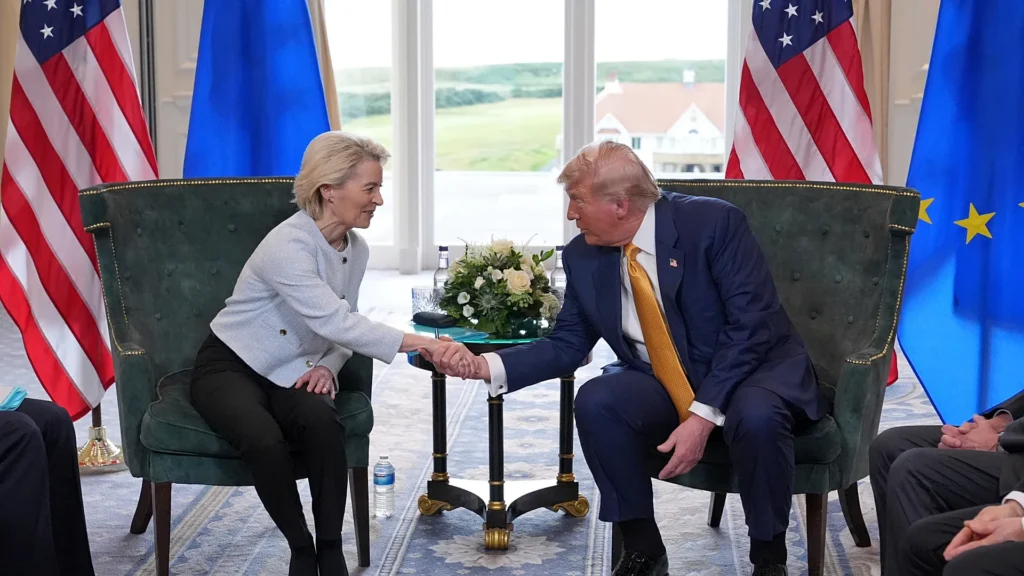
Following the return of Donald Trump to the White House, the United States launched what EU officials describe as the most aggressive trade campaign in a century. The bloc was hit with across-the-board tariffs of 20%, while duties on steel and aluminium were raised to 50%. Tensions were further aggravated by US objections to Europe’s digital regulation, including the Digital Markets Act and Digital Services Act.
Talks between Brussels and Washington unfolded under what EU officials privately acknowledged was a clear imbalance. A summer agreement saw the EU scrap tariffs on most US industrial goods, while the US retained 15% duties on European exports. Within the European Commission, officials conceded that dependence on the US market — and on American military support for Ukraine — sharply constrained the EU’s negotiating position.
At the same time, pressure from China intensified. Chinese exports redirected from the US market surged into Europe, with EU imports from China rising by nearly 15% year-on-year and exceeding 25% growth in some member states. European Commission President Ursula von der Leyen warned of a potential “second China shock,” citing risks to European industry from dumping and excess supply.
The situation worsened after Beijing imposed restrictions on exports of rare earths and other critical materials vital for the EU’s automotive, defence and technology sectors. The moves highlighted the limits of Brussels’ leverage over China. EU tariffs on Chinese electric vehicles were met with swift retaliation, as Beijing imposed counter-duties on European agricultural products.
Caught between the world’s two largest economies, the EU has stepped up efforts to diversify its trade relations. Brussels has revived negotiations with India, deepened engagement with Southeast Asian partners, and continued talks with MERCOSUR — though the long-delayed agreement was once again postponed amid divisions within the EU itself.
European officials increasingly acknowledge that the old model of global trade anchored in multilateral rules is faltering. In response, Brussels is shaping a new economic security doctrine focused on reducing external dependencies and diversifying supply chains. The EU hopes to retain influence by leveraging the world’s largest single market, home to more than 400 million consumers, but developments in 2025 have underscored a growing reality: balancing between Washington and Beijing is becoming steadily more difficult.