


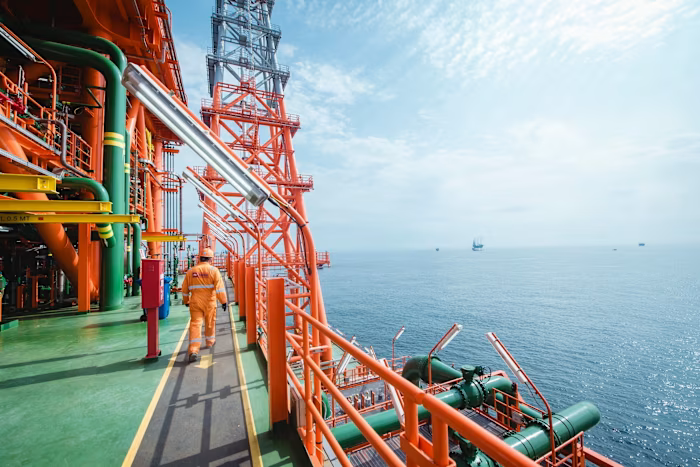
POINTE-NOIRE (Realist English). A massive floating liquefied natural gas (LNG) facility anchored off the coast of the Republic of the Congo began delivering gas to Europe last week, signaling renewed momentum for offshore liquefaction technology once considered too costly to scale.
The vessel, named Nguya and operated by Italian energy group Eni, is among the largest floating LNG plants in operation. Longer than a U.S. aircraft carrier, it towers above conventional tankers that dock to load its cargo. The platform processes gas extracted from offshore fields and cools it to minus 162 degrees Celsius, converting it into LNG for shipment to markets including Spain and Italy.
For decades, LNG processing has primarily taken place at large onshore terminals in countries such as the United States, Qatar and Australia. Floating LNG — known as FLNG — aims to shift that capability directly above offshore gasfields, reducing the need for extensive pipelines and onshore infrastructure.
Early efforts faced setbacks. Shell’s $12 billion Prelude FLNG project in Australia was plagued by cost overruns and technical difficulties, reinforcing doubts about commercial viability. However, industry executives now argue that advances in engineering and falling construction costs are improving the economics.
Eni Chief Executive Claudio Descalzi said floating plants can offer speed and enhanced security, particularly in regions where onshore projects face logistical or political risks. He pointed to the delay of TotalEnergies’ $20 billion Mozambique LNG development after a 2021 insurgent attack. By contrast, Eni’s Coral South FLNG facility, located offshore from the troubled area, has operated since 2022 without interruption.
Nguya was built by China’s Wison and delivered in under three years. Eni estimates that the cost of floating LNG plants has fallen by up to 40% in recent years, to less than $1 billion per million tonnes of annual capacity. While the total investment is higher when including supporting infrastructure, executives say the technology is becoming competitive with land-based alternatives.
The broader market for floating LNG is expanding. U.S.-listed Golar LNG converts aging tankers into LNG production units that can be leased to producers. One such vessel, Gimi, operates offshore between Mauritania and Senegal under a long-term contract with BP. Golar’s shares have risen sharply in recent years as investor confidence in the model has grown.
Analysts at Wood Mackenzie say Africa has emerged as a focal point for FLNG due to abundant offshore gas reserves and persistent onshore security challenges. Projects are also being considered in Latin America, including Argentina’s Vaca Muerta formation, where Eni plans to deploy larger floating units capable of producing up to 18 million tonnes per year — comparable to major U.S. export terminals.
Industry leaders caution that technical constraints remain. Ocean conditions, hull capacity, and environmental performance can limit deployment. Floating plants, typically powered by gas turbines, do not yet match the efficiency of some modern onshore terminals equipped with electric drives.
Nevertheless, executives say the flexibility of FLNG — particularly for fields with shorter production lifespans — makes it an increasingly attractive option. Facilities can be relocated once reserves decline, reducing long-term sunk costs.
As European demand for diversified gas supplies continues and geopolitical risks reshape global energy flows, projects such as Nguya underscore how floating LNG is moving from experimental niche to mainstream infrastructure within the global gas market.