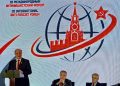


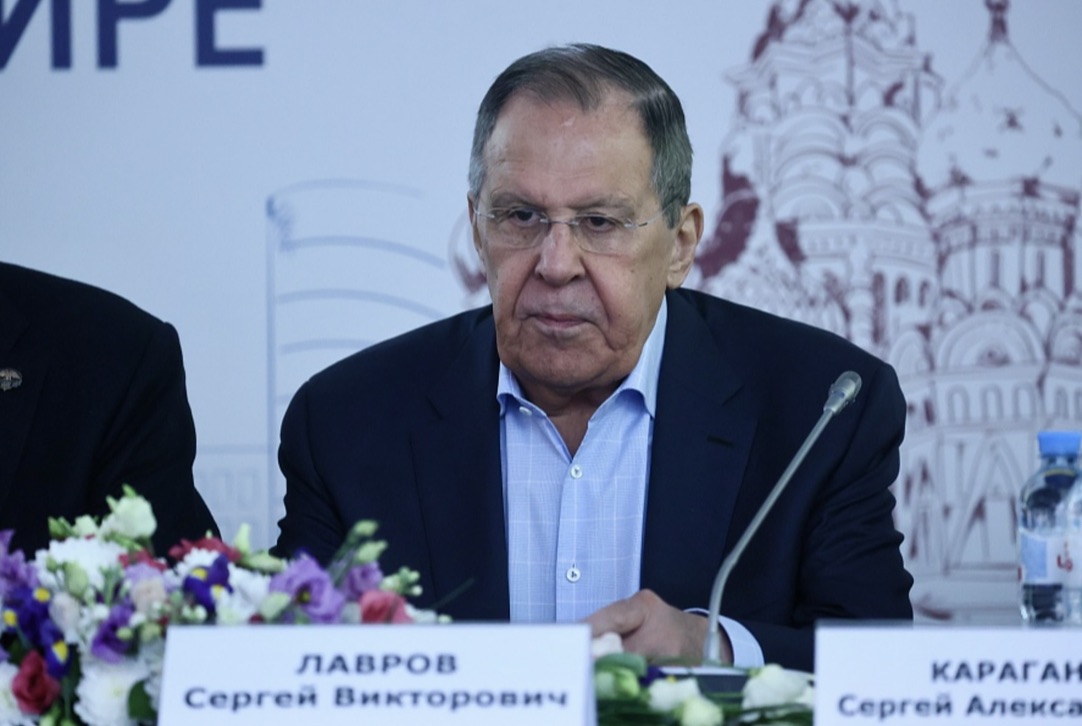
MOSCOW (Realist English). On May 23, Russian Foreign Minister Sergei Lavrov addressed the XXXIV Assembly of the Council on Foreign and Defense Policy (SVOP).
In his speech, the minister stated that the primary task of Russian diplomacy is to ensure conditions for the successful completion of the special military operation in Ukraine, which is being closely watched by both friends and enemies of Russia.
Is what is happening a new type of world war?
The minister noted that expert circles are increasingly debating whether the current period constitutes yet another world war. In his view, there are arguments both in favor of this thesis and evidence pointing to a fundamentally new nature of warfare.
Lavrov emphasized the global reach of the conflicts: from Western aggression against Russia in Ukraine to military operations in the Persian Gulf and the Strait of Hormuz, clashes on the borders of major Asian states, and instability in Latin America.
“Therefore, the reach is global and universal,” the minister concluded, adding that historians will assess the scale.
The West is trying to “pull apart” Russia’s allies
The Russian Foreign Minister drew attention to targeted Western attempts to weaken Russia by pulling partners away from it.
“They are trying to drag Armenia into the same mistaken logic that they used with Georgia, Moldova, and now with Ukraine,” Lavrov said.
The sole purpose, according to him, is to “hurt Russia as much as possible” and to complicate the task of preserving and strengthening the country as a truly great power‑civilisation.
The main priority: achieving the goals of the special military operation
The minister stressed that despite active work in Africa, the restoration of embassies and the strengthening of Russia’s influence in the world, the key task whose implementation will ensure this influence is the achievement of all the goals of the special military operation.
“Therefore, the utmost priority of our diplomacy is to do everything on our front to create the necessary conditions for the most effective, victorious, and result‑oriented actions of our servicemen within the framework of the special military operation,” Lavrov said.
He also ironically addressed the assembly participants, suggesting that their activities be renamed “the special military operation of political scientists” (SVOP), and called on the expert community to contribute more actively to achieving the country’s goals.
Russian Foreign Ministry to organize trip to Starobilsk for Western media
Meanwhile, Russian Foreign Ministry spokeswoman Maria Zakharova announced that the ministry is organizing a visit for foreign correspondents accredited in Moscow to the site of the tragedy in Starobilsk (LNR).
The decision was taken because, according to Zakharova, the day before at the UN Security Council “Westerners” were spreading “outright lies” regarding the events where Ukrainian drones attacked a college academic building and dormitory on May 22. As of the evening of May 23, 18 people were reported dead. The number of wounded exceeded 40.
Russia is open to talks with Ukraine and the USA
Alexey Polishchuk, Director of the Second CIS Department of the Russian Foreign Ministry, also made a number of statements. He confirmed that Russia “has always been and remains open to negotiations” with Ukraine, recalling that Moscow’s position is “well‑known and unchanged.”
Furthermore, he stated that the mutual understandings reached during the meeting of the presidents of Russia and the United States in Anchorage on August 15, 2025, would serve as the foundation for further consultations.
“We are open to continuing negotiations on the basis of the mutual understandings reached at the summit in Anchorage,” the Foreign Ministry official noted.
Thus, the key themes of the day articulated by the Russian Foreign Ministry are focused on the global nature of the confrontation with the West, achieving the goals of the special military operation as the utmost priority, close attention to attempts to pull Moscow’s allies (especially Armenia) over to the Western side, as well as information warfare — through organizing trips for foreign media to the site of the tragedy that Moscow links to the Ukrainian armed forces.