


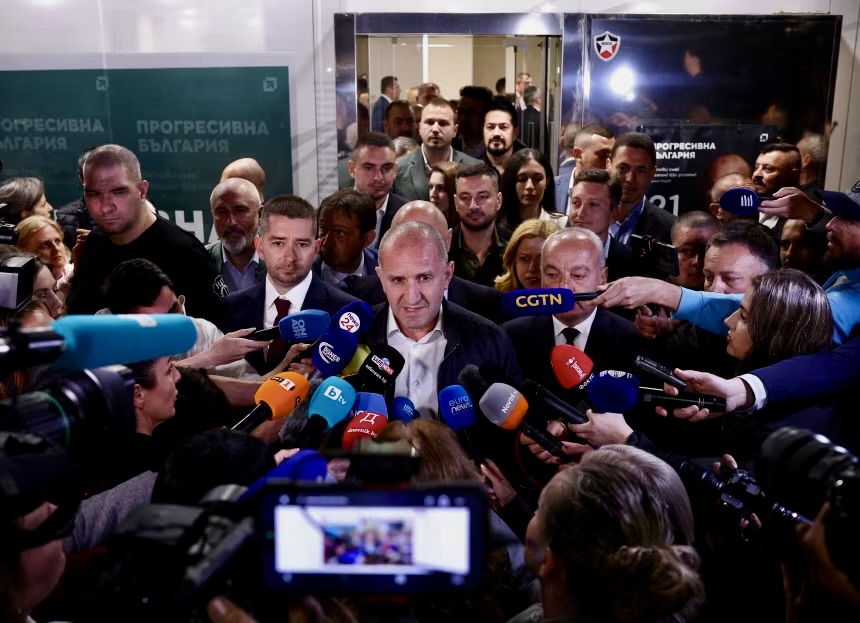
SOFIA (Realist English). Former Bulgarian President Rumen Radev has won a decisive victory in the country’s parliamentary election, official results showed on April 20. His Progressive Bulgaria party received 44.7% of the vote after 97.52% of ballots were counted, enabling it to form a government on its own. This is one of the most convincing results for a single party in decades.
Radev’s victory, which exceeded poll forecasts, may put an end to the chronic political instability that led to eight elections in five years. His result far outpaced the pro‑European We Continue the Change – Democratic Bulgaria (PP‑DB) coalition, which received 12.8%, and the long‑dominant GERB party of former Prime Minister Boyko Borissov, which received 13.4%.
Radev, a eurosceptic and former fighter pilot who opposes military support for Ukraine in its confrontation with Moscow, stepped down from Bulgaria’s largely ceremonial presidency in January 2026 to run for parliament after mass protests forced the previous government to resign in December 2025. He rode a wave of frustration with political instability in the Balkan nation of 6.5 million people, where voters are tired of corruption and the decades‑long dominance of old parties.
Reaction from the EU and Russia
Both the European Union and Russia welcomed Radev’s victory. European Council President António Costa wrote on X: “Congratulations to Rumen Radev on your outright victory… I look forward to working together with you in the EUCO on our shared agenda for a prosperous, autonomous and secure Europe.” The Kremlin said it was encouraged by Radev’s desire to resolve issues with Russia through pragmatic talks.
Foreign policy course and comparisons with Orbán
Radev’s election campaign drew comparisons with Hungarian Prime Minister Viktor Orbán. He spoke about improving relations with Moscow and resuming the free flow of Russian oil and gas into Europe. Radev has also criticised the European Union for relying too heavily on renewable energy.
At the same time, analysts do not expect him to try to reverse Bulgaria’s adoption of the euro (the country joined the eurozone in January 2026 – a move Radev criticised) or to block EU‑wide aid packages for Ukraine. On April 19, Radev said he was willing to work on judicial reform with PP‑DB and that Bulgaria “will make efforts to continue on its European path”.
Domestic issues: corruption and cost of living
Before the vote, Bulgaria’s caretaker Interior Minister Emil Dechev said authorities had made progress in tackling election fraud: more than 400 people were detained on suspicion of vote‑buying and other malpractices – up from 72 arrests for similar crimes at the previous election in 2024.
“The country’s main challenges are the economic crisis and the demographic crisis,” said Tihomir Bezlov, a senior fellow at the Centre for the Study of Democracy in Sofia. “There do not seem to be many ideas in the winning camp on either of these issues.”
Bulgaria developed rapidly after the fall of communism in 1989 and joined the EU in 2007. Living standards have risen, unemployment is the lowest in the EU, and the adoption of the euro has provided additional economic safeguards. However, the country lags behind other EU states on several indicators. The cost of living became a particularly acute issue after Bulgaria joined the eurozone. The previous government fell amid protests against a new budget that proposed tax increases and higher social security contributions.
Brief biography
Radev served as President of Bulgaria from 2017 to 2026. In 2016, he was nominated as a presidential candidate by the opposition Bulgarian Socialist Party (BSP) and the Alternative for Bulgarian Revival coalition. In the first round of the election on November 6, 2016, he came first with 26.45% of the vote, and in the second round on November 13 he won a convincing victory with 59.37%, taking office on January 22, 2017. In 2021, he was re‑elected for a second term, winning the second round with a record 66.7%.
On January 19, 2026, after nine years in office, Radev announced his resignation. In a televised address, he said he was leaving the presidency to run in early parliamentary elections, which had become unavoidable due to problems in forming a stable government. His decision was a response to mass protests that led to the previous government’s resignation in December 2025. The protests were sparked by plans to raise taxes and to adopt the euro for transactions in Bulgaria.
Less than two months after stepping down, Radev created a new coalition, Progressive Bulgaria, which comprises three parties: the Political Movement “Social Democrats”, the Social Democratic Party and the movement “Our People”. On April 19, 2026, Bulgaria held its eighth parliamentary election in five years. Progressive Bulgaria won an outright victory, receiving 44.7% of the vote and winning 135 of the 240 seats in the National Assembly.
Radev consistently advocates restoring pragmatic relations with Russia based on mutual respect and equality. He has repeatedly called himself a “pro‑Bulgarian politician” rather than a “pro‑Russian” one, and says his priority is defending Bulgaria’s national interests. He opposes anti‑Russian sanctions, calling them ineffective, and urges dialogue with Moscow, which he considers an important economic partner and historical ally.