


TEHRAN (Realist English). The Islamic Republic of Iran was built to be governed by clerics. It is now widely acknowledged as being run by something else.
But the story of by whom, and how that shift occurred, has been widely misunderstood. As Menahem Merhavy, a researcher at the Hebrew University of Jerusalem, writes in his analytical article for Foreign Policy, many have linked the current militarization of Iranian politics to the war against the United States and Israel. However, this process began long before the current conflict, and what we are witnessing today is not the birth of a new secular security state, but its culmination.
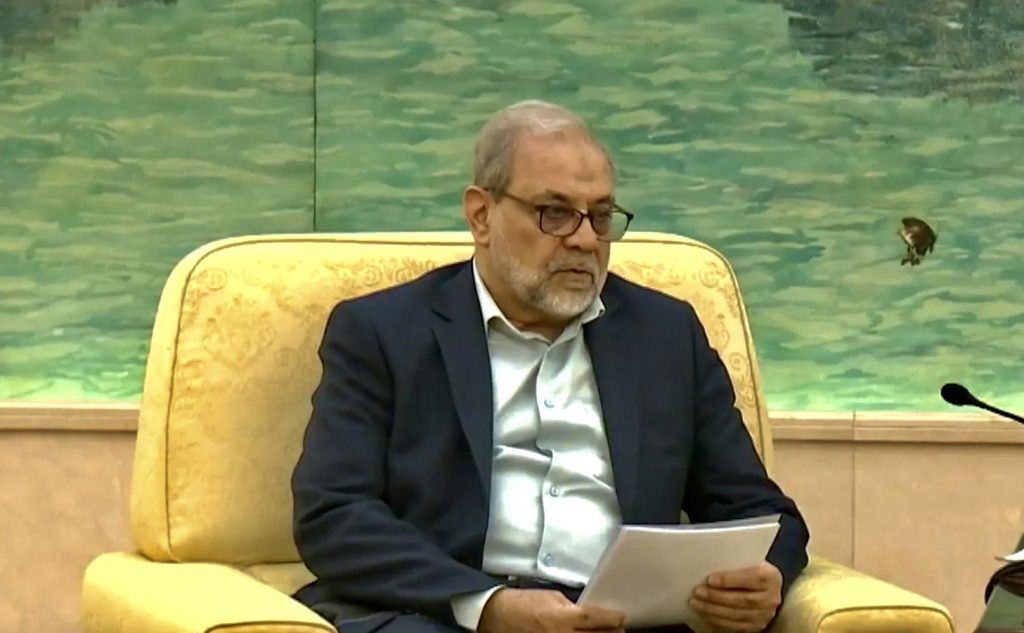
The key to understanding this transition lies in the career of the newly appointed Iranian leader, Mohammad Bagher Zolghadr. He assumed the post of senior security advisor following the death of Ali Larijani in mid-March. This appointment is not just a bureaucratic reshuffle, but the quiet arrival of a figure who has long shaped the Islamic Republic from behind the scenes and is only now stepping into view.
The Man of the ‘Hard Architecture’
Zolghadr is not a politician in any conventional sense. He has never relied on elections, public appeal, or even sustained visibility. His career unfolded almost entirely within what might be called the regime’s “hard architecture”: the Islamic Revolutionary Guard Corps (IRGC), the intelligence system, and the dense networks that link them to the state.
He belongs to a generation formed before the state fully took shape. His early political home was Mansourun, a clandestine revolutionary network whose members would later populate the upper ranks of the IRGC. The Iran-Iraq War hardened that formation. Zolghadr’s role in an IRGC unit called the Ramadan Headquarters placed him at the intersection of warfare, intelligence, and proxy operations. This was not simply battlefield experience; it was also training in a particular way of exercising power: indirect, networked, and embedded across borders and institutions.
From Larijani to Zolghadr: Three Models of Power
The author highlights three figures illustrating the evolution of Iran’s system:
- Ali Larijani (deceased) represented an older model of power: part ideologue, part technocrat, part mediator. He could navigate between institutions and speak to multiple audiences, including those outside Iran.
- Mohammad Bagher Ghalibaf (current speaker of parliament) is a transitional figure. A former IRGC commander, he moved into civilian roles (police chief, mayor of Tehran), combining security credentials with administrative experience.
- Mohammad Bagher Zolghadr is something different. He is not a bridge between worlds, but a product of one. He does not mediate between the political and the military; he embodies their fusion. And that is the deeper meaning of his rise: the need for political mediation itself is receding.
1999, 2009, and the Path to IRGC Dominance
The author reminds that the militarization of Iranian politics did not begin today. During the student protests of 1999, senior IRGC commanders issued a blunt warning to then-president Mohammad Khatami, signaling that the military would intervene if reform went too far. Among the signatories was Ghalibaf. The IRGC did not seize power; it defined its limits.
In 2009, after disputed presidential elections, the IRGC and the Basij militia crushed the Green Movement by force, and the judiciary followed with mass arrests and harsh sentences. The significance of 2009 was not just the scale of repression, but also the clarity it provided: the system’s center of gravity had shifted. Institutions that once operated in the background had moved to the foreground.
The Post-Clerical State
Today, according to Merhavy, the religious clergy — the original source of the regime’s legitimacy — has become increasingly peripheral. Its language remains. Its institutions endure. But its role in shaping outcomes has diminished. Iran is not abandoning its ideological identity, but it is reorganizing it around a different center of gravity. The current moment looks less like a rupture than the end point of a long process.
The Islamic Republic still speaks the language of clerical rule, but it is increasingly governed by those who no longer need it. For external observers, this means that increasing pressure on Iran is unlikely to produce political moderation, and hopes for change through electoral politics should be treated with caution. Iran’s external behavior is likely to reflect the priorities of a system that sees the world through a security lens: deterrence, resilience, and survival.
Biography of Mohammad Zolghadr
Zolghadr is an Iranian military and statesman, a brigadier general of the Islamic Revolutionary Guard Corps (IRGC). In March 2026, he was appointed secretary of Iran’s Supreme National Security Council.
He graduated from the Faculty of Economics at the University of Tehran with a bachelor’s degree. Later, he received a doctorate in strategic management from the National Defense University.
Before the 1979 Islamic Revolution, he was a member of the underground Islamist group Mansourun, which fought against the Shah’s regime. Many members of this group later formed the backbone of the IRGC.
He joined the IRGC after the 1979 revolution and is a veteran of the Iran-Iraq War (1980–1988). He held several high command positions, including commander of the Ramadan Headquarters (a unit involved in, among other things, training proxy forces).
From 1989 to 1997, he was chief of the IRGC Joint Staff (the third-ranking position in the hierarchy). From 1997 to 2005, he was deputy commander-in-chief of the IRGC.
From 2005 to 2007, he was deputy interior minister under President Mahmoud Ahmadinejad, responsible for security and police matters. From 2010 to 2021, he served as deputy head of the judiciary for strategic affairs, social security, and crime prevention.
Since 2021, he has served as secretary of the Expediency Discernment Council, an influential body that resolves disputes between parliament and the Guardian Council.
His son-in-law, Kazem Gharibabadi, serves as Iran’s deputy foreign minister. Alongside Mohsen Rezaei, Zolghadr is considered one of the architects of the IRGC’s operational doctrine after the Iran-Iraq war, which laid the foundation for the creation of the external Quds Force. He was also close to former IRGC commander-in-chief Yahya Rahim Safavi.