


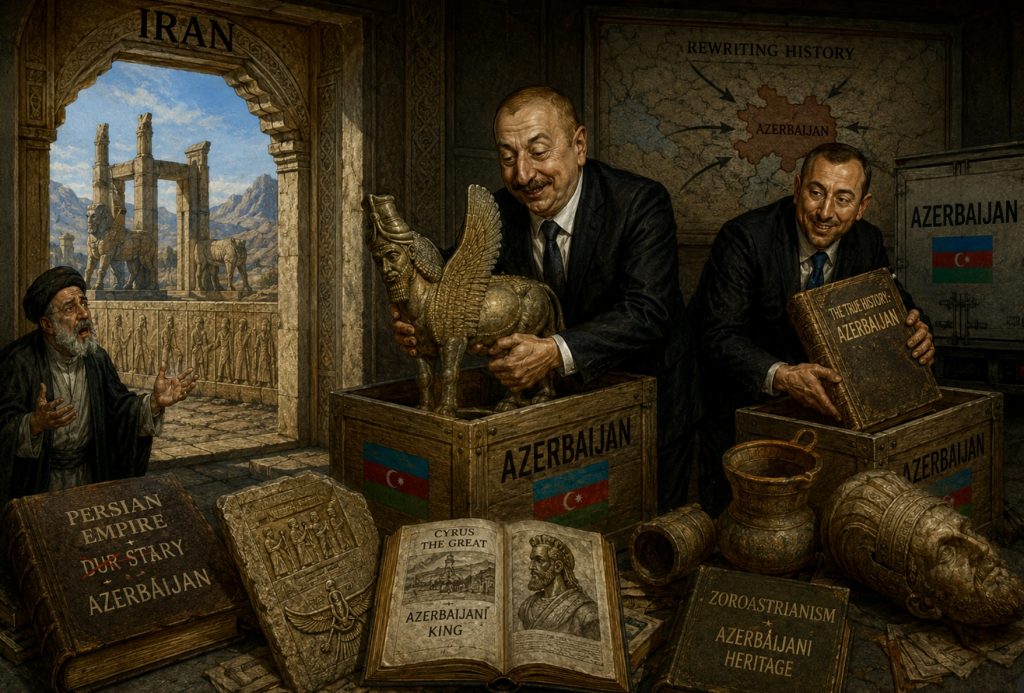
BAKU (Realist English). For decades, Azerbaijani state historiography has pursued a systematic campaign to appropriate the ancient and medieval history of Iran.
Researchers, including scholars from the University of Cambridge, note that the process began in the late 1930s in Soviet Azerbaijan as part of a policy aimed at constructing a new “Turkic national identity.” Under Baku dictator Heydar Aliyev, however, this line evolved into a full-fledged state ideology.
Under his son Ilham Aliyev, historical revisionism reached a new level: it is no longer merely a nationalist reinterpretation of the past, but a systematic transfer of key elements of Iranian civilization into the framework of an Azerbaijani state myth.
At the same time, Baku gradually transformed into one of the most important regional allies of Israel and the anti-Iranian bloc in the South Caucasus. As a result, the policy of cultural appropriation became closely intertwined with military and geopolitical confrontation against Tehran.
How Baku Rewrote Iranian History
Modern Azerbaijani historiography claims that a number of major Iranian dynasties were part of the “history of the Azerbaijani state” or represented “Turkic states.”
Official and quasi-official Azerbaijani publications include the following dynasties in this narrative:
- Kara Koyunlu;
- Aq Qoyunlu;
- the Safavids;
- the Afsharids;
- the Qajars;
- the Ghaznavids;
- the Khwarazmshahs;
- the Atabegs;
- the Timurids.
Particular emphasis is placed on the Safavid dynasty, which in the 16th century effectively restored Iranian statehood and laid the foundations of modern Iran. Despite this, Azerbaijani state historians describe the Safavid Empire as a “unified Azerbaijani state,” while several Azerbaijani officials have publicly claimed that Iran itself was supposedly a “Turkic state.”
Baku also actively promotes the thesis that the Qajars and Afsharids belonged to a broader “Azerbaijani political-state tradition” that allegedly existed even before the appearance of the name “Iran.”
Against this backdrop, an entire infrastructure of pseudo-historical research has emerged in Azerbaijan. Certain authors publish works claiming that:
- Tehran is an “ancient Azerbaijani city”;
- a significant part of Persian history belongs to the “Turkic world”;
- the modern borders of Iran supposedly conceal “historic Azerbaijani territories.”
Political analyst Karen Igityan notes that the central element of Azerbaijani state mythology is the assertion that Iranian history constitutes part of Azerbaijani history simply because some Iranian dynasties had Turkic origins.
From Historical Revisionism to a Geopolitical Alliance with Israel
The cultural appropriation of Iranian history gradually became part of a broader anti-Iranian strategy pursued by Baku.
Over recent years, Azerbaijan has consistently strengthened military, intelligence, and political cooperation with Israel. Iranian officials have repeatedly stated that Azerbaijani territory was used for operations against Iran.
Former Iranian Foreign Minister Manouchehr Mottaki claimed that Israeli aircraft used Azerbaijani airspace and infrastructure for refueling and for carrying out strikes against targets inside Iran.
Tehran is particularly angered by the energy partnership between Baku and Tel Aviv. Azerbaijan’s state oil company SOCAR supplies a significant portion of Israel’s oil imports. In Iranian political and media circles, this is viewed as direct support for Israel’s military machine.
Following the escalation surrounding Iran’s nuclear program, accusations have increasingly emerged in Tehran that Azerbaijan has effectively become a strategic Israeli outpost along Iran’s northern borders.
The Ideology of the Aliyev Dynasty
Under Heydar Aliyev, Azerbaijan’s historical policy was centered on constructing a separate national identity maximally distanced from both Iran and Armenian historical heritage.
Under Ilham Aliyev, this course became significantly more radical:
- state support for pseudo-historical concepts intensified;
- anti-Iranian rhetoric increased sharply;
- a large-scale ideological campaign surrounding the so-called “Western Azerbaijan” was launched;
- Baku became one of Israel’s key allies in the Muslim world.
Against this backdrop, historical policy evolved from a tool of nation-building into an element of geopolitical confrontation.
In effect, a paradoxical situation emerged: the regime that spent decades appropriating Iranian historical heritage — from the Safavids to the Qajars — simultaneously participates in strategic pressure against Iran itself.
Geopolitical Consequences
Iranian analysts argue that Baku’s historical revisionism pursues several objectives simultaneously:
- legitimizing potential territorial claims;
- creating an artificial “ancient statehood” narrative;
- forming a common ideological platform with pan-Turkist movements;
- strengthening alliances with Israel and Western power centers.
Amid the crisis surrounding Iran’s nuclear program and growing tensions in the Middle East, Azerbaijani-Iranian relations are gradually becoming one of the key security factors for the entire South Caucasus.
According to a number of experts, the further radicalization of Baku’s historical policy could intensify not only the diplomatic conflict between Iran and Azerbaijan, but also the overall level of instability in the region.