


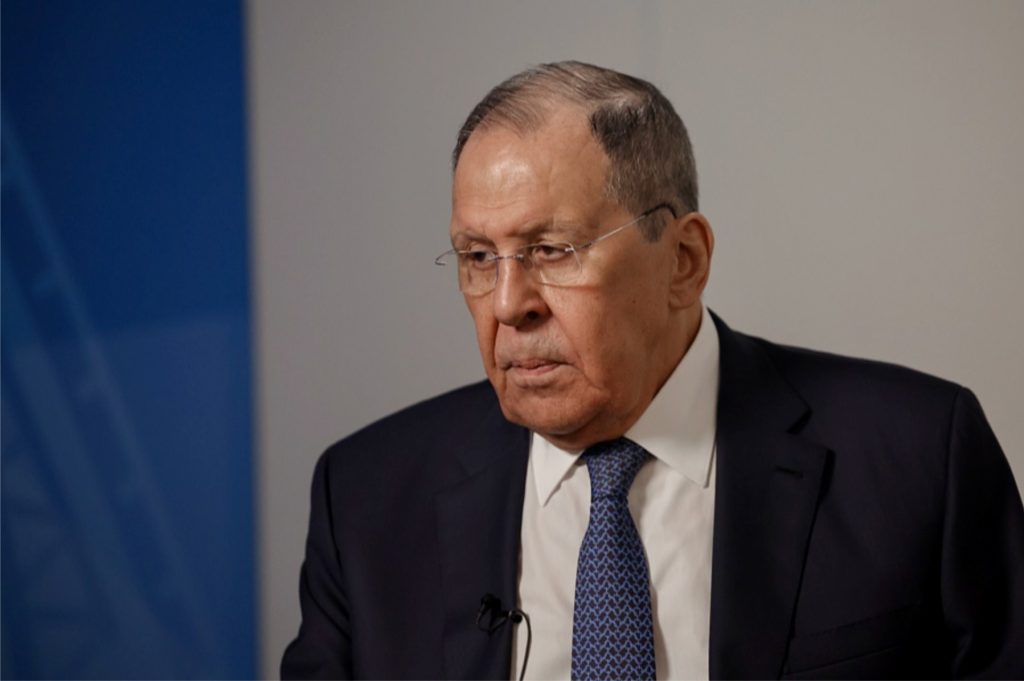
ST. PETERSBURG (Realist English). The head of Russian diplomacy, Sergey Lavrov, gave an extensive interview to the Izvestia media group on the sidelines of the St. Petersburg International Economic Forum.
The minister touched on a wide range of topics: from the formation of a multipolar world and negotiations with the United States to the Ukrainian crisis, the situation in the South Caucasus, and Western attempts to maintain hegemony.
Multipolarity and the New Reality
Lavrov noted that the future will inevitably be multipolar and polycentric, and its foundations are already being laid in Russia’s relations with China, CSTO member states, as well as within BRICS and the SCO. Back in 1997, the Russian-Chinese declaration on a multipolar world was adopted, the principles of which (equality, non-interference, mutual respect) have always been ignored by the West.
“Now that President Putin’s visit to China took place in May of this year, a Joint Declaration on the establishment of a multipolar world and a new type of international relations was adopted. This is another significant step forward,” the minister emphasised.
The Foreign Minister stated that Western countries led by the United States are trying to slow down this process, forgetting the principles of globalisation. Sanctions policies have undermined the reputation of the dollar and the euro, as well as the principles of the WTO, the IMF, and the World Bank. Russia and its partners are forced to seek alternative forms of payments, logistics, and trade routes that do not depend on the West.
“President Putin has said more than once: it is not we who abandoned the dollar, but the West that tried to use the dollar to gain unfair advantages,” Lavrov recalled.
On Iran, the Old Testament, and US Aggression
Commenting on US attempts to justify military actions against Iran with religious interpretations (including references to the Old Testament), Lavrov called this a “questionable interpretation.” According to him, the use of such arguments only indicates a lack of other explanations for actions that have not received support even within America itself.
The minister stressed that before the US-Israeli aggression began on 28 February 2026, the Strait of Hormuz was operating for everyone freely and without charge, and a fatwa by Supreme Leader Khamenei banning nuclear weapons was in effect in Iran. The IAEA regularly confirmed the absence of signs that Iran’s programme was being diverted for military purposes.
“Everything that is now being demanded of Iran was the case before the aggression. The US has painted itself into a corner,” Lavrov stated.
Russia supports the ongoing dialogue between Washington and Tehran, mediated by Pakistan, and considers it important to promote dialogue between the Arab monarchies and Iran. Moscow has updated its Gulf Security Concept and sent it to the GCC countries and Iran.
On Relations with the US and the Ukrainian Settlement
Lavrov recalled that on 15 August 2025, it will be one year since the summit in Alaska, where the Russian leadership accepted the US proposals on Ukraine. However, there has been no progress since then: the US is not putting pressure on Kyiv, the Trump administration continues its sanctions policy (new restrictions have been imposed against Lukoil and Rosneft), and the Pentagon has allocated budget assistance to Ukraine through 2029.
“We are told: get rid of the Ukrainian problem, then we can develop joint projects. But we have already accepted the proposal in Anchorage. So why has the mediator cooled off?” the minister asked.
At the same time, he drew attention to US Secretary of State Marco Rubio’s statement that the US cannot be a mediator because it supports Ukraine with weapons supplies. “It turns out to be a vicious circle,” Lavrov concluded.
Responding to a question about the “madman theory” (Nixon–Reagan) that Trump is allegedly using, Lavrov noted that the actions of the current administration do not fit into the framework of international law. As examples, he cited the kidnapping of Venezuelan President Nicolás Maduro, the designation of Iran as a “state sponsor of terrorism” with the aim of “destroying it as a civilisation,” and the growing tension around Cuba.
Lavrov reaffirmed Russia’s commitment to dialogue but stressed that the position formalised in response to the US proposal in Anchorage remains unchanged. The absence of a US ambassador in Moscow (an American decision) and frozen diplomatic property represent a “vicious circle” that the parties have been walking around for a long time.
“We appreciate that special envoys Witkoff and Kushner have good feelings toward our country and are genuinely interested in normalising relations, but so far this interest has not materialised into anything concrete,” the Foreign Minister concluded.
On Europe, Ukraine, and “Either-Or”
The minister spoke harshly about Europe’s attempts to maintain control over Ukraine. He recalled that Hungarian Prime Minister Péter Magyar had announced the restoration of the rights of the Hungarian minority in Ukraine, after which Hungary is lifting its veto on the start of negotiations on Ukraine’s accession to the EU.
Lavrov called this an ignoring of the grossest violations of the rights of national minorities in Ukraine (the ban on the Russian language, the canonical Ukrainian Orthodox Church).
“The Russophobic subtext of dragging Ukraine into the European Union is not concealed,” he stated.
Assessing Europe’s position, Lavrov noted that Europeans want to “wrap the US around their finger,” even though America is the leader of the Western world. He compared the situation to “a tail trying to wag the dog.”
Armenia, Georgia, and Lessons from the Past
Lavrov dwelt in detail on the “either-or” policy that the West is imposing on post‑Soviet countries. He recalled the first “Maidan” in 2004, when Western leaders demanded that Ukraine choose between Europe and Russia, and the second coup in 2014.
“This mentality has not gone away,” the minister stated.
He also recalled the 2008 NATO Bucharest summit, where the alliance promised membership to Ukraine and Georgia, which provoked Saakashvili’s aggression in South Ossetia. According to Lavrov, an EU commission confirmed that Georgia started the war, but the West prefers to forget about this.
Regarding Armenia, Lavrov emphasised that Yerevan has already adopted a law on starting the process of moving towards the EU: “If such a law exists, it means you yourself have put the question point‑blank. We need to turn to the people and hold a referendum, not wait until the question comes to a head.”
He added that President Putin spoke in detail on this topic on 9 May, and Russia will respect any choice of the Armenian people, but the choice must be made openly.