


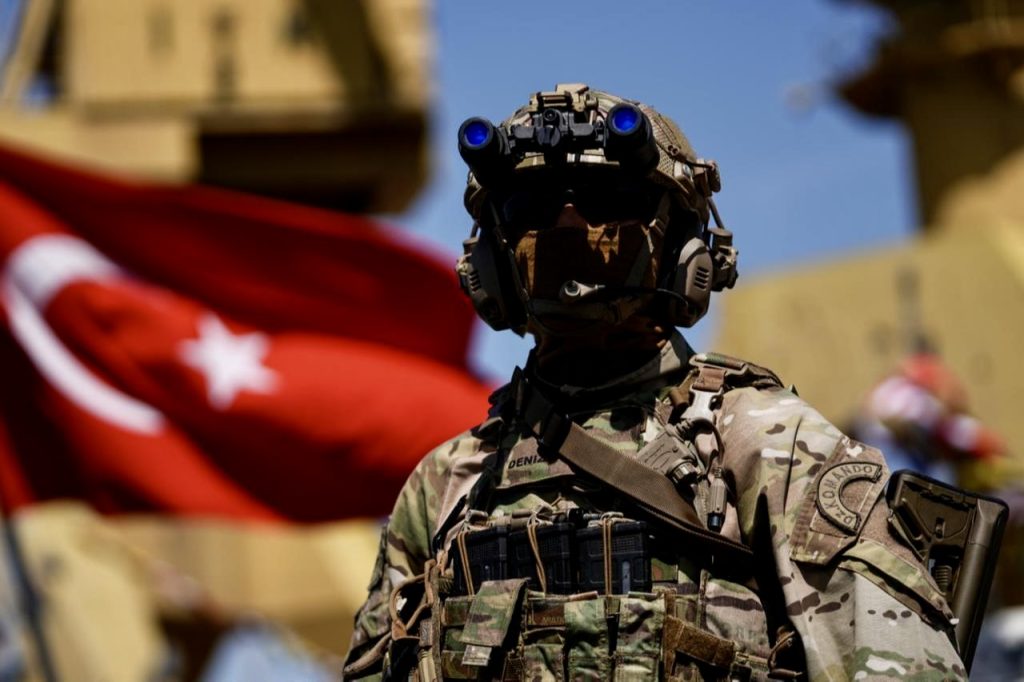
ANKARA (Realist English). Over the past two months, Turkey has taken a number of steps to strengthen its military presence and modernise its army. These actions, as follows from official statements and practical measures, signal Ankara’s growing ambitions and readiness to defend its interests on several fronts — from the Aegean Sea to Syria and Iraq.
Record Defense Budget and Focus on Domestic Defense Industry
In 2026, Turkey significantly increased its military spending, reflecting its strategic ambitions in the national budget. A total of $27.34 billion has been allocated for defense and security — a 30% increase over the previous year. With this, the country’s defense spending reached 2.33% of GDP, comfortably exceeding the NATO target.
Key figures of the allocation:
- Ministry of National Defense: To receive $19.08 billion (a 31.6% increase).
- Personnel & Welfare: 53.9% of the Ministry’s budget is earmarked for personnel costs and social security.
- Modernization: 44.1% of the funds will be directed toward the procurement of new weapon systems.
Industrial Development and Exports
Ankara continues its push for import substitution and technological leadership. The launch of new Roketsan facilities (following a $3 billion investment) is set to significantly boost the production of missiles and air defense systems. The leader of the Turkish regime Recep Erdogan confirmed the global objective: to establish Turkey as one of the world’s top 10 arms exporters. The plans are ambitious, aiming to raise export revenue from a record $10 billion in 2025 to $11 billion by 2028.
New weapons and large‑scale exercises
The rearmament process is accompanied by large‑scale manoeuvres demonstrating the army’s new capabilities.
- Force modernisation. The Turkish army is expanding its elite commando units, analysing the experience of the wars in Ukraine and the Middle East. The navy is being actively reinforced: 41 vessels are simultaneously under construction, including frigates, air‑defence destroyers, the national submarine MİLDEN and the future aircraft carrier MUGEM (60,000 tonnes). In terms of shipbuilding pace, Turkey ranks second in NATO.
- The largest exercises. In early April, the largest naval exercise in history, Blue Homeland‑2026, took place, involving 120 ships, 50 aircraft and 15,000 servicemen. The exercises simultaneously covered the Black, Aegean and Mediterranean Seas, where combat missions were practised using exclusively national weapons.
Army strength and preparation for conflicts
Turkey has large armed forces that continue to adapt to new challenges.
- The active army numbers about 355,000 military personnel — the second largest standing army in NATO (according to some estimates, the total strength reaches 550,000).
- The army is deliberately increasing the number of commando brigades — elite light infantry designed for operations in difficult conditions and outside the country.
- The Turkish Defence Ministry has stated its readiness to provide “support” to the new Syrian authorities in the fight against Kurdish formations, if Damascus asks for help.
Harsh rhetoric towards Israel
In recent months, Ankara has markedly intensified its criticism of Israel, adding extra tension to the region.
- Accusations of expansion. Turkish Foreign Minister Hakan Fidan, speaking at the Antalya Diplomatic Forum on 18 April, said that Israel does not actually care about its security but uses it as a pretext to seize new lands. In his words, the Israeli government has created an “international illusion” while in fact engaging in “occupation and expansion.”
- Accusation of conspiracy. Later, Fidan also accused Israel of creating a “military alliance with Greece and Cyprus” aimed against “Muslim countries.”
Tensions around Greece and Cyprus
Turkey’s activity in the Eastern Mediterranean remains a source of constant friction with Greece and Cyprus.
- During the Blue Homeland‑2026 exercises, the Greek Air Force recorded 15 violations of its airspace by Turkish aircraft and drones.
- Ankara expresses growing concern over the military cooperation between Greece, Cyprus and Israel, seeing in it an attempt to “surround” Turkey. In response, the Turkish leadership insists on resolving disputes through direct dialogue with Greece without intermediaries.
- Turkey previously warned the Cypriot side that allowing the island to be used as a base for Middle East operations makes it a “military target” and threatens regional security.
Escalation in Syria and the Kurdish issue
The most acute and dynamic front for Turkey over the past two months has unfolded in Syria, where actions against Kurdish forces reached a critical point.
- Reaction to attacks in Ankara. After an explosion in Ankara on 9 April, in which two policemen were injured, Turkey launched retaliatory airstrikes against Kurdish targets in north‑east Syria and northern Iraq. During the escalation, a Turkish soldier was killed — the first recorded case in recent times.
- Signs of preparations for an invasion. The Russian Defence Ministry said it was recording “more and more signs of covert preparation” by Turkey for a full‑scale invasion of Syria. Video footage of Turkish artillery shelling Syrian settlements was cited as evidence. Turkish media admitted that the build‑up was aimed at creating a “buffer zone” along the border and eliminating Kurdish units.
- Demand for disarmament and insertion of troops. Erdogan, in an ultimatum tone, called on Kurdish forces in Syria to “immediately lay down their arms and disband.” At the same time, the Turkish army inserted its units into Idlib province to continue the operation to eliminate sources of threat.
Ankara is simultaneously modernising its army, relying on domestic weapons production, reacting harshly to challenges to its own security (especially the Kurdish question) and not hesitating to make harsh statements towards Israel. The preparations in Syria deserve special attention; in the opinion of many observers, they could escalate into a new large‑scale invasion. This set of measures represents a coordinated strategy to strengthen regional influence and ensure security.