


YEREVAN (Realist English). On May 28, Armenia marked the 108th anniversary of the Battle of Sardarapat – one of the most remarkable events in the modern history of the Armenian people, which saved the nation from physical destruction and opened the way to the restoration of statehood.
Course of the Battle
The Battle of Sardarapat took place on May 21–28, 1918, near the railway station of Sardarapat (close to the modern town of Armavir). Having violated the Erzincan Armistice of December 5, 1917, Turkish troops went on the offensive in February 1918. Taking advantage of the withdrawal of most of the Russian army after the revolution, the Ottomans sought to seize all of Western and Eastern Armenia. By the end of May, Turkish forces were within a few dozen kilometres of Yerevan.
The enemy advanced along three main axes:
- Karakilis (Vanadzor): from the north, having captured Alexandropol (Gyumri).
- Aparan: moving towards Yerevan from the direction of Bash‑Aparan.
- Sardarapat: the main enemy forces advanced towards Sardarapat, trying to break through to Yerevan and the Ararat Valley.
On May 21, Turkish troops occupied Sardarapat station.
Heroism of the People and Unity of the Nation
At the moment of mortal danger, the Armenian people displayed incredible selflessness and unity. Volunteer registration began throughout Armenia.
“Armenia in 1918 was a horrible place: thousands who had escaped the sword, destitute, without a piece of bread or a roof over their heads. This was the Armenian people, bleeding, at their last gasp… But the Armenians, as always, gathered their will into a fist and stopped the Turkish troops,” the publication Panarmenian.net describes the situation.
The battle became a symbol of national unity in defence of the fatherland. The people’s militia played an invaluable role in the historic victory, fighting shoulder to shoulder with regular units. According to estimates, a 20,000‑strong Armenian force faced a 100,000‑strong Turkish army.
About a thousand Russian soldiers also fought in the battle, having voluntarily remained on the Caucasus Front to defend Armenia after Russia withdrew from the First World War.
Role of Armenian Commanders
Overall command of the Armenian forces on the Sardarapat front was entrusted to General Movses Silikyan (Silikov). Under his command were the 2nd Rifle Division, the 3rd Infantry Brigade and the 1st Regiment of the 2nd Cavalry Brigade.
The main forces of the Armenian grouping were commanded by Colonel Daniel Bek‑Pirumyan.
Especially distinguished was the 5th Armenian Regiment under Colonel Poghos Bek‑Pirumyan, which managed to halt the Ottoman army and push it back 15‑20 km to the west.
In the thick of the battle was also the 20‑year‑old Ivan Khristoforovich Bagramyan, the future Marshal of the Soviet Union. Then still a lieutenant, he commanded a company and a sabre squadron.
The provision of rear support for the Armenian units and the defence of Yerevan were entrusted to Aram Manukyan.
The Turning Point and Rout of the Enemy
On May 22, the 5th Armenian Rifle Regiment, the Partisan Infantry Regiment, the Igdir Infantry Regiment and the Special Cavalry Regiment went on the offensive from the areas of Kerpalu and Kurdukuli, broke Turkish resistance and forced them to flee, pushing the enemy back 15‑20 km.
The nine‑day battle ended in a complete Armenian victory. As a result, the Turks were crushed and pushed back 50‑65 km, and the immediate threat to Yerevan was eliminated.
Historical Significance
The victory at the Battle of Sardarapat had epochal significance for Armenia:
- Saving the people: the Armenian population of the northern part of the Ararat Valley escaped Turkish genocide.
- Saving territories: a large part of Eastern Armenia was saved from Turkish capture.
- Restoration of statehood: conditions were created for the restoration of Armenian statehood, lost nearly six centuries earlier.
As the British historian Christopher Walker aptly put it: if the Armenians had lost the battle, “it is quite possible that the word Armenia would have survived only as a term of historical geography.”
The famous Armenian writer and diplomat Avetis Aharonyan called the Battle of Sardarapat the “Avarayr of the 20th century,” drawing a parallel with the legendary battle of 451 AD, in which the Armenians defended their right to faith.
The victory at Sardarapat created the conditions for the proclamation of independence. On May 28, 1918, the Armenian National Council declared the creation of the First Republic of Armenia.
Commemoration
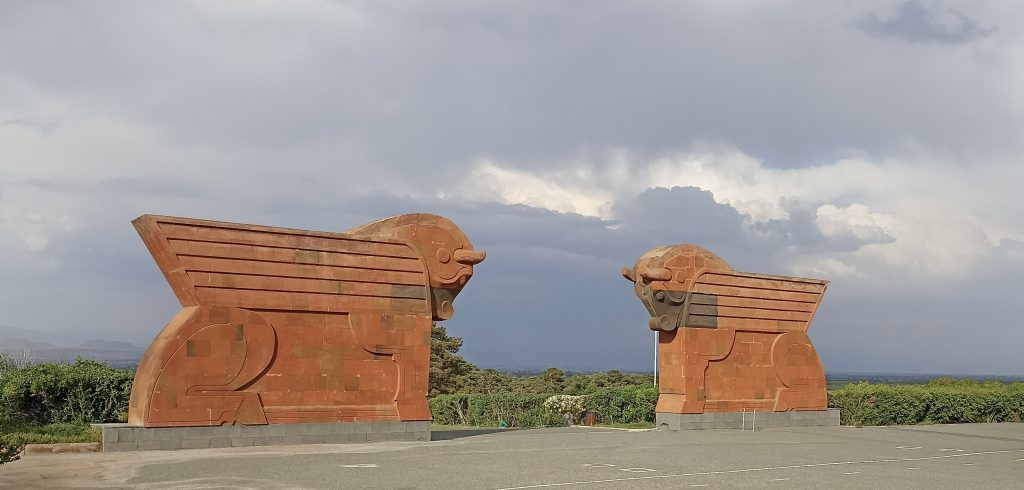
A commemorative day was established in Armenia in honour of the victory. For the 50th anniversary of the battle, in May 1968, the majestic Sardarapat memorial complex was opened (architect Rafael Israelyan). Today, the memorial is a place of pilgrimage and a symbol of national rebirth.
The Battle of Sardarapat became a turning point that saved the nation from physical destruction and revived Armenian statehood, forever entering history as a symbol of the unconquered spirit of the Armenian people.