


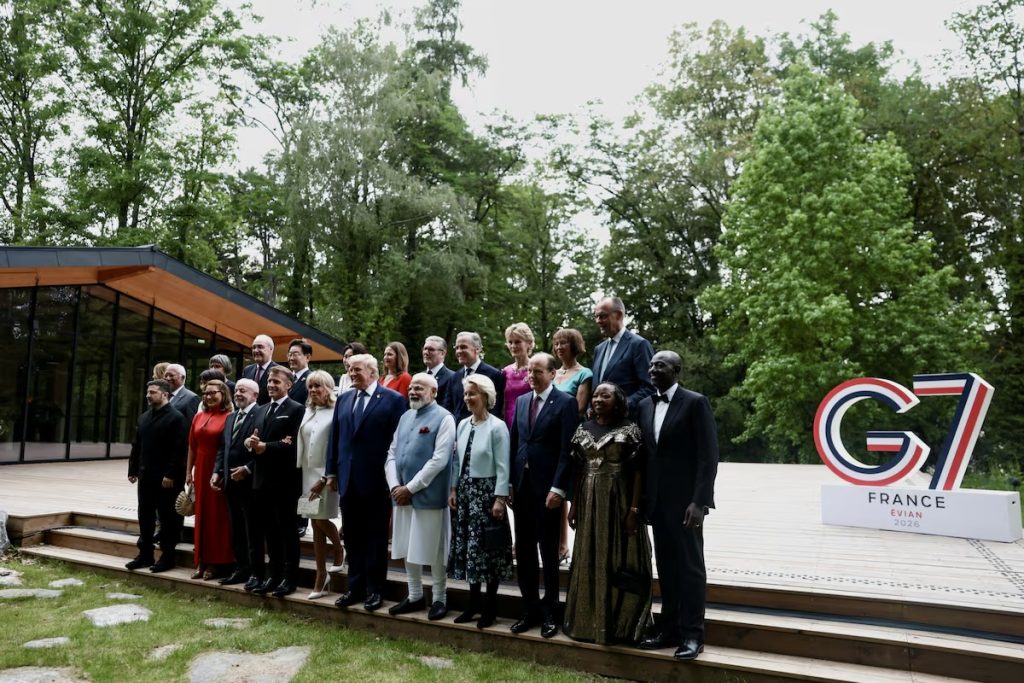
EVIAN-LES-BAINS (Realist English). On the final day of the G7 summit in the French resort town of Evian-les-Bains, the leaders of the Group of Seven are holding a working meeting with the heads of leading global artificial intelligence companies.
The discussion, focused on AI safety and the protection of democracies, includes OpenAI CEO Sam Altman, Anthropic CEO Dario Amodei, and the founder of European competitor Mistral AI, Arthur Mensch.
The agenda covers cybersecurity, child protection online, and safeguarding democratic institutions in the era of rapid AI development. French President Emmanuel Macron said ahead of the summit that the discussion would centre on how to “improve cybersecurity and protect our children and our democracies.”
Anthropic conflict as ‘elephant in the room’
The meeting takes place against the backdrop of a sharp diplomatic incident: last week, the administration of US President Donald Trump ordered Anthropic to block access to its latest models, Fable 5 and Mythos 5, for all foreign citizens, including non‑American employees of the company. The decision was justified on national security grounds.
The move has caused concern in Europe, where it is seen as an act of technological protectionism and a signal of possible “weaponisation” of US technology. According to Politico, one European diplomat called the Anthropic situation the “elephant in the room” ahead of the meeting. According to sources, European leaders do not intend to enter into open confrontation with Trump, but rather seek ways to cooperate.
‘Trusted partners’ as a path to compromise
One option being discussed on the sidelines is the creation of a “trusted partners” mechanism. The idea is to grant selected countries and companies access to cutting‑edge US AI models, allowing the G7 to use them to develop more advanced cybersecurity systems.
Financial Times reports that this plan was discussed on the margins with US Commerce Secretary Howard Lutnick. An agreement on broader access to advanced models would allow G7 countries to strengthen their cyber defences in the face of competitors such as China.
Special focus on the Mythos model
The Mythos model from Anthropic, which can identify vulnerabilities in computer code, has drawn particular attention. Cyber experts warn that this AI could be used to amplify attacks on banking systems. The European Union has already expressed interest in gaining access to Mythos to study its potential.
Before the restrictions were imposed, Anthropic provided access to this model to organisations in more than 15 countries, including those in the healthcare, energy and water supply sectors.
Different approaches to regulation
AI regulation also remains a point of disagreement between G7 members. While the EU has already introduced a strict AI law obliging model providers to assess various risks, the US position remains more flexible. Washington insists that access to cutting‑edge models should be selective and based on trust.
Amid these discussions, the United Kingdom announced its intention to ban the use of social media for children under 16. France is considering similar measures. A joint declaration on restricting minors’ access to social media is expected to be adopted following the summit.
After the meeting, G7 leaders will hold separate press conferences, and in the evening French President invited Donald Trump to dinner at the Palace of Versailles.