


TBILISI (Realist English). Over the past month, Georgia has strengthened its position as a key transit hub between Asia and Europe. The conflict in the Middle East, which led to the effective blockade of the Strait of Hormuz, has forced international carriers to seek alternative routes, and the Middle Corridor (Trans-Caspian International Transport Route), passing through Georgia, has become one of the main beneficiaries of this shift.
Macroeconomics and forecasts of international institutions.
- Despite the global uncertainty caused by the war in the Middle East, leading financial institutions maintain positive forecasts for Georgia’s economy. The IMF, after its mission to Georgia (March 25 – April 7), confirmed its GDP growth forecast for 2026 at 5.3%. Mission chief Alejandro Hajdenberg stated that Georgia’s economic indicators remain stable thanks to “sound macroeconomic management.”
- Given the short-term nature of the Middle East conflict, sustainable albeit more moderate growth is expected. The Asian Development Bank (ADB) on April 10 raised its 2026 GDP growth forecast for Georgia to 5.5% (from 5% in its September forecast), expecting a slowdown to 5.2% in 2027.
- However, the bank emphasizes that a protracted conflict and persistently high energy prices could lead to further growth slowdown. The World Bank, in its regional economic outlook, also forecasts Georgia’s economic growth at 5% in 2026 and 5.5% in 2027.
- Deputy Minister of Economy Vakhtang Tsintsadze noted that Georgia’s average growth rate is “almost twice the indicators of EU candidate countries.” Actual data for January–February 2026 show average economic growth of 8.4%, with February recording 8.8%, which Prime Minister Irakli Kobakhidze called “a strong start to the year.” Georgia’s GDP in 2025 reached $39.04 billion, surpassing 100 billion lari for the first time.
Monetary policy and inflation
The National Bank of Georgia (NBG) kept its policy rate at 8.0% following its March 25 meeting. Inflation in the country is gradually slowing: after a peak of 4.8% in January, annual inflation fell to 4.6% in February and to 4.3% in March 2026.
The main driver of inflation remains food prices, which rose by 7.5% year-on-year. Particularly notable increases were seen in fish (+21.2%), fruit (+13.4%), bread and meat (+9.6%). Core CPI was 2.8%.
Investment bank Galt & Taggart raised its 2026 inflation forecast from 3% to 4.2% due to the negative impact of the Middle East crisis and electricity tariffs. Georgia’s international reserves at the end of March stood at $6.32 billion, 2.6% higher than on December 31, 2025.
Foreign trade
Georgia’s foreign trade turnover for January–February 2026 amounted to $3.5 billion, a decrease of 6.9% compared to the same period last year.
Exports rose by 22.9% (to $1.03 billion), while imports fell by 15.4% (to $2.4 billion). In the export structure, domestic supplies (excluding re-exports) grew by an impressive 70% to $659.7 million.
- Key trading partners: China became Georgia’s largest export market ($147.1 million).
- Turkey leads in imports ($415.6 million).
- Russia ranks third in bilateral trade turnover ($418 million, +0.3% year-on-year). Exports to Russia increased by 28% ($92 million), with precious metals and ores ($125.6 million) forming the bulk of supplies.
Transit and logistics: The Middle Corridor gains momentum
The war in the Middle East, which made the Iranian route unsafe, is pushing shippers to switch to the Middle Corridor. The EBRD called this route an “obvious and attractive alternative.”
According to Georgian logistics estimates, the blockade of the Strait of Hormuz and disruptions to Red Sea supplies could lead to increased demand for the port of Poti, putting upward pressure on tariffs.
Georgian ports show positive dynamics: container turnover in the first quarter of 2026 grew by 4%, reaching 188,149 TEU.
The port of Poti showed the best results in terms of volume and number of vessel calls, while the port of Batumi saw a 3% increase. In 2025, container traffic volumes increased by 17%, general cargo by 20%, and ferry traffic by 31%. The deep-water port of Anaklia, capable of receiving Panamax and Post-Panamax class vessels, remains a key priority.
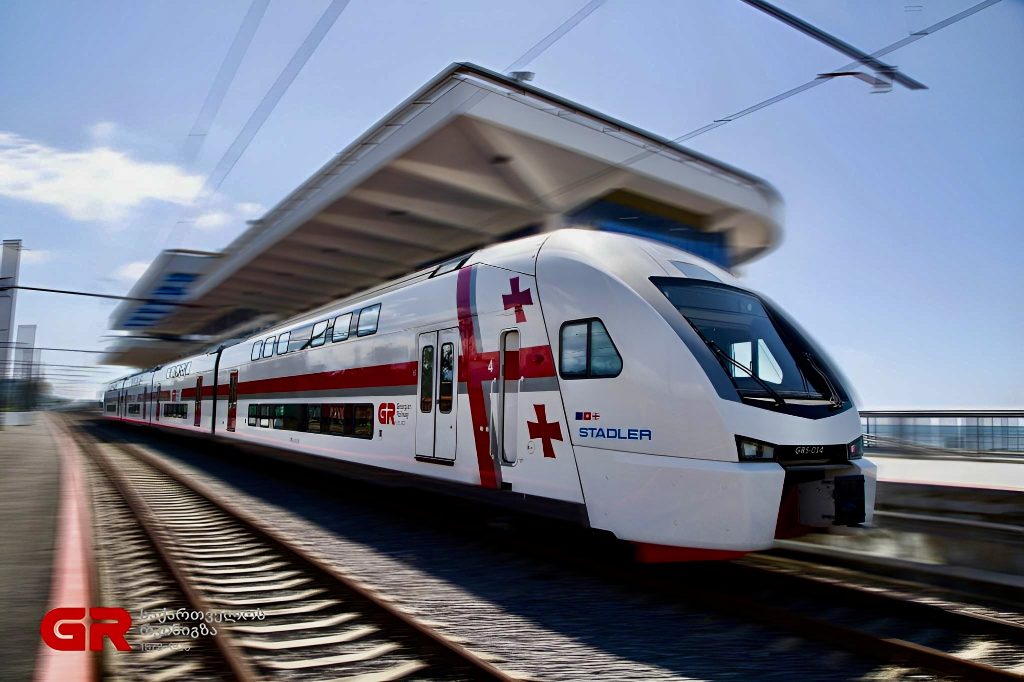
Infrastructure projects. Railways: On April 8, Prime Minister Irakli Kobakhidze announced a railway infrastructure development plan for 2026–2028, which envisages doubling network capacity. Under the plan, 50 new locomotives and 1,500 wagons will be purchased, and annual passenger traffic will increase from 2 million to 5 million people.
Highways: The government is completing the integration of the road network into the global Middle Corridor route. By 2026, it plans to fully commission the strategic highways Rustavi – Red Bridge (border with Azerbaijan), Algeti – Sadakhlo (border with Armenia), and Batumi – Sarpi (border with Turkey).
Port digitalization: Georgia’s ports already successfully operate a maritime single window system, ensuring fast and transparent operations management.