


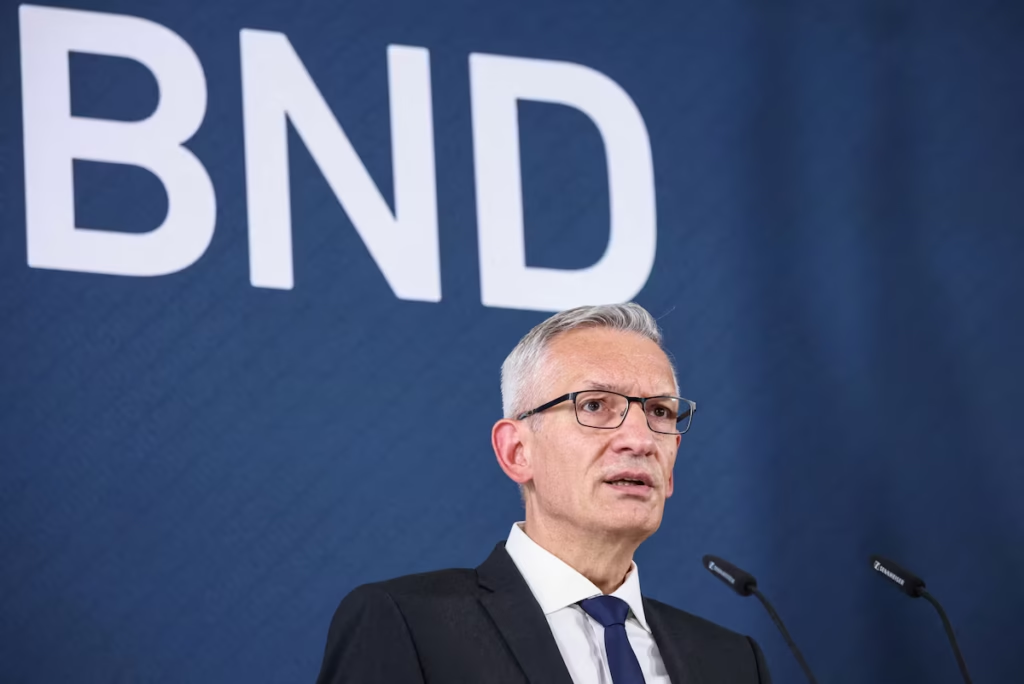
MUNICH (Realist English). The head of Germany’s foreign intelligence service called on Western governments to impose clearer and more direct costs on Russia for its hybrid warfare activities, warning that current deterrence efforts remain inadequate.
Speaking at a Munich Security Conference panel titled “Destructive Ambiguity: Deterring and Countering Hybrid Warfare,” Martin Jager, president of the German Federal Intelligence Service (BND), said Moscow must feel “pain” if its actions are to be curbed.
“We must make it very clear to the other side: if you continue to do such things, this will not be without consequences,” Jager said, describing the lack of tangible repercussions as a “missing last link” in Western strategy.
He argued that Western governments should more frequently demonstrate their capacity to respond proportionally to Russian actions. Hybrid warfare, he said, is embedded in Moscow’s military doctrine and is designed to divide NATO, influence elections and weaken European Union institutions.
Jager cited sabotage, cyberattacks, disinformation campaigns, drone incursions and espionage as key elements of Russia’s toolkit. “Deterrence is not working yet,” he said, calling for a more operational and coordinated “whole-of-government” approach. He added that public opinion itself is often the primary target of such operations.
Moldovan President Maia Sandu told the conference that her country has experienced nearly every form of hybrid pressure. She described information warfare as particularly damaging, saying Moscow has sought to portray Moldova as a weak state and to frame European integration as incompatible with its traditional values.
Sandu said that during Moldova’s recent election, the Central Electoral Commission’s website faced close to one billion malicious online requests. She also claimed that a single troll network generated tens of millions of views in a country of 2.4 million people, estimating that Russia devoted the equivalent of 2% of Moldova’s GDP last year to interference efforts.
Swedish Prime Minister Ulf Kristersson said democratic states must remain firm while operating within legal and ethical boundaries. Responding to questions about Russia’s so-called shadow fleet in the Baltic Sea, he noted that economic measures — including sanctions targeting Russia’s revenue streams — remain tools at Europe’s disposal.
Admiral Giuseppe Cavo Dragone, chair of NATO’s Military Committee, stressed the importance of early and proportionate responses, suggesting that preemptive cyber or electronic countermeasures could help prevent escalation and save lives. However, he acknowledged that NATO’s actions are constrained by democratic norms and ethical considerations not shared by its adversaries.
The discussion highlighted growing concern among European officials that hybrid threats — operating below the threshold of conventional warfare — require a recalibrated deterrence strategy, balancing firmness with adherence to democratic principles.