


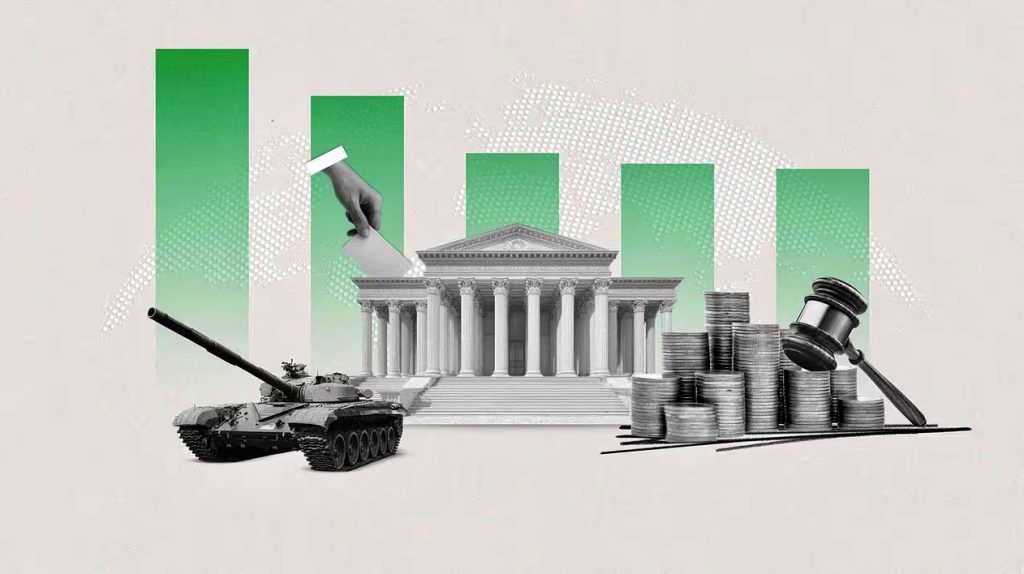
LONDON (Realist English). Contrary to the widespread belief of a global crisis of confidence in institutions, Gallup data over the past 20 years paint a different picture: in many countries around the world, trust in key national institutions is higher today than it was two decades ago. These are the findings of the “Gallup World Poll at 20” study.
The analysis is based on surveys conducted in more than 140 countries since 2006. Median confidence in the military, courts, elections and banks is higher today than 20 years ago, while confidence in national governments has remained at roughly the same level.
Military — the most trusted institution
Of the five institutions, the military commands the highest trust worldwide, with a median of 72% of adults expressing confidence. Financial institutions follow at 63%. Confidence in judicial systems stands at 52%, in national governments at 50%, while the honesty of elections inspires trust in 49% of respondents.
At the same time, the absence of a global decline does not mean that confidence remains high everywhere. In many countries, people still distrust key institutions, especially governments, courts and electoral systems.
Moreover, countries often cited as models of democracy – the United States, France and the United Kingdom – show declining confidence in most of these institutions. However, as the researchers note, they are more the exception than the rule.
Confidence in government higher in autocracies
An analysis by type of political system – liberal democracies, electoral democracies and autocracies – reveals significant differences. In 2025, the median level of confidence in national governments in autocracies was 62% – significantly higher than in liberal democracies (47%) and electoral democracies (41%). At the same time, in liberal democracies, confidence in governments has risen from its 2012 historical low of 35%.
The authors of the study note that high confidence levels in autocracies may be partly explained by respondents’ reluctance to speak openly, as freedom of speech is restricted in such countries.
Honesty of elections: liberal democracies lead
The picture changes when it comes to confidence in the honesty of elections. Liberal democracies show consistently high levels of trust: the median in 2025 was 64% , despite a slight decline from a peak of 67% in 2024. In electoral democracies and autocracies, the figure is significantly lower – 44% and 47% respectively.
The researchers stress that the gap in autocracies between confidence in government (62%) and confidence in the honesty of elections (47%) shows that populations can remain loyal to the authorities even while acknowledging the imperfections of the electoral system.
Confidence in courts rising in all systems
Unlike elections and governments, confidence in judicial systems has grown over the past two decades across all three types of political systems. In 2025, median confidence in liberal democracies was 58%, in autocracies 53%, and in electoral democracies 45%.
Military and banks: minimal differences
Confidence in the military remains consistently high across all political systems – at or above 70%. Confidence in banks in liberal democracies, after falling during the 2008 financial crisis, has recovered to pre‑crisis highs.
Europe: lowest trust among far‑right supporters
An analysis of data from Europe – EU countries and the United Kingdom – taking party identification into account shows that supporters of parties at the extreme ends of the political spectrum display the lowest levels of trust in institutions.
The least trust is recorded among far‑right supporters – parties such as Reform UK, Vox and Alternative for Germany. On average, they trust only 2.8 of the five key institutions, while centrist supporters trust 3.3–3.4 institutions.
Gallup effectively debunks the prevailing narrative of a universal decline in trust in institutions. Globally, confidence is either stable or growing – regardless of the type of political system.
However, the study also highlights serious problems: a significant portion of the world’s population still distrusts key institutions, while confidence in autocratic governments remains higher than in democratic ones. In European democracies, the decline in trust is particularly noticeable among supporters of political extremes, especially the far right.