


DUBAI (Realist English). The escalating war involving Iran, the United States and Israel has triggered one of the largest disruptions to global air travel in recent years, leaving more than a million passengers stranded and forcing airlines to cancel or reroute tens of thousands of flights.
Among those affected is Zoey Gong, a 30-year-old Chinese medicine food therapist who had planned to fly from Paris to Shanghai via Dubai on an Emirates flight. After the outbreak of hostilities, her travel plans collapsed, forcing her to pay $1,600 for an alternative route — more than twice the cost of her original ticket.
Industry analysts say millions of travelers have been affected by conflicts around the world this year, highlighting the vulnerability of a tourism sector valued at about $11.7 trillion globally, according to the World Travel & Tourism Council.
The US-Israeli strikes on Iran triggered a cascade of aviation disruptions across the Middle East. Airspace closures have grounded more than 20,000 flights since the weekend, according to aviation analytics firm Cirium. Major transit hubs in the Gulf region have been heavily affected as airlines scramble to reroute aircraft away from conflict zones.
Iran has since launched retaliatory strikes targeting several countries, including the United Arab Emirates, Qatar, Jordan, Israel and Cyprus. The attacks have complicated evacuation efforts and left airlines with limited options to repatriate passengers.
The United States has urged citizens in parts of the region to leave immediately, though commercial flights remain scarce. The State Department said it is organizing charter flights to assist Americans departing Saudi Arabia, Israel, the UAE and Qatar.
Travel industry experts describe the situation as a major aviation crisis. Henry Harteveldt, founder of Atmosphere Research Group and a former airline executive, said the scale of disruption has few modern precedents.
“This has turned into an aviation quagmire,” he said.
The conflict is also affecting other segments of the tourism industry. Debris from missile and drone interceptions has fallen near hotels in Dubai, including near the Fairmont The Palm resort, where four people were injured, though none were guests or staff. The Burj Al Arab hotel also experienced a fire earlier this week after being struck by falling debris from an intercepted Iranian drone.
Cruise operators have also been caught in the disruption. Several vessels carrying thousands of passengers remain docked in Gulf ports because of security concerns and limited flight connections for returning travelers. One of them, MSC Cruises’ Euribia liner, with more than 6,300 passengers on board, has been unable to depart Dubai while the company works to arrange charter flights to return guests home.
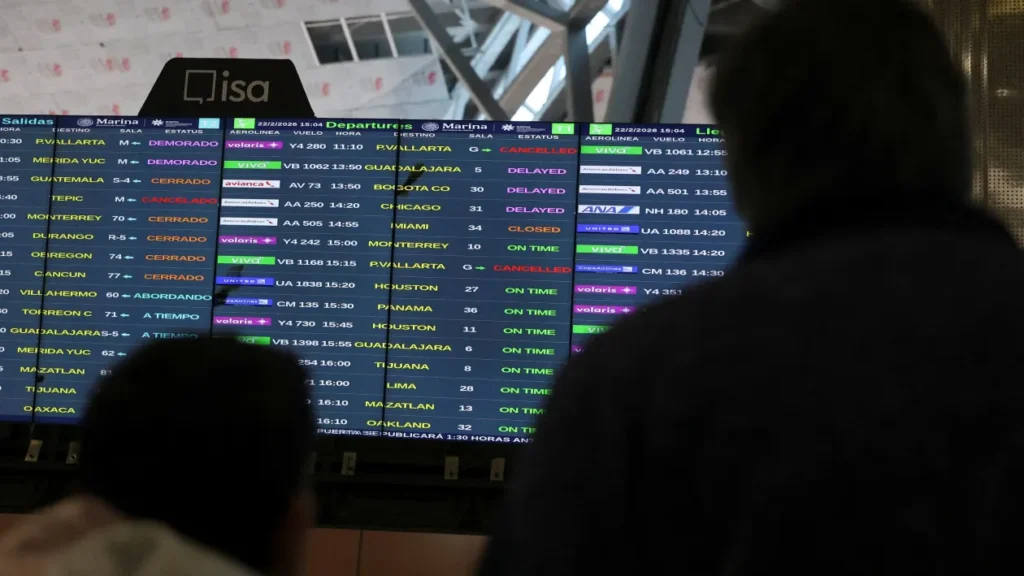
The Iran conflict is only the latest shock to the global travel industry in 2026. Earlier this year, US military action in Venezuela forced the closure of Caribbean airspace, stranding travelers across the region. In February, violence linked to cartel operations in Mexico led to flight cancellations in major tourist destinations including Puerto Vallarta and Guadalajara.
These crises are forcing airlines, cruise operators and hotels to make costly adjustments, including rerouting flights, canceling trips, issuing refunds and discounting hotel stays.
Higher operating costs — particularly fuel expenses — are likely to translate into more expensive travel for consumers, industry executives say.
Despite the disruptions, the tourism sector had entered 2026 with optimism. Several major airlines, including Delta Air Lines and United Airlines, had predicted record revenues for the year.
But the series of geopolitical crises now threatens demand, particularly for high-end travel segments that have become a key source of revenue for airlines and hospitality companies.
In Mexico, where tourism accounts for nearly 9% of the national economy, some hotels have already reported weaker bookings following recent violence. At the Rivera del Rio hotel in Puerto Vallarta, reservations are down roughly 10% compared with last year, prompting discounts of up to 20% ahead of the spring holiday season.
Industry observers say the travel market remains resilient but warn that continued geopolitical instability could prolong uncertainty for airlines, hotels and tourism-dependent economies worldwide.