


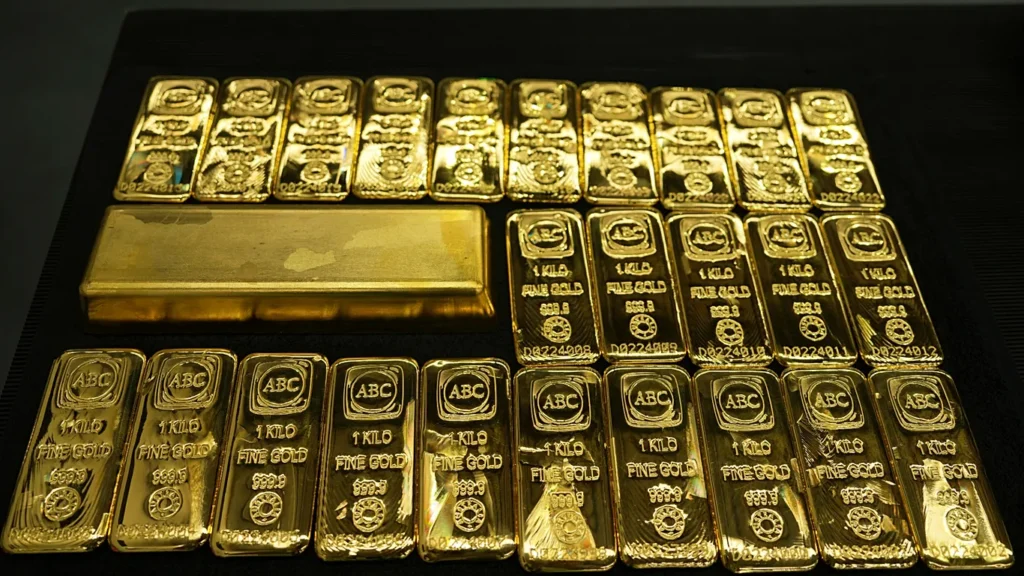
LONDON (Realist English). Gold surged more than 60% in 2025 — its strongest annual performance since 1979 — as geopolitical turmoil, aggressive central-bank buying, interest-rate cuts and a weakening U.S. dollar pushed the metal to more than 50 record highs. With investors now looking ahead to 2026, analysts say gold’s safe-haven appeal remains intact, but the rally faces a more complex macro landscape.
According to the World Gold Council (WGC), no single catalyst dominated last year’s move. Instead, a combination of persistent geopolitical tensions, trade uncertainty, lower real yields, softening dollar conditions and momentum-driven investor positioning fuelled the surge. The WGC calculates that geopolitics alone added roughly 12 percentage points to year-to-date performance, with dollar weakness and lower rates contributing another 10 points.
Central banks — particularly in emerging markets — continued to buy at a pace well above pre-pandemic norms, helping anchor demand.
2026: a different starting point
The WGC warns that gold now enters 2026 from a fundamentally different position. Much of the “macro consensus” — expectations of steady global growth, moderate U.S. rate cuts and a broadly stable dollar — is already reflected in prices.
Real interest rates are no longer falling decisively, opportunity costs are neutral, and the powerful positive momentum of 2025 has begun to ease. Investor risk appetite, the Council notes, is balanced rather than defensive.
Under its baseline scenario, the WGC sees gold trading in a tight band of –5% to +5% next year.
However, three alternative paths remain possible:
- Mild slowdown: Softer growth and extra Fed rate cuts lift gold 5%–15% as investors shift defensively.
- “Doom loop” recession: A deeper downturn triggers aggressive easing and falling Treasury yields, driving gold 15%–30% higher.
- Reflation return: If Trump-era fiscal stimulus revives U.S. growth, yields and the dollar could rise, pushing gold down 5%–20%.
Wall Street sees more upside
Major banks remain more bullish than the WGC:
- J.P. Morgan Private Bank: $5,200–$5,300 per ounce
- Goldman Sachs: ~$4,900 by end-2026
- Deutsche Bank: $3,950–$4,950, with a base case near $4,450
- Morgan Stanley: ~$4,500, but warns of volatility
Analysts cite persistent central-bank accumulation, lower prospective real yields and under-allocation to gold among institutional investors as key supports.
Risks that could break the trend
The rally faces several headwinds:
- A stronger-than-expected U.S. recovery could delay or reverse Fed rate cuts, boosting real yields and the dollar.
- Softer ETF inflows or a slowdown in central-bank buying could weaken demand.
- A rise in recycled supply — particularly from India, where gold is widely used as collateral — could weigh on prices.
A stable but not explosive path
While few expect a repeat of 2025’s extraordinary surge, analysts agree that gold enters 2026 on firm footing. Macroeconomic uncertainty, geopolitical instability and central-bank diversification remain powerful structural drivers.
In a world defined by unpredictability, gold’s value is not only in its returns but its resilience — serving as a strategic anchor when traditional assets face heightened risk.