


NEW YORK (Realist English). Artificial intelligence has ceased to be just a buzzword in investment circles — it has fundamentally reshaped the global stock market.
Record‑breaking rallies in tech giants’ shares, the emergence of billion‑dollar fortunes built on AI bets, and even the use of neural networks by retail investors to pick stocks all point to AI becoming the primary market driver, overshadowing traditional macroeconomic threats.
However, the meteoric rise is raising increasing concerns: experts warn of a “bubble” and that the algorithmic arms race could make the market itself vulnerable to catastrophic failures.
AI Drives Markets to Records
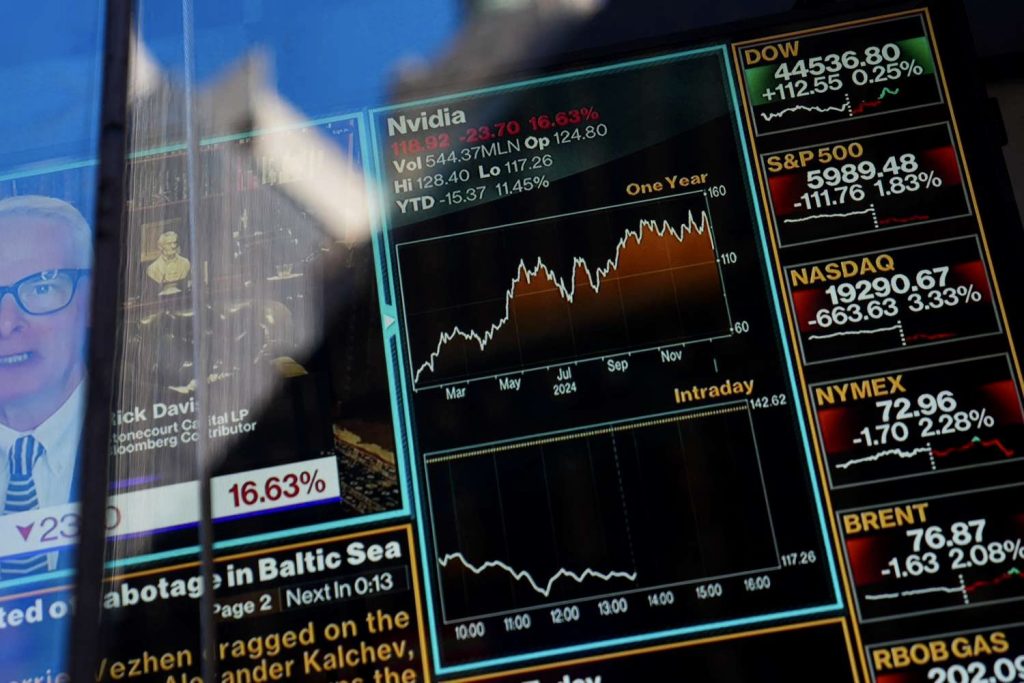
The rally sparked by the artificial intelligence boom has lifted global stock indices to all‑time highs, compensating for the risks created by the war in Iran and global economic instability. The AI bellwether — Nvidia shares — have soared more than 1,300% since the end of 2022, and its quarterly reports are now tracked by investors as closely as key economic indicators. The “hyperscalers” — Microsoft, Alphabet (Google) and Amazon — are also among the main beneficiaries, pouring hundreds of billions of dollars into building data centres around the world.
The growth has not been confined to the United States. European tech stocks, including chip equipment maker ASML, are at their highest level since 2000. South Korea’s market, dominated by Samsung Electronics, is approaching a record high, while SK Hynix and Micron Tech have periodically joined the elite group of companies with market capitalisations exceeding $1 trillion. Even Elon Musk’s SpaceX, ahead of its record IPO, joined the wave, reaching a valuation of about $1.8 trillion.
The world’s largest investors are reallocating capital to companies integrating AI. According to Goldman Sachs, hedge funds managing more than $4 trillion have made the biggest shift into tech stocks in history, raising the share of semiconductors in their portfolios to 10%.
At the same time, bets against non‑AI sectors (healthcare, utilities, consumer goods) are at record highs. “It looks like funds are betting not on the whole market, but only on AI,” said Goldman strategist Ben Snider.
Hedge Funds Riding the AI Wave
One of the brightest symbols of the boom is 24‑year‑old Leopold Aschenbrenner, whose AI‑focused hedge fund Situational Awareness has grown from a few hundred million dollars to $20 billion under management in less than two years. The fund’s return since the beginning of 2026 exceeds 270% after fees, and more than 1,000% since launch. A key success came from a bet on Anthropic, whose valuation rose from $60 billion in early 2025 to $965 billion by May 2026.
Hedge funds are betting on pure “AI stories”: Goldman highlights a basket of Amazon, Nvidia, Alphabet, Microsoft and Meta shares as the most popular assets. New favourites include SanDisk and Lam Research. Meanwhile, the software sector, which could be disrupted by new AI tools, has become the least popular among funds since 2019.
Retail Investors and Robo‑Advisors
AI has also democratised access to the market. According to a survey by broker eToro, about 50% of retail investors said they use tools such as ChatGPT or Google Gemini to select or change their investments, with 13% already doing so on a regular basis. The robo‑advisory market is forecast to reach $470 billion by 2029.
Former UBS analyst Jeremy Leung admits he uses ChatGPT to manage his portfolio after leaving the bank: “I no longer have the luxury of a Bloomberg terminal, but even plain ChatGPT can replicate many of the workflows.” Nevertheless, experts warn that using general‑purpose models as “crystal balls” is fraught with errors, and it is better to use specialised AI platforms trained specifically for market analysis.
Bubble, Overheating and the “Paradox of Smart Markets”
While investors continue to pour money into AI, more and more voices are warning of overheating. Analysts at Prometeia report a reversal in market sentiment: after years of a boom, stock reactions to news about the development of generative AI are turning negative.
In the technology sector, returns in the 10 days following such events were 0.75% below expectations. Investors are increasingly asking whether the colossal capital expenditures (Morgan Stanley forecasts $3 trillion by 2028) are paying off given the still unclear returns.
Moreover, the spread of AI algorithms may itself destroy excess returns. According to a study titled “AI‑Driven Alpha Decay”, AI‑based strategies are “self‑destroying” on a large scale. Because too many players are using the same data and signals, the “half‑life” of profitable trading signals has shrunk from 5–7 years to just 18 months.
The Dark Side: “Algorithms Are Not Ready”
The latest tests show that fully autonomous trading using LLMs (such as Claude and ChatGPT) is still failing. In the Alpha Arena competition, a portfolio of eight leading models lost about a third of its value in just two weeks, making chaotic trades.
The Dutch regulator AFM warns that self‑learning systems can create “patterns reminiscent of coordinated behaviour” without any prior collusion between participants. A single erroneous reaction from a model could trigger an instant cascade of selling, as happened during the Flash Crash of 2010.
Artificial intelligence has fundamentally changed the architecture of the stock market, creating a new “digital” era of investing. It has become the main driver of growth, but has also generated unprecedented concentration of capital and systemic risks.
The paradox of 2026 is that the more the market relies on AI, the harder it is to make money on it, and the more dangerous its fall becomes. The coming years will show whether this boom leads to a new industrial revolution or ends with the collapse of one of the most inflated bubbles in history.